


 Cart
Cart
 sales@molnova.com


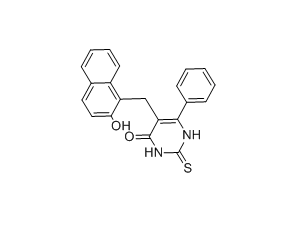
Cambinol
CAS No. 14513-15-6
Cambinol( SIRT 1/2 inhibitor IV | NSC112546 | NSC-112546 )
Catalog No. M17306 CAS No. 14513-15-6
Cambinol is a cell-permeable b-naphthol compound that inhibits the NAD-dependent deacetylase activity of SIRT1/2 (IC50: 56/59 μM, respectively) in a substrate-, but not NAD-, competitive manner.
Purity : >98% (HPLC)
 COA
Datasheet
HNMR
HPLC
MSDS
Handing Instructions
COA
Datasheet
HNMR
HPLC
MSDS
Handing Instructions
| Size | Price / USD | Stock | Quantity |
| 1 mL x 10 mM in DMSO | 58 | In Stock |


|
| 2MG | 46 | In Stock |
|
| 5MG | 73 | In Stock |
|
| 10MG | 120 | In Stock |
|
| 25MG | 219 | In Stock |
|
| 50MG | 343 | In Stock |
|
| 100MG | 511 | In Stock |
|
| 200MG | Get Quote | In Stock |
|
| 500MG | 1107 | In Stock |
|
| 1G | Get Quote | In Stock |
|
Biological Information
-
Product NameCambinol
-
NoteResearch use only, not for human use.
-
Brief DescriptionCambinol is a cell-permeable b-naphthol compound that inhibits the NAD-dependent deacetylase activity of SIRT1/2 (IC50: 56/59 μM, respectively) in a substrate-, but not NAD-, competitive manner.
-
DescriptionCambinol is a cell-permeable b-naphthol compound that inhibits the NAD-dependent deacetylase activity of SIRT1/2 (IC50: 56/59 μM, respectively) in a substrate-, but not NAD-, competitive manner. Cambinol inhibits SIRT5 deacetylase activity only at much higher concentrations (IC50 >300 μM) and no inhibitory for the class I and II HDACs. In BCL6-expressing Burkitt lymphoma cell lines, Cambinol-induced apoptosis has been attributed to the hyperacetylation of p53 and BCL6.
-
In VitroCambinol inhibits NAD-dependent deacetylase activity of human SIRT1 and SIRT2. Inhibition of SIRT1 activity with cambinol during genotoxic stress leads to hyperacetylation of key stress response proteins and promotes cell cycle arrest. Treatment of BCL6-expressing Burkitt lymphoma cells with cambinol as a single agent induces apoptosis, which is accompanied by hyperacetylation of BCL6 and p53. Cambinol has only weak inhibitory activity against SIRT5 (42% inhibition at 300 μM) and no activity against SIRT3.
-
In VivoCambinol is well tolerated in mice (100 mg/kg) and inhibits growth of Burkitt lymphoma xenografts. No significant weight loss occurs in cambinol-treated animals relative to controls. Inhibitors of NAD-dependent deacetylases may constitute novel anticancer agents.
-
SynonymsSIRT 1/2 inhibitor IV | NSC112546 | NSC-112546
-
PathwayMetabolic Enzyme/Protease
-
TargetP450
-
RecptorSIRT1| SIRT2
-
Research Area——
-
Indication——
Chemical Information
-
CAS Number14513-15-6
-
Formula Weight360.09
-
Molecular FormulaC21H16N2O2S
-
Purity>98% (HPLC)
-
SolubilityDMSO : 50 mg/mL. 138.72 mM;H2O : < 0.1 mg/mL
-
SMILESO=c1c(Cc2c3ccccc3ccc2O)c(c2ccccc2)[nH]c(=S)[nH]1
-
Chemical Name5-((2-hydroxynaphthalen-1-yl)methyl)-6-phenyl-2-thioxo-2,3-dihydropyrimidin-4(1H)-one
Shipping & Storage Information
-
Storage(-20℃)
-
ShippingWith Ice Pack
-
Stability≥ 2 years
Reference
1. Lugrin J.,et al. The sirtuin inhibitor cambinol impairs MAPK signaling, inhibits inflammatory and innate immune responses and protects from septic shock. Biochim Biophys Acta. 2013 Jun;1833(6):1498-510.
molnova catalog



related products
-
DMU2105
DMU2105 is a specific CYP1B1 inhibitor(CYP1B1 and CYP1A1 with IC50 of 10 nM and 742 nM, respectively)
-
N-Desethyl Chloroqui...
N-Desethyl Chloroquine Hydrochloride ((±)-Desethylchloroquine 2HCl) is a desethylchloroquine derivative. desethylchloroquine competitively inhibits cyp2d1 /6-mediated reactions in vitro and in vivo.
-
Cholesterol 24-hydro...
Cholesterol 24-hydroxylase-IN-1 is an orally active, selective, and potent inhibitor of cholesterol 24-hydroxylase (CH24H or CYP46A1) that crosses the blood-brain barrier.
