


 Cart
Cart
 sales@molnova.com


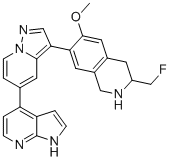
PKCiota-IN-51
CAS No. ——
PKCiota-IN-51( —— )
Catalog No. M16985 CAS No. ——
PKCiota-IN-51 is a potent and selective inhibitor of Protein Kinase C iota (PKC-ι) with IC50 of 2.7 nM。
Purity : >98% (HPLC)
 COA
Datasheet
HNMR
HPLC
MSDS
Handing Instructions
COA
Datasheet
HNMR
HPLC
MSDS
Handing Instructions
| Size | Price / USD | Stock | Quantity |
| 100MG | Get Quote | Get Quote |


|
| 200MG | Get Quote | Get Quote |
|
| 500MG | Get Quote | Get Quote |
|
| 1G | Get Quote | Get Quote |
|
Biological Information
-
Product NamePKCiota-IN-51
-
NoteResearch use only, not for human use.
-
Brief DescriptionPKCiota-IN-51 is a potent and selective inhibitor of Protein Kinase C iota (PKC-ι) with IC50 of 2.7 nM。
-
DescriptionPKCiota-IN-51 is a potent and selective inhibitor of Protein Kinase C iota (PKC-ι) with IC50 of 2.7 nM, >15-fold selectivity over PKC-α and PKC-β; inhibits PKC-ι on the phosphorylation of substrate ECT2 in HCCLM3 cells with IC50 of 3.3 uM.
-
In Vitro——
-
In Vivo——
-
Synonyms——
-
PathwayAngiogenesis
-
TargetPKC
-
RecptorPKC
-
Research Area——
-
Indication——
Chemical Information
-
CAS Number——
-
Formula Weight427.483
-
Molecular FormulaC25H22FN5O
-
Purity>98% (HPLC)
-
Solubility——
-
SMILES——
-
Chemical Name7-(5-(1H-pyrrolo[2,3-b]pyridin-4-yl)pyrazolo[1,5-a]pyridin-3-yl)-3-(fluoromethyl)-6-methoxy-1,2,3,4-tetrahydroisoquinoline
Shipping & Storage Information
-
Storage(-20℃)
-
ShippingWith Ice Pack
-
Stability≥ 2 years
Reference
1. Kwiatkowski J, et al. J Med Chem. 2018 May 4. doi: 10.1021/acs.jmedchem.8b00060.
molnova catalog



related products
-
LXS196
LXS196 is a potent selective and orally active protein kinase C (PKC) inhibitor(IC50 values of 1.9 nM 0.4 nM and 3.1 μM for PKCα PKCθ and GSK3β respectively).
-
LY379196
LY379196 is a highly specific PKCβ inhibitor with IC50 of 30-50 nM for PKCβI and PKCβII.
-
Bisindolylmaleimide ...
Bisindolylmaleimide VIII (Ro-31-7549) is a selective and potent protein kinase C (PKC) inhibitor with good inhibition of PKC-α, PKC-β I, PKC-β II, PKC-γ, and PKC-ε.
