


 Cart
Cart
 sales@molnova.com


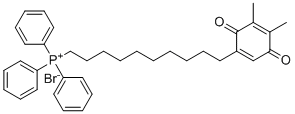
Visomitin
CAS No. 934826-68-3
Visomitin( SKQ1 bromide | PDTP )
Catalog No. M16686 CAS No. 934826-68-3
Visomitin (SKQ1 bromide, PDTP) is a mitochondria-targeted antioxidant that decreases transmembrane potential and production of reactive oxygen species (ROS).
Purity : >98% (HPLC)
 COA
Datasheet
HNMR
HPLC
MSDS
Handing Instructions
COA
Datasheet
HNMR
HPLC
MSDS
Handing Instructions
| Size | Price / USD | Stock | Quantity |
| 1 mL x 10 mM in DMSO | 56 | In Stock |


|
| 5MG | 41 | In Stock |
|
| 10MG | 65 | In Stock |
|
| 25MG | 120 | In Stock |
|
| 50MG | 193 | In Stock |
|
| 100MG | 339 | In Stock |
|
| 200MG | Get Quote | In Stock |
|
| 500MG | Get Quote | In Stock |
|
| 1G | Get Quote | In Stock |
|
Biological Information
-
Product NameVisomitin
-
NoteResearch use only, not for human use.
-
Brief DescriptionVisomitin (SKQ1 bromide, PDTP) is a mitochondria-targeted antioxidant that decreases transmembrane potential and production of reactive oxygen species (ROS).
-
DescriptionVisomitin (SKQ1 bromide, PDTP) is a mitochondria-targeted antioxidant that decreases transmembrane potential and production of reactive oxygen species (ROS); prevents neuronal loss and synaptic damage in a rat model of spontaneous Alzheimer’s disease, slows development of age-related ocular pathologies in murine, porcine, bovine, and canine model systems.(In Vitro):Direct treatment of tumor infiltrating leukocytes with Visomitin (SkQ1) does not influence their cytotoxicity against Panc02 cells. While Visomitin does not affect viability of the cell lines, this drug at 500 nM concentration reduces heavily the proliferation of human PDAC cells.(In Vivo):Regarding systemic angiogenic factors, it is observed in serum of Pancreatic ductal adenocarcinoma (PDAC) bearing mice a decrease in KC in the group of continuous treatment with Visomitin (SkQ1). Treatment of the mice with Visomitin increases the level of VEGF molecules. The amount of MIP1a and prolactin is reduced in all Visomitin treatment groups or after the follow-up treatment, respectively. Also, an increase in the IL-6 and IL-13 amount is found in the Visomitin treated groups. TGF-b amount is decreased in the pretreatment setting. On the contrary, all schemes of the Visomitin treatment decrease the NKT cell percentage. The Visomitin treatment has prolonged the median survival of PDAC-bearing mice, but the difference does not reach the level of significance defined.
-
In VitroDirect treatment of tumor infiltrating leukocytes with Visomitin (SkQ1) does not influence their cytotoxicity against Panc02 cells. While Visomitin does not affect viability of the cell lines, this drug at 500 nM concentration reduces heavily the proliferation of human PDAC cells.
-
In VivoRegarding systemic angiogenic factors, it is observed in serum of Pancreatic ductal adenocarcinoma (PDAC) bearing mice a decrease in KC in the group of continuous treatment with Visomitin (SkQ1). Treatment of the mice with Visomitin increases the level of VEGF molecules. The amount of MIP1a and prolactin is reduced in all Visomitin treatment groups or after the follow-up treatment, respectively. Also, an increase in the IL-6 and IL-13 amount is found in the Visomitin treated groups. TGF-b amount is decreased in the pretreatment setting. On the contrary, all schemes of the Visomitin treatment decrease the NKT cell percentage. The Visomitin treatment has prolonged the median survival of PDAC-bearing mice, but the difference does not reach the level of significance defined.
-
SynonymsSKQ1 bromide | PDTP
-
PathwayOthers
-
TargetOther Targets
-
RecptorOthers
-
Research AreaOther Indications
-
IndicationOther Disease
Chemical Information
-
CAS Number934826-68-3
-
Formula Weight617.61
-
Molecular FormulaC36H42BrO2P
-
Purity>98% (HPLC)
-
SolubilityDMSO: ≥29 mg/mL ( < 1 mg/ml refers to the product slightly soluble or insoluble )
-
SMILESCC1=C(C(=O)C(=CC1=O)CCCCCCCCCC[P+](C2=CC=CC=C2)(C3=CC=CC=C3)C4=CC=CC=C4)C.[Br-]
-
Chemical Name(10-(4,5-dimethyl-3,6-dioxocyclohexa-1,4-dien-1-yl)decyl)triphenylphosphonium bromide
Shipping & Storage Information
-
Storage(-20℃)
-
ShippingWith Ice Pack
-
Stability≥ 2 years
Reference
1. Novikova YP, et al. Biochemistry (Mosc). 2014 Oct;79(10):1101-10.
2. Stefanova NA, et al. Aging (Albany NY). 2016 Oct 6;8(11):2713-2733.
3. Skulachev VP, et al. Biochem Biophys Res Commun. 2013 Nov 15;441(2):275-9.
4. Brzheskiy VV, et al. Adv Ther. 2015 Dec;32(12):1263-79.
molnova catalog



related products
-
Riddelline
Riddelline is a potent genotoxic agent in vitro and induces significant elevations in unscheduled DNA synthesis and S-phase synthesis in rat liver.
-
Bintrafusp alfa
Bintrafusp alfa (M7824) is a bifunctional fusion protein consisting of the extracellular structural domain of TGF-βRII (a TGF-β “trap”) fused to a monoclonal antibody against human immunoglobulin G1 fused to programmed death ligand 1 (PD-L1).
-
Isotoosendanin
Isotoosendanin is a limonoid isolated from Melia toosendan fruit with anti-inflammatory and analgesic capacity.
