


 Cart
Cart
 sales@molnova.com


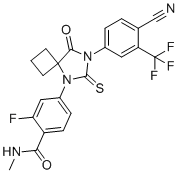
RD162
CAS No. 915087-27-3
RD162( RD 162 | RD-162 )
Catalog No. M16572 CAS No. 915087-27-3
RD162 is a second-generation, orally available antiandrogen that binds to androgen receptor (AR) with IC50 of 30.9 nM.
Purity : >98% (HPLC)
 COA
Datasheet
HNMR
HPLC
MSDS
Handing Instructions
COA
Datasheet
HNMR
HPLC
MSDS
Handing Instructions
| Size | Price / USD | Stock | Quantity |
| 1 mL x 10 mM in DMSO | 140 | In Stock |


|
| 5MG | 116 | In Stock |
|
| 10MG | 187 | In Stock |
|
| 25MG | 392 | In Stock |
|
| 50MG | 572 | In Stock |
|
| 100MG | 815 | In Stock |
|
| 200MG | Get Quote | In Stock |
|
| 500MG | Get Quote | In Stock |
|
| 1G | Get Quote | In Stock |
|
Biological Information
-
Product NameRD162
-
NoteResearch use only, not for human use.
-
Brief DescriptionRD162 is a second-generation, orally available antiandrogen that binds to androgen receptor (AR) with IC50 of 30.9 nM.
-
DescriptionRD162 is a second-generation, orally available antiandrogen that binds to androgen receptor (AR) with IC50 of 30.9 nM; suppresses growth and induces apoptosis in human prostate cancer cells in vitro, demonstrates greater relative affinity than the clinically used antiandrogen bicalutamide, reduces the efficiency of its nuclear translocation, and impairs both DNA binding to androgen response elements and recruitment of coactivators; induces tumor regression in mouse models of castration-resistant human prostate cancer.
-
In VitroRD162 (1-10 μM; 4 days) suppresses growth and induces apoptosis in the human prostate cancer cell line VCaP which has endogenous AR gene amplification. RD162 has little to no binding to the progesterone, estrogen or glucocorticoid receptors in an in vitro fluorescence polarization assay. Cell Viability AssayCell Line:VCaP cells Concentration:1, 10 μM Incubation Time:4 daysResult:Suppressed cell growth.
-
In VivoRD162 (10 mg/kg; oral gavage; daily; for 28 days) causes all tumors regressed. RD162 (0.1, 1, 10 mg/kg; oral gavage; daily; for 5 days) consistently reduces luciferase activity with 10 mg/kg/day human LNCaP/AR xenografts grown in castrated male mice whereas lower doses of 0.1 and 1.0 mg/kg/day has minimal effect. RD162 substantially reduces cellular proliferation after 5 days. RD162 (20 mg/kg; gavage) is ~50 percent bioavailable after oral delivery with a serum half-life of about 30 hours. Animal Model:Castrate male mice bearing LNCaP/AR xenograftsDosage:10 mg/kg Administration:Oral gavage; daily; for 28 days Result:Caused all tumors regressed.Animal Model:Male miceDosage:20 mg/kg (Pharmacokinetic Analysis) Administration:Oral gavage (in 0.5% hydroxy-methyl-propyl-cellulose)Result:Had ~50 percent bioavailable after oral delivery with a serum half-life of about 30 hours.
-
SynonymsRD 162 | RD-162
-
PathwayEndocrinology/Hormones
-
TargetAndrogen Receptor (AR)
-
RecptorAndrogen Receptor (AR)
-
Research AreaNeurological Disease
-
Indication——
Chemical Information
-
CAS Number915087-27-3
-
Formula Weight476.45
-
Molecular FormulaC22H16F4N4O2S
-
Purity>98% (HPLC)
-
SolubilityIn Vitro:?DMSO : 125 mg/mL (262.36 mM)
-
SMILESCNC(=O)C1=C(C=C(C=C1)N2C(=S)N(C(=O)C23CCC3)C4=CC(=C(C=C4)C#N)C(F)(F)F)F
-
Chemical Name4-[7-[4-cyano-3-(trifluoromethyl)phenyl]-8-oxo-6-thioxo-5,7-diazaspiro[3.4]oct-5-yl]-2-fluoro-N-methyl-benzamide
Shipping & Storage Information
-
Storage(-20℃)
-
ShippingWith Ice Pack
-
Stability≥ 2 years
Reference
1. Tran C, et al. Science. 2009 May 8;324(5928):787-90.
2. Makkonen H, et al. Mol Cell Endocrinol. 2011 Jan 1;331(1):57-65.
molnova catalog



related products
-
JNJ63576253
JNJ-63576253 is a Clinical Stage Androgen Receptor Antagonist for F877L Mutant and Wild-Type Castration-Resistant Prostate Cancer (mCRPC).
-
ACP-105
ACP-105 is a novel and potent nonsteroidal selective androgen receptor modulator (SARM) with partial agonist activity relative to the natural androgen testosterone.
-
2,2,5,7,8-Pentamethy...
2,2,5,7,8-Pentamethyl-6-Chromanol is the anti-oxidant moiety of vitamin E (α-tocopherol), which has potent androgen receptor (AR) signaling modulation and anti-cancer activity against prostate cancer cell lines.
