


 Cart
Cart
 sales@molnova.com


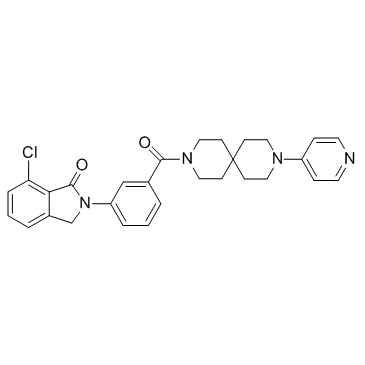
ELN 441958
CAS No. 913064-47-8
ELN 441958( ELN441958 | ELN 441958 | ELN-441958 )
Catalog No. M16558 CAS No. 913064-47-8
ELN-441958 is a potent, neutral antagonist of B1 receptor, inhibits the binding of the B1 agonist ligand [3H]DAKD to IMR-90 cells with Ki of 0.26 nM.
Purity : >98% (HPLC)
 COA
Datasheet
HNMR
HPLC
MSDS
Handing Instructions
COA
Datasheet
HNMR
HPLC
MSDS
Handing Instructions
| Size | Price / USD | Stock | Quantity |
| 2MG | 123 | In Stock |


|
| 5MG | 205 | In Stock |
|
| 10MG | 335 | In Stock |
|
| 25MG | 566 | In Stock |
|
| 50MG | 806 | In Stock |
|
| 100MG | 1098 | In Stock |
|
| 500MG | 2205 | In Stock |
|
| 1G | Get Quote | In Stock |
|
Biological Information
-
Product NameELN 441958
-
NoteResearch use only, not for human use.
-
Brief DescriptionELN-441958 is a potent, neutral antagonist of B1 receptor, inhibits the binding of the B1 agonist ligand [3H]DAKD to IMR-90 cells with Ki of 0.26 nM.
-
DescriptionELN-441958 is a potent, neutral antagonist of B1 receptor, inhibits the binding of the B1 agonist ligand [3H]DAKD to IMR-90 cells with Ki of 0.26 nM.
-
In VitroELN-441958 is selective for primate over rodent B1 receptors with a rank order potency (KB, nanomolar) of human (0.12 ± 0.02) ~ rhesus monkey (0.24 ± 0.01) > rat (1.5 ± 0.4) > mouse (14 ± 4).ELN-441958 has good permeability and metabolic stability.
-
In VivoELN-441958 (1-10 mg/kg; s.c.; once) dose-dependently reduces carrageenan-induced thermal hyperalgesia in a rhesus monkey tail-withdrawal model.ELN-441958 (0-10 mg/kg; i.v. or p.o.) exhibits a favorable pharmacokinetic profile in the rat and rhesus monkey. Animal Model:Adult male and female rhesus monkeysDosage:1, 3, or 10 mg/kg Administration:Subcutaneous injection, 30 min before carrageenan injection Result:Increased the tail-withdrawal latencies in a dose-dependent manner.Animal Model:Rhesus monkeys or Sprague-Dawley rats Dosage:2.5 or 10 mg/kg for rats, 1 mg/kg or 5 mg/kg for rhesus monkeys Administration:Intravenous injection (2.5 mg/kg and 1 mg/kg) or oral administration (10 mg/kg and 5 mg/kg) (Pharmacokinetic Analysis)Result:In rats: When dosed intravenously, showed a moderate volume of distribution (2.7 L/kg, approximately four times total body water) and a moderate clearance (0.96 L/h/kg, approximately 24% of hepatic blood flow). The terminal plasma half-life of this compound in rats was 1.7 h. When dosed orally, the concentrations increased to a maximum of 1.2 g/mL at 2 h after dosing. The oral availability was 57%.In rhesus monkeys: When dosed intravenously, showed a moderate volume of distribution (2.7 L/kg) and a moderate clearance (0.49 L/h/kg, approximately 32% of hepatic blood flow). The terminal plasma half-life was 3.9 h. When dosed orally, the concentrations increased to a maximum of 3.6 g/mL at 3.3 h after dosing. The calculated oral bioavailability was greater than 100%.
-
SynonymsELN441958 | ELN 441958 | ELN-441958
-
PathwayGPCR/G Protein
-
TargetBradykinin Receptor
-
RecptorB1 Receptor
-
Research AreaCancer
-
Indication——
Chemical Information
-
CAS Number913064-47-8
-
Formula Weight501.02
-
Molecular FormulaC29H29ClN4O2
-
Purity>98% (HPLC)
-
SolubilityDMSO: 10 mM
-
SMILESO=C1N(C2=CC=CC(C(N3CCC4(CCN(C5=CC=NC=C5)CC4)CC3)=O)=C2)CC6=C1C(Cl)=CC=C6
-
Chemical Name7-Chloro-2-[3-(9-pyridin-4-yl-3,9-diazaspiro[5.5]undecane-3-carbonyl)phenyl]-3H-isoindol-1-one
Shipping & Storage Information
-
Storage(-20℃)
-
ShippingWith Ice Pack
-
Stability≥ 2 years
Reference
1.Hawkinson JE, et al. J Pharmacol Exp Ther.2007 Aug;322(2):619-630.
molnova catalog



related products
-
Bradykinin (1-6)
Bradykinin (1-6) is an amino-truncated Bradykinin peptide. Bradykinin (1-6) is a stable metabolite of Bradykinin, cleaved by carboxypeptidase Y (CPY).Bradykinin (1-6) is a fragment of bradykinin. Bradykinin activates pain receptors. It induces smooth muscle contractions and activates Ca2+-dependent nitric oxide synthetase.
-
[Phe8Ψ(CH-NH)-Arg9]-...
Selective bradykinin B2 receptor agonist that is resistant to carboxypeptidase cleavage. 5-fold more potent and exhibits a more prolonged duration of action than bradykinin in vivo.
-
Anatibant 2HCl
Anatibant 2HCl is a small molecule bradykinin B2 receptor antagonist for the treatment of neurological disorders and may be used in the study of brain injury.
