


 Cart
Cart
 sales@molnova.com


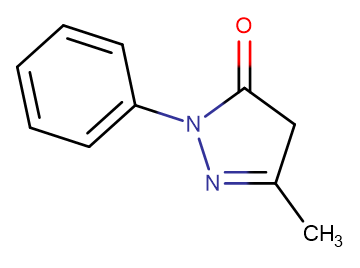
Edaravone
CAS No. 89-25-8
Edaravone( Edaravone | NSC 2629 )
Catalog No. M16437 CAS No. 89-25-8
Edaravone(MCI-186), a strong novel free radical scavenger.
Purity : >98% (HPLC)
 COA
Datasheet
HNMR
HPLC
MSDS
Handing Instructions
COA
Datasheet
HNMR
HPLC
MSDS
Handing Instructions
| Size | Price / USD | Stock | Quantity |
| 500MG | 39 | In Stock |


|
| 1G | Get Quote | In Stock |
|
Biological Information
-
Product NameEdaravone
-
NoteResearch use only, not for human use.
-
Brief DescriptionEdaravone(MCI-186), a strong novel free radical scavenger.
-
DescriptionEdaravone(MCI-186), a strong novel free radical scavenger, is used for treatment of patients with acute brain infarction. (In Vitro):Edaravone performs both preventative and therapeutic effects against toxicity of glutamate. Pretreatment of edaravone reduces the toxicity of glutamate towards SGNs. Edaravone reduces apoptosis and necrosis caused by glutamate. Pretreatment of edaravone (500 μM) reverses these changes to approximately normal levels. The protective effect of edaravone on SGNs against glutamate-induced apoptosis is associated with PI3K/Akt pathway and Bcl-2 protein family.(In Vivo):Edaravone exerts neuroprotective effects by inhibiting endothelial injury and by ameliorating neuronal damage in brain ischemia. Edaravone provides the desirable features of NOS: it increases eNOS (beneficial NOS for rescuing ischemic stroke) and decreases nNOS and iNOS (detrimental NOS). Post-reperfusion brain edema and hemorrhagic events induced by thrombolytic therapy may be reduced by edaravone pretreatment. Edaravone significantly decreases infarct volume, with the average infarct volume in the edaravone-treated rats (227.6 mm3) being significantly lower than that in the control rats (264.0 mm3). Edaravone treatment also decreases the postischemic hemorrhage volumes (53.4 mm3 in edaravone-treated rats vs 176.4 mm3 in controls). In addition, the ratio of hemorrhage volume to infarct volume is lower in the edaravone-treated rats (23.5%) than in the untreated rats (63.2%). In edaravone (20 mg/kg)-treated rats, astrocyte activity (glial fibrillary acidic protein) and apoptotic cells (caspase-3) are decreased on the corpus callosum, germinal matrix, and cerebral cortex.
-
In Vitro——
-
In Vivo——
-
SynonymsEdaravone | NSC 2629
-
PathwayNF-κB
-
TargetFree radical scavengers
-
RecptorFree radical scavengers
-
Research AreaNeurological Disease
-
Indication——
Chemical Information
-
CAS Number89-25-8
-
Formula Weight174.2
-
Molecular FormulaC10H10N2O
-
Purity>98% (HPLC)
-
SolubilityEthanol: 35 mg/mL (200.91 mM); DMSO: 35 mg/mL (200.91 mM)
-
SMILESO=C1CC(C)=NN1C2=CC=CC=C2
-
Chemical Name5-methyl-2-phenyl-2,4-dihydro-3H-pyrazol-3-one
Shipping & Storage Information
-
Storage(-20℃)
-
ShippingWith Ice Pack
-
Stability≥ 2 years
Reference
1. Yoshida H, et al. CNS Drug Rev, 2006, 12(1), 9-20.
molnova catalog



related products
-
2266-Tetramethylpipe...
TEMPO has a wide range of applications including use as a free radical scavenger a reagent in organic synthesis and as a structural probe in electron spin resonance spectroscopy.
-
Sodium 4-aminosalicy...
Sodium 4-Aminosalicylate is an antibiotic used to treat tuberculosis via NF-κB inhibition and free radical scavenging.
-
HC-030031
HC-030031 is a potent TRPA1 inhibitor, which antagonizes AITC- and formalin-evoked calcium influx with IC50s of 6.2±0.2 and 5.3±0.2 μM, respectively.
