


 Cart
Cart
 sales@molnova.com


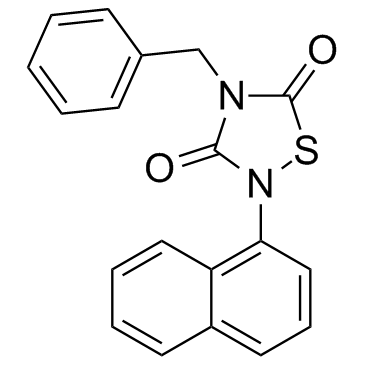
Tideglusib
CAS No. 865854-05-3
Tideglusib( NP031112 )
Catalog No. M16292 CAS No. 865854-05-3
Tideglusib is an irreversible, non ATP-competitive GSK-3β inhibitor with IC50 of 60 nM in a cell-free assay.
Purity : >98% (HPLC)
 COA
Datasheet
HNMR
HPLC
MSDS
Handing Instructions
COA
Datasheet
HNMR
HPLC
MSDS
Handing Instructions
| Size | Price / USD | Stock | Quantity |
| 1 mL x 10 mM in DMSO | 41 | In Stock |


|
| 10MG | 37 | In Stock |
|
| 25MG | 67 | In Stock |
|
| 50MG | 107 | In Stock |
|
| 100MG | 183 | In Stock |
|
| 200MG | 276 | In Stock |
|
| 500MG | 480 | In Stock |
|
| 1G | Get Quote | In Stock |
|
Biological Information
-
Product NameTideglusib
-
NoteResearch use only, not for human use.
-
Brief DescriptionTideglusib is an irreversible, non ATP-competitive GSK-3β inhibitor with IC50 of 60 nM in a cell-free assay.
-
DescriptionTideglusib is an irreversible, non ATP-competitive GSK-3β inhibitor with IC50 of 60 nM in a cell-free assay; fails to inhibit kinases with a Cys homologous to Cys-199 located in the active site. Phase 2.(In Vitro):Incubation of both astrocyte and microglial cultures with Tideglusib (NP031112) completely abrogates the induction of TNF-α and COX-2 expression after glutamate treatment. These effects of NP031112 are not caused by a loss of cell viability, because the 24 h exposure of astrocyte and microglial cells to this TDZD does not modify cell viability.(In Vivo):Injection of Tideglusib (NP031112) (50 mg/kg) into the rat hippocampus dramatically reduces kainic acid-induced inflammation, as measured by edema formation using T2-weighted magnetic resonance imaging and glial activation and has a neuroprotective effect in the damaged areas of the hippocampus.
-
In VitroIncubation of both astrocyte and microglial cultures with Tideglusib (NP031112) completely abrogates the induction of TNF-α and COX-2 expression after glutamate treatment. These effects of NP031112 are not caused by a loss of cell viability, because the 24 h exposure of astrocyte and microglial cells to this TDZD does not modify cell viability.
-
In VivoInjection of Tideglusib (NP031112) (50 mg/kg) into the rat hippocampus dramatically reduces kainic acid-induced inflammation, as measured by edema formation using T2-weighted magnetic resonance imaging and glial activation and has a neuroprotective effect in the damaged areas of the hippocampus.
-
SynonymsNP031112
-
PathwayPI3K/Akt/mTOR signaling
-
TargetGSK-3
-
RecptorGSK-3β
-
Research AreaNeurological Disease
-
Indication——
Chemical Information
-
CAS Number865854-05-3
-
Formula Weight334.39
-
Molecular FormulaC19H14N2O2S
-
Purity>98% (HPLC)
-
SolubilityDMSO: 1 mg/mL (2.99 mM)
-
SMILESO=C(N1CC2=CC=CC=C2)N(C3=C4C=CC=CC4=CC=C3)SC1=O
-
Chemical Name2-(1-naphthalenyl)-4-(phenylmethyl)-1,2,4-thiadiazolidine-3,5-dione
Shipping & Storage Information
-
Storage(-20℃)
-
ShippingWith Ice Pack
-
Stability≥ 2 years
Reference
1.Domínguez JM, et al. J Biol Chem, 2012, 287(2), 893-90
molnova catalog



related products
-
A 1070722
A 1070722 is a potent and selective GSK-3 inhibitor, shows high affinity GSK-3α(Ki = 0.6 nM) and GSK-3β(Ki = 0.6 nM).
-
GS87
GS87 is a highly specific inhibitor of GSK3 (glycogen synthase kinase 3) that induces extensive differentiation of AML cells.GS87 potently inhibits growth of AML cells in mice with little effect on normal bone marrow cells. GS87 causes terminal differentiation of AML cells.
-
BRD0705
BRD0705 (BRD-0705) is a potent, paralog-selective GSK3α inhibitor with IC50 of 66 nM.
