


 Cart
 sales@molnova.com


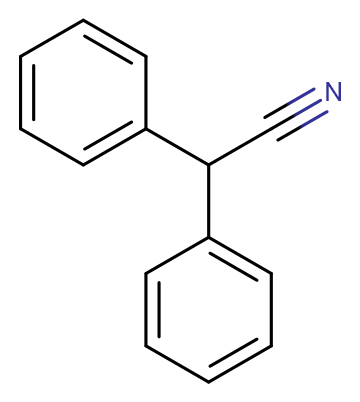
Diphenylacetonitrile
CAS No. 86-29-3
Diphenylacetonitrile( —— )
Catalog No. M16244 CAS No. 86-29-3
Diphenylacetonitrile can be used as herbicide and industrial intermediate.
Purity : >98% (HPLC)
 COA
Datasheet
HNMR
HPLC
MSDS
Handing Instructions
| Size | Price / USD | Stock | Quantity |
| 1 mL x 10 mM in DMSO | 28 | In Stock |


|
| 100MG | Get Quote | In Stock |
|
| 200MG | Get Quote | In Stock |
|
| 500MG | Get Quote | In Stock |
|
| 1G | 26 | In Stock |
|
Biological Information
-
Product NameDiphenylacetonitrile
-
NoteResearch use only, not for human use.
-
Brief DescriptionDiphenylacetonitrile can be used as herbicide and industrial intermediate.
-
DescriptionDiphenylacetonitrile can be used as herbicide and industrial intermediate.
-
In Vitro——
-
In Vivo——
-
Synonyms——
-
PathwayOthers
-
TargetOther Targets
-
RecptorOthers
-
Research Area——
-
Indication——
Chemical Information
-
CAS Number86-29-3
-
Formula Weight193.24
-
Molecular FormulaC14H11N
-
Purity>98% (HPLC)
-
SolubilityDMSO: 10 mM
-
SMILESN#CC(C1=CC=CC=C1)C1=CC=CC=C1
-
Chemical Name——
Shipping & Storage Information
-
Storage(-20℃)
-
ShippingWith Ice Pack
-
Stability≥ 2 years
Reference
1.SCHULTZ EM, et al. J Am Chem Soc. 1947 Oct;69(10):2454-9.
molnova catalog



related products
-
20-Hydroxylucidenic ...
20-Hydroxylucidenic acid E2 is a triterpenoid compound found in Ganoderma lucidum. It exhibits significant inhibitory effects on inflammation induced by TPA . Additionally, 20-Hydroxylucidenic acid E2 can suppress the expression of EBV early antigen induced by TPA , with a IC50 of 290 mol ratio/32 pmol TPA (meaning that when the molar concentration of this compound is 290 times that of 32 pmol of TPA, it can inhibit 50% of EBV early antigen expression). Therefore, 20-Hydroxylucidenic acid E2 has potential applications in anti-inflammatory and anticancer research.
-
GLYCODEOXYCHOLIC ACI...
Glycodeoxycholic Acid is a bile acid that induces severe pancreatitis in rats. It can induce the apoptosis of SMMC-7721 cells.
-
HPV-E7-N
HPV-E7-N
