


 Cart
Cart
 sales@molnova.com


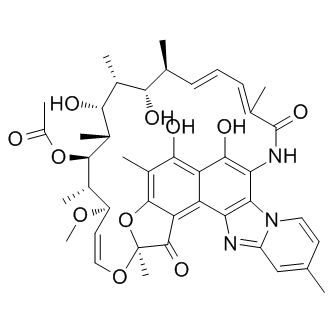
Rifaximin
CAS No. 80621-81-4
Rifaximin( L 105SV | Rifamycin L 105 )
Catalog No. M16017 CAS No. 80621-81-4
Rifaximin is an oral, semi-synthetic antibiotic derived from Rifamycin SV with antibacterial activity.
Purity : >98% (HPLC)
 COA
Datasheet
HNMR
HPLC
MSDS
Handing Instructions
COA
Datasheet
HNMR
HPLC
MSDS
Handing Instructions
| Size | Price / USD | Stock | Quantity |
| 1 mL x 10 mM in DMSO | 54 | In Stock |


|
| 100MG | Get Quote | In Stock |
|
| 200MG | 29 | In Stock |
|
| 500MG | 49 | In Stock |
|
| 1G | 75 | In Stock |
|
Biological Information
-
Product NameRifaximin
-
NoteResearch use only, not for human use.
-
Brief DescriptionRifaximin is an oral, semi-synthetic antibiotic derived from Rifamycin SV with antibacterial activity.
-
DescriptionRifaximin is an oral, semi-synthetic antibiotic derived from Rifamycin SV with antibacterial activity, interferes with transcription by binding to the β-subunit of bacterial RNA polymerase; Rifaximin is widely used to treat traveler's diarrhea, irritable bowel syndrome, and hepatic encephalopathy.Bacterial Infection Approved(In Vitro):Rifaximin has a good inhibitory activity against Staphylococcus, Streptococcus, Enterococcus, Escherichia coli, Shigella, Salmonella, Bacillus cereus, Moraxella catarrhalis, Haemophilus influenzae, Haemophilus ducreyi,Bacteroides bivius-disiens, Gardnerella vaginalis, Lactobacillus spp.,Mobiluncus spp.,Neisseria gonorrhoeae, Pseudomonas and Acinetobacter . Rifaximin rarely causes side effects.Rifaximin (0.1, 1.0 and 10.0 μM) causes significant and concentration-dependent reduction of cell proliferation, cell migration and PCNA expression in the Caco-2 cells vs. untreated cells.Rifaximin (0.1-10 μM) downregulates Akt/mTOR and p38MAPK/NF-κB pathways through a PXR-dependent mechanism.(In Vivo):Rifaximin administration (30 or 50 mg/kg/day) increases survival rates of colitic mice and reduces colitis severity by improvement of wasting syndrome, histologic scores, decrease in colon IL-2, IL-12, IFN-gamma and TNF-alpha (protein and mRNA) levels, and diminishes colon myeloperoxidase (MPO) activity.
-
In VitroRifaximin has a good inhibitory activity against Staphylococcus, Streptococcus, Enterococcus, Escherichia coli, Shigella, Salmonella, Bacillus cereus, Moraxella catarrhalis, Haemophilus influenzae, Haemophilus ducreyi, Bacteroides bivius-disiens, Gardnerella vaginalis, Lactobacillus spp.,Mobiluncus spp.,Neisseria gonorrhoeae, Pseudomonas andAcinetobacter . Rifaximin rarely causes side effects.Rifaximin (0.1, 1.0 and 10.0 μM) causes significant and concentration-dependent reduction of cell proliferation, cell migration and PCNA expression in the Caco-2 cells vs. untreated cells. Rifaximin (0.1-10 μM) downregulates Akt/mTOR and p38MAPK/NF-κB pathways through a PXR-dependent mechanism. Cell Viability Assay Cell Line:Caco-2 cells Concentration:0.1, 1.0 and 10.0 μM Incubation Time:48 hours Result:Caused a significant and concentration-dependent reduction in cell proliferation. Reduced the expression of PCNA in a concentration-dependent manner.Western Blot Analysis Cell Line:Caco-2 cells Concentration:0.1, 1.0 and 10.0 μM Incubation Time:24 hours Result:Reduced Akt, mTOR, p38 MAPK and HIF-1α expression in a concentration-dependent manner.Inhibited NF-κB nuclear activation and p70S6K.
-
In VivoRifaximin has a good inhibitory activity against Staphylococcus, Streptococcus, Enterococcus, Escherichia coli, Shigella, Salmonella, Bacillus cereus, Moraxella catarrhalis, Haemophilus influenzae, Haemophilus ducreyi, Bacteroides bivius-disiens, Gardnerella vaginalis, Lactobacillus spp.,Mobiluncus spp.,Neisseria gonorrhoeae, Pseudomonas andAcinetobacter . Rifaximin rarely causes side effects.Rifaximin (0.1, 1.0 and 10.0 μM) causes significant and concentration-dependent reduction of cell proliferation, cell migration and PCNA expression in the Caco-2 cells vs. untreated cells. Rifaximin (0.1-10 μM) downregulates Akt/mTOR and p38MAPK/NF-κB pathways through a PXR-dependent mechanism. Cell Viability Assay Cell Line:Caco-2 cells Concentration:0.1, 1.0 and 10.0 μM Incubation Time:48 hours Result:Caused a significant and concentration-dependent reduction in cell proliferation. Reduced the expression of PCNA in a concentration-dependent manner.Western Blot AnalysisCell Line:Caco-2 cells Concentration:0.1, 1.0 and 10.0 μM Incubation Time:24 hours Result:Reduced Akt, mTOR, p38 MAPK and HIF-1α expression in a concentration-dependent manner.Inhibited NF-κB nuclear activation and p70S6K.
-
SynonymsL 105SV | Rifamycin L 105
-
PathwayGPCR/G Protein
-
TargetAntibacterial
-
RecptorDNA/RNASynthesis
-
Research AreaInfection
-
IndicationBacterial Infection
Chemical Information
-
CAS Number80621-81-4
-
Formula Weight785.8785
-
Molecular FormulaC43H51N3O11
-
Purity>98% (HPLC)
-
SolubilityDMSO: ≥ 26 mg/mL
-
SMILESOC1=C(NC(/C(C)=C\C=C\[C@H](C)[C@H](O)[C@@H](C)[C@@H](O)[C@@H](C)[C@H](OC(C)=O)[C@H](C)[C@@H](OC)/C=C/O[C@@](C2=O)(C)O3)=O)C4=C(N=C5N4C=CC(C)=C5)C6=C2C3=C(C)C(O)=C61
-
Chemical Name2,7-(Epoxypentadeca[1,11,13]trienimino)benzofuro[4,5-e]pyrido[1,2-a]benzimidazole-1,15(2H)-dione, 25-(acetyloxy)-5,6,21,23-tetrahydroxy-27-methoxy-2,4,11,16,20,22,24,26-octamethyl-, (2S,16Z,18E,20S,21S,22R,23R,24R,25S,26R,27S,28E)-
Shipping & Storage Information
-
Storage(-20℃)
-
ShippingWith Ice Pack
-
Stability≥ 2 years
Reference
molnova catalog



related products
-
Calcimycin
Calcimycin is an ionophorous, polyether carboxylic antibiotic from Streptomyces chartreusensis.?It binds and transports calcium and other divalent cations across membranes and uncouples oxidative phosphorylation while inhibiting ATPase of rat liver mitochondria.?The substance is used mostly as a biochemical tool to study the role of divalent cations in various biological systems.?
-
Azlocillin sodium
Azlocillin is an acylampicillin with a broad spectrum against bacteria.
-
SPI009
SPI009 is a novel antipersister compound active against P. aeruginosa.
