


 Cart
Cart
 sales@molnova.com


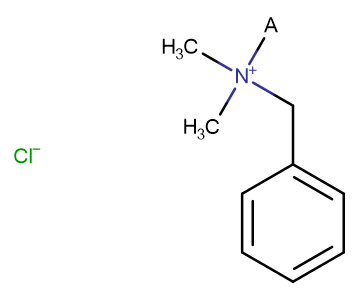
Benzalkonium chloride
CAS No. 8001-54-5
Benzalkonium chloride( —— )
Catalog No. M15995 CAS No. 8001-54-5
Benzalkonium chloride is a cationic surface-acting agent belonging to the quaternary ammonium group.
Purity : >98% (HPLC)
 COA
Datasheet
HNMR
HPLC
MSDS
Handing Instructions
COA
Datasheet
HNMR
HPLC
MSDS
Handing Instructions
| Size | Price / USD | Stock | Quantity |
| 100MG | 47 | In Stock |


|
| 200MG | Get Quote | In Stock |
|
| 500MG | Get Quote | In Stock |
|
| 1G | Get Quote | In Stock |
|
Biological Information
-
Product NameBenzalkonium chloride
-
NoteResearch use only, not for human use.
-
Brief DescriptionBenzalkonium chloride is a cationic surface-acting agent belonging to the quaternary ammonium group.
-
DescriptionBenzalkonium chloride is a cationic surface-acting agent belonging to the quaternary ammonium group. It has three main categories of use: as a biocide, a cationic surfactant, and phase transfer agent in the chemical industry. The chemical is a heterogeneous mixture of alkylbenzyldimethylammonium chlorides of various even-numbered alkyl chain lengths.
-
In Vitro——
-
In Vivo——
-
Synonyms——
-
PathwayOthers
-
TargetOther Targets
-
RecptorOthers
-
Research Area——
-
Indication——
Chemical Information
-
CAS Number8001-54-5
-
Formula Weight——
-
Molecular FormulaC??H??ClN
-
Purity>98% (HPLC)
-
SolubilityWater: 10 mM
-
SMILES[Cl-].C[N+](C)([*])CC1=CC=CC=C1
-
Chemical Name——
Shipping & Storage Information
-
Storage(-20℃)
-
ShippingWith Ice Pack
-
Stability≥ 2 years
Reference
1.Baudouin C, et al. Prog Retin Eye Res. 2010 Jul;29(4):312-34.
molnova catalog



related products
-
Ezabenlimab
Ezabenlimab (BI-754091) is an anti-PD-1 monoclonal antibody (mAb) with a binding constant (Kd) of 6 nM in CHO cells.
-
γ-TAC4 (30 - 61) - N...
γ-TAC4 (30 - 61) - NH2
-
Ac-a-CGRP (19-37) (h...
Ac-a-CGRP (19-37) (human)
