


 Cart
Cart
 sales@molnova.com


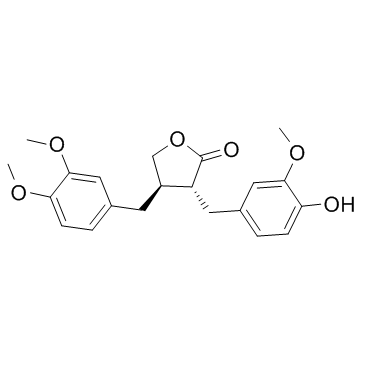
Arctigenin
CAS No. 7770-78-7
Arctigenin( —— )
Catalog No. M15933 CAS No. 7770-78-7
Arctigenin is a lignan found in certain plants of the Asteraceae; it has shown antiviral and anticancer effects in glass.
Purity : >98% (HPLC)
 COA
Datasheet
HNMR
HPLC
MSDS
Handing Instructions
COA
Datasheet
HNMR
HPLC
MSDS
Handing Instructions
| Size | Price / USD | Stock | Quantity |
| 1 mL x 10 mM in DMSO | 46 | In Stock |


|
| 25MG | 29 | In Stock |
|
| 50MG | 41 | In Stock |
|
| 100MG | 68 | In Stock |
|
| 200MG | Get Quote | In Stock |
|
| 500MG | 164 | In Stock |
|
| 1G | Get Quote | In Stock |
|
Biological Information
-
Product NameArctigenin
-
NoteResearch use only, not for human use.
-
Brief DescriptionArctigenin is a lignan found in certain plants of the Asteraceae; it has shown antiviral and anticancer effects in glass.
-
DescriptionArctigenin is a lignan found in certain plants of the Asteraceae; it has shown antiviral and anticancer effects in glass; it is the aglycone of arctiin.(In Vitro):Arctigenin (0.01-1 μg/mL; 0.5-24 h) shows preferential cytotoxicity against the PANC-1 cell line under nutrient-deprived conditions in a concentration- and time-dependent manner.Arctigenin (0.01-1 μg/mL; 0.5-24 h) inhibits the survival of various cancer cell lines (ASPC-1, BXPC-3, Alexander, and PSN-1 cells) under nutrient-deprived conditions.Arctigenin (0.1-1 μg/mL; 24 h) completely inhibits Akt phosphorylation stimulated by glucose deprivation in PANC-1 cells.Arctigenin (5-25 μM) shows potent in vitro antiviral activities (IC50=2.9 μM) against influenza A virus.(In Vivo):Arctigenin (250 μg/mL; 0.2 mL; i.p. 6 times a week for 9 weeks) suppress the PANC-1 tumor growth in nude mice.Arctigenin (10 mg/kg; i.p. daily for 30 days) relieves experimental autoimmune encephalomyelitis (EAE) symptoms of mice.
-
In VitroArctigenin (0.01-1 μg/mL; 0.5-24 h) shows preferential cytotoxicity against the PANC-1 cell line under nutrient-deprived conditions in a concentration- and time-dependent manner.?Arctigenin (0.01-1 μg/mL; 0.5-24 h) inhibits the survival of various cancer cell lines (ASPC-1, BXPC-3, Alexander, and PSN-1 cells) under nutrient-deprived conditions.?Arctigenin (0.1-1 μg/mL; 24 h) completely inhibits Akt phosphorylation stimulated by glucose deprivation in PANC-1 cells.?Arctigenin (5-25 μM) shows potent in vitro antiviral activities (IC50=2.9 μM) against influenza A virus.
-
In VivoArctigenin (250 μg/mL; 0.2 mL; i.p. 6 times a week for 9 weeks) suppress the PANC-1 tumor growth in nude mice.Arctigenin (10 mg/kg; i.p. daily for 30 days) relieves experimental autoimmune encephalomyelitis (EAE) symptoms of mice. Animal Model:Female SPF/VAF BALB/cAn Ncrj-nu/nu mice were injected with PANC-1 cells Dosage:250 μg/mL, 0.2 mL Administration:I.p. 6 times a week for 9 weeks Result:Reduced the tumor weight and volume.
-
Synonyms——
-
PathwayOthers
-
TargetOther Targets
-
RecptorOthers
-
Research AreaCancer
-
Indication——
Chemical Information
-
CAS Number7770-78-7
-
Formula Weight372.41
-
Molecular FormulaC21H24O6
-
Purity>98% (HPLC)
-
SolubilityDMSO: 10 mM
-
SMILESO=C1OC[C@H](CC2=CC=C(OC)C(OC)=C2)[C@H]1CC3=CC=C(O)C(OC)=C3
-
Chemical Name(3R,4R)-4-[(3,4-dimethoxyphenyl)methyl]-3- [(4-hydroxy-3-methoxyphenyl)methyl]-2-tetrahydrofuranone
Shipping & Storage Information
-
Storage(-20℃)
-
ShippingWith Ice Pack
-
Stability≥ 2 years
Reference
1.Wu X, et al. Biochem Pharmacol. 2015 Aug 15;96(4):323-36.
molnova catalog



related products
-
MSNBA
MSNBA is a selective and potent inhibitor of fructose transport through GLUT5 and also acts as a probe of the GLUT5 transporter. MSNBA inhibited GLUT5 fructose uptake in MCF7 cells with KI of 3.2±0.4 μM.
-
Etrolizumab
Etrolizumab (rhuMAb Beta7), a gut-selective anti-β7 integrin monoclonal antibody, targets the β7 subunit of α4β7 and αEβ7 integrins specifically, demonstrating affinity with K i values of 18 nM for Human α4β7 and 1800 pM for Human αEβ7-293.
-
Neuronostatin-19 (hu...
Neuronostatin-19 (human, canine, porcine)
