


 Cart
Cart
 sales@molnova.com


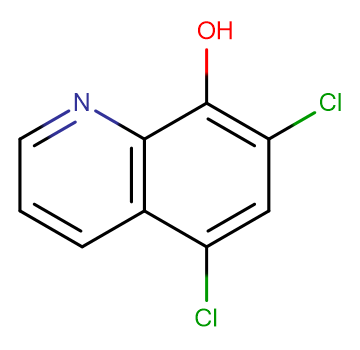
Capitrol
CAS No. 773-76-2
Capitrol( chloroxine hydrofluoride | chlorquinol | dichlorohydroxyquinoline | dichloroquine | quixalin )
Catalog No. M15923 CAS No. 773-76-2
Chloroxine is a synthetic antibacterial compound that is effective in the treatment of dandruff and seborrheic dermatitis when incorporated in a shampoo.
Purity : >98% (HPLC)
 COA
Datasheet
HNMR
HPLC
MSDS
Handing Instructions
COA
Datasheet
HNMR
HPLC
MSDS
Handing Instructions
| Size | Price / USD | Stock | Quantity |
| 1 mL x 10 mM in DMSO | 28 | In Stock |


|
| 100MG | Get Quote | In Stock |
|
| 200MG | Get Quote | In Stock |
|
| 500MG | 29 | In Stock |
|
| 1G | 37 | In Stock |
|
Biological Information
-
Product NameCapitrol
-
NoteResearch use only, not for human use.
-
Brief DescriptionChloroxine is a synthetic antibacterial compound that is effective in the treatment of dandruff and seborrheic dermatitis when incorporated in a shampoo.
-
DescriptionChloroxine is a synthetic antibacterial compound that is effective in the treatment of dandruff and seborrheic dermatitis when incorporated in a shampoo.(In Vitro):By using the Jouyban-Acree model, the Chloroxine solubility is well correlated obtaining RAD values lower than 3.64% and RMSD values lower than 8.82 × 10 6. Chloroxine is preferentially solvated by water for the studied mixtures in water-rich compositions; while within intermediate and co-solvent-rich compositions, Chloroxine is preferentially solvated by DMSO (DMF, NMP or 1,4-dioxane) in DMSO (DMF, NMP or 1,4-dioxane) + water mixtures. It is shown that the change in solvent-solvent interaction energy accounted by cavity term governed the solubility variation of Chloroxine in all aqueous mixtures.
-
In VitroBy using the Jouyban-Acree model, the Chloroxine solubility is well correlated obtaining RAD values lower than 3.64% and RMSD values lower than 8.82?×?10?6. Chloroxine is preferentially solvated by water for the studied mixtures in water-rich compositions; while within intermediate and co-solvent-rich compositions, Chloroxine is preferentially solvated by DMSO (DMF, NMP or 1,4-dioxane) in DMSO (DMF, NMP or 1,4-dioxane)?+?water mixtures. It is shown that the change in solvent-solvent interaction energy accounted by cavity term governed the solubility variation of Chloroxine in all aqueous mixtures.
-
In Vivo——
-
Synonymschloroxine hydrofluoride | chlorquinol | dichlorohydroxyquinoline | dichloroquine | quixalin
-
PathwayOthers
-
TargetOther Targets
-
RecptorOthers
-
Research AreaInfection
-
Indication——
Chemical Information
-
CAS Number773-76-2
-
Formula Weight214.05
-
Molecular FormulaC9H5Cl2NO
-
Purity>98% (HPLC)
-
SolubilityDMSO: 43 mg/mL (200.88 mM)
-
SMILESC1=CC2=C(C(=C(C=C2Cl)Cl)O)N=C1
-
Chemical Name5,7-dichloroquinolin-8-ol
Shipping & Storage Information
-
Storage(-20℃)
-
ShippingWith Ice Pack
-
Stability≥ 2 years
Reference
1.Malaveille C, et al. IARC Sci Publ. 1991;(115):261-6.
molnova catalog



related products
-
(Tyr0,Trp2)-Melanocy...
Tyr-W-MIF-1 is an opioid tetrapeptide with opiate and antiopiate activity. Tyr-W-MIF-1 can induce analgesia.
-
Maximaisoflavone B
Maximaisoflavone B
-
[Pyr1]-Apelin-13
[Pyr1]-Apelin-13 is a potent and selective endogenous Apelin receptor (APJ) agonist.[Pyr1]-apelin-13 encapsulation in lipoPEG particles (lipoPEG-PA13) results in sustained and extended drug release under physiological conditions[1].[Pyr1]-apelin-13 nanocarriers in a mouse model of pressure-overload induced heart failure demonstrate a sustainable long-term effect of [Pyr1]-apelin-13 in preventing cardiac dysfunction.
