


 Cart
Cart
 sales@molnova.com


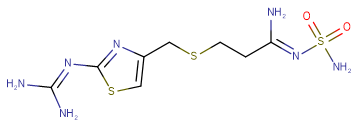
Famotidine
CAS No. 76824-35-6
Famotidine( MK-208 | YM-11170 )
Catalog No. M15908 CAS No. 76824-35-6
Famotidine is a competitive histamine H2-receptor antagonist.
Purity : >98% (HPLC)
 COA
Datasheet
HNMR
HPLC
MSDS
Handing Instructions
COA
Datasheet
HNMR
HPLC
MSDS
Handing Instructions
| Size | Price / USD | Stock | Quantity |
| 10MG | 49 | In Stock |


|
| 25MG | 59 | In Stock |
|
| 50MG | 72 | In Stock |
|
| 100MG | Get Quote | In Stock |
|
| 200MG | Get Quote | In Stock |
|
| 500MG | Get Quote | In Stock |
|
| 1G | Get Quote | In Stock |
|
Biological Information
-
Product NameFamotidine
-
NoteResearch use only, not for human use.
-
Brief DescriptionFamotidine is a competitive histamine H2-receptor antagonist.
-
DescriptionFamotidine is a competitive histamine H2-receptor antagonist. Its main pharmacodynamic effect is the inhibition of gastric secretion.(In Vitro):Famotidine (MK-208) is a histamine H2-receptor antagonist that inhibits stomach acid production, and it is commonly used in the treatment of peptic ulcer disease (PUD) and gastroesophageal reflux disease (GERD/GORD). Famotidine (MK-208) Group(2 mg/kg/day) were significantly lower than the equivalent parameters for the Control Group on both the third and seventh days post-surgery. Famotidine (MK-208) exerts detrimental effects on the anastomotic bursting pressure and hydroxyproline content of perianastomotic tissues in the colon of rats. Famotidine (MK-208) increased the transgastric potential difference (PD) and promoted the recovery of decreased transgastric PD induced by acidified ethanol in rats. The preventive effect of famotidine on gastric lesions is attributable not only to suppression of acid secretion but to activation of the gastric mucosal defensive mechanisms.
-
In VitroFamotidine (MK-208) is a histamine H2-receptor antagonist that inhibits stomach acid production, and it is commonly used in the treatment of peptic ulcer disease (PUD) and gastroesophageal reflux disease (GERD/GORD). Famotidine (MK-208) Group(2 mg/kg/day) were significantly lower than the equivalent parameters for the Control Group on both the third and seventh days post-surgery. Famotidine (MK-208) exerts detrimental effects on the anastomotic bursting pressure and hydroxyproline content of perianastomotic tissues in the colon of rats. Famotidine (MK-208) increased the transgastric potential difference (PD) and promoted the recovery of decreased transgastric PD induced by acidified ethanol in rats. The preventive effect of famotidine on gastric lesions is attributable not only to suppression of acid secretion but to activation of the gastric mucosal defensive mechanisms.
-
In Vivo——
-
SynonymsMK-208 | YM-11170
-
PathwayGPCR/G Protein
-
TargetHistamine Receptor
-
RecptorH2 receptor
-
Research AreaOther Indications
-
Indication——
Chemical Information
-
CAS Number76824-35-6
-
Formula Weight337.45
-
Molecular FormulaC8H15N7O2S3
-
Purity>98% (HPLC)
-
SolubilityDMSO: 67 mg/mL (198.54 mM)
-
SMILESN/C(N)=N\C1=NC(CSCC/C(N)=N/S(=O)(N)=O)=CS1
-
Chemical Name(Z)-3-(((2-((diaminomethylene)amino)thiazol-4-yl)methyl)thio)-N'-sulfamoylpropanimidamide
Shipping & Storage Information
-
Storage(-20℃)
-
ShippingWith Ice Pack
-
Stability≥ 2 years
Reference
1. Takahashi HK, et al. Mol Pharmacol. 2006 Aug;70(2):450-3.
molnova catalog



related products
-
Sodium butanoate
Sodium Butyrate(Butanoic acid sodium salt) has been reported to cause hyperacetylation of histones due to its role as a histone deacetylase (HDAC) inhibitor (IC50 values are 0.3, 0.4, 0.3, mM for HDAC1, 2 and 7 respectively).
-
Pitolisant oxalate
A potent and selective antagonist of H3 receptor with Ki/EC50 of 0.16/1.5 nM; no effect on H1, H2, H4 receptors (IC50>10 uM).
-
Propionyl-L-carnitin...
Levocarnitine propionate hcl is used to treat the deterioration of renal function, congestive heart failure, intermittent claudication, and other diseases.
