


 Cart
Cart
 sales@molnova.com


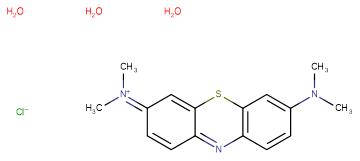
Methylene Blue trihydrate
CAS No. 7220-79-3
Methylene Blue trihydrate( —— )
Catalog No. M15760 CAS No. 7220-79-3
A compound consisting of dark green crystals or crystalline powder, having a bronze-like luster.
Purity : >98% (HPLC)
 COA
Datasheet
HNMR
HPLC
MSDS
Handing Instructions
COA
Datasheet
HNMR
HPLC
MSDS
Handing Instructions
| Size | Price / USD | Stock | Quantity |
| 100MG | Get Quote | In Stock |


|
| 200MG | Get Quote | In Stock |
|
| 500MG | Get Quote | In Stock |
|
| 1G | Get Quote | In Stock |
|
Biological Information
-
Product NameMethylene Blue trihydrate
-
NoteResearch use only, not for human use.
-
Brief DescriptionA compound consisting of dark green crystals or crystalline powder, having a bronze-like luster.
-
DescriptionA compound consisting of dark green crystals or crystalline powder, having a bronze-like luster. Solutions in water or alcohol have a deep blue color. Methylene blue is used as a bacteriologic stain and as an indicator. It inhibits GUANYLATE CYCLASE, and has been used to treat cyanide poisoning and to lower levels of methemoglobin.
-
In VitroBy acting as an alternative electron acceptor/donor Methylene blue restores mitochondrial function, improves neuronal energy production and inhibits the formation of superoxide. Methylene blue inhibits cytochrome P450 (CYP) isozymes. Methylene blue is an odorless, water soluble, dark blue-green crystalline powder, which turns blue whenever mixed in solution. Methylene blue is a vasopressor that impacts the NO synthetic pathway by inhibiting inducible NOS and inhibiting the subsequent activation of sGC.In addition, by binding to the iron heme moiety of sGC and causing enzyme inhibition, Methylene blue blocks accumulation of cyclic GMP (cGMP), competing directly with NO in its ability to activate soluble guanylyl cyclase.
-
In VivoMethylene Blue (1, 5, and 25 μg/rat) significantly decreases sevoflurane minimum alveolar anesthetic concentration (MAC) and brain cyclic guanosine monophosphate (cGMP) content in a dose-dependent manner in male Sprague-Dawley rats (7-week-old, 200-250 g).Methylene blue is used as a dye in chromoendoscopy, and is sprayed onto the mucosa of the gastrointestinal tract in order to identify dysplasia, or pre-cancerous lesions. Methylene blue is able to restore vascular tone, normalize mean arterial pressures (MAP), and reduce vasopressor usage.
-
Synonyms——
-
PathwayOthers
-
TargetOther Targets
-
RecptorOthers
-
Research Area——
-
Indication——
Chemical Information
-
CAS Number7220-79-3
-
Formula Weight373.9
-
Molecular FormulaC16H24ClN3O3S
-
Purity>98% (HPLC)
-
SolubilityWater: 43,600 mg/L.
-
SMILESO.O.O.[Cl-].CN(C)C1=CC2=C(C=C1)N=C1C=CC(C=C1S2)=[N+](C)C
-
Chemical Name——
Shipping & Storage Information
-
Storage(-20℃)
-
ShippingWith Ice Pack
-
Stability≥ 2 years
Reference
1.Rager T, et al. Phys Chem Chem Phys. 2012 Jun 14;14(22):8074-82.
molnova catalog



related products
-
Pyridoxal phosphate
Pyridoxal Phosphate is the active form of vitamin B6 and a coenzyme for many pyridoxal phosphate (PLP)-dependent enzymes.
-
Z-D-E-V-D-AMC
Z-D-E-V-D-AMC
-
Chrysophanol 1-O-bet...
Chrysophanol 1-O-beta-tetraglucoside is a natural product.
