


 Cart
Cart
 sales@molnova.com


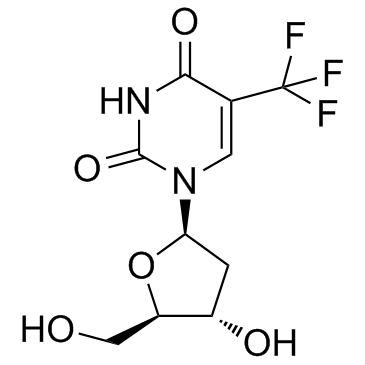
Trifluridine
CAS No. 70-00-8
Trifluridine( NSC 75520 | NSC 529182 | TFT | Trifluridine )
Catalog No. M15687 CAS No. 70-00-8
Trifluorothymidine (TFT) and is an inhibitor of thymidine phosphorylase.
Purity : >98% (HPLC)
 COA
Datasheet
HNMR
HPLC
MSDS
Handing Instructions
COA
Datasheet
HNMR
HPLC
MSDS
Handing Instructions
| Size | Price / USD | Stock | Quantity |
| 1 mL x 10 mM in DMSO | 60 | In Stock |


|
| 10MG | 29 | In Stock |
|
| 25MG | 44 | In Stock |
|
| 50MG | 60 | In Stock |
|
| 100MG | 81 | In Stock |
|
| 200MG | 126 | In Stock |
|
| 500MG | 207 | In Stock |
|
| 1G | Get Quote | In Stock |
|
Biological Information
-
Product NameTrifluridine
-
NoteResearch use only, not for human use.
-
Brief DescriptionTrifluorothymidine (TFT) and is an inhibitor of thymidine phosphorylase.
-
DescriptionTrifluorothymidine (TFT) and is an inhibitor of thymidine phosphorylase. TFT also inhibits thymidylate synthase (TS), a rate-limiting enzyme of DNA biosynthesis, and is incorporated into DNA.
-
In VitroCell Viability Assay Cell Line:HUVEC cellsConcentration: 0-5 μM Incubation Time:3 days Result:Cell viability dropped sharply at 3 μM and 5 μM.Immunofluorescence Cell Line:HUVEC cells Concentration: 0-5 μM Incubation Time:3 days Result:Induced cellular senescence by inhibiting autophagy flux.Western Blot Analysis Cell Line:HUVEC cells Concentration: 0-5 μM Incubation Time:3 daysResult:Increased protein levels of senescence markers: p53, p16, SASP (IL-1, IL-6, TNF-α, p21).Cell Proliferation AssayCell Line:MCF-7, MDA-MB-231, BT-549, Hs578T and MCF-10A(control non-tumor) cells Concentration:5 μM-20 μM Incubation Time:24 h–72 h Result:Inhibited the proliferation of MDA-MB231, BT549 and Hs578T cells at 10μM and 20μM, significantly.Apoptosis AnalysisCell Line: MDA-MB-231, BT-549, and Hs578T cells Concentration:10μM or 20 μMIncubation Time:48 h Result:Increased the percentages of apoptotic TNBC cells (MDA-MB-231, BT-549, and Hs578Tcells) at 10μM and 20μM, significantly.
-
In VivoAnimal Model:Nude mice (human colorectal intraperitoneal xenograft model) Dosage: 200 mg/kg(trifluridine/tipiracil)Administration:Oral administration; Once a day; 5 days followed by 2 drug-free days, a total of 6 weeks Result:Exhibited a significantly longer survival time compared with untreated mice.Animal Model:Mouse model of breast cancerDosage:75 or 150 mg/kg Administration:Oral gavage; daily for 10 days Result:Treatment with different doses inhibited the growth of TNBC tumors in mouse in a dose-dependent mannerAnimal Model:The human gastric MKN45 intraperitoneal xenograft model Dosage:200 mg/kg (Trifluridine/tipiracil)Administration:twice daily for 5 consecutive days followed by 2 drug?free days for 6 weeks Result:Prolonged the survival of mice compared with untreated mice.
-
SynonymsNSC 75520 | NSC 529182 | TFT | Trifluridine
-
PathwayCell Cycle/DNA Damage
-
TargetDNA/RNA Synthesis
-
RecptorDNA/RNA Synthesis| Thymidylate synthase
-
Research AreaCancer
-
Indication——
Chemical Information
-
CAS Number70-00-8
-
Formula Weight296.2
-
Molecular FormulaC10H11F3N2O5
-
Purity>98% (HPLC)
-
SolubilityEthanol: 59 mg/mL (199.18 mM); Water: 59 mg/mL (199.18 mM); DMSO: 59 mg/mL (199.18 mM)
-
SMILESO=C1NC(C(C(F)(F)F)=CN1[C@@H]2O[C@H](CO)[C@@H](O)C2)=O
-
Chemical Name1-((2R,4S,5R)-4-hydroxy-5-(hydroxymethyl)tetrahydrofuran-2-yl)-5-(trifluoromethyl)pyrimidine-2,4(1H,3H)-dione.
Shipping & Storage Information
-
Storage(-20℃)
-
ShippingWith Ice Pack
-
Stability≥ 2 years
Reference
1.Shintani M, et al. Oncol Rep. 2010 May; 23(5):1345-50.
molnova catalog



related products
-
Proflavine Hemisulfa...
Proflavine Hemisulfate is a topical antiseptic by interchelating DNA, thereby disrupting DNA synthesis and leading to high levels of mutation in the copied DNA strands.
-
ART812
ART812 is an orally active inhibitor of DNA polymerase Polθ, possessing an IC50 value of 7.6 nM. Additionally, ART812 exhibits a cell-based microhomology-mediated end joining (MMEJ) IC50 value of 240 nM.
-
Sempervirine
Sempervirine can unwind circular DNA, it shows selective inhibition of in vitro synthesis of cancer DNA .
