


 Cart
Cart
 sales@molnova.com


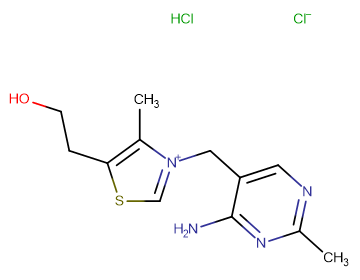
Thiamine hydrochloride
CAS No. 67-03-8
Thiamine hydrochloride( Aneurine | Vitamin B1 )
Catalog No. M15563 CAS No. 67-03-8
Thiamine or vitamin B1 is a water-soluble vitamin of the B complex, its phosphate derivatives are involved in many cellular processes.
Purity : >98% (HPLC)
 COA
Datasheet
HNMR
HPLC
MSDS
Handing Instructions
COA
Datasheet
HNMR
HPLC
MSDS
Handing Instructions
| Size | Price / USD | Stock | Quantity |
| 100MG | 45 | In Stock |


|
| 200MG | Get Quote | In Stock |
|
| 500MG | Get Quote | In Stock |
|
| 1G | 61 | In Stock |
|
Biological Information
-
Product NameThiamine hydrochloride
-
NoteResearch use only, not for human use.
-
Brief DescriptionThiamine or vitamin B1 is a water-soluble vitamin of the B complex, its phosphate derivatives are involved in many cellular processes.
-
DescriptionThiamine or vitamin B1 is a water-soluble vitamin of the B complex, its phosphate derivatives are involved in many cellular processes. Thiamine deficiency results in amyloid precursor protein immunoreactivity accumulated in swollen neurites within, or around lesions in rats, or in abnormal clusters in mice.
-
In Vitro——
-
In Vivo——
-
SynonymsAneurine | Vitamin B1
-
PathwayMetabolic Enzyme/Protease
-
TargetVitamin
-
RecptorVB1
-
Research AreaMetabolic Disease
-
Indication——
Chemical Information
-
CAS Number67-03-8
-
Formula Weight337.27
-
Molecular FormulaC12H18Cl2N4OS
-
Purity>98% (HPLC)
-
SolubilityDMSO: <1mg/ml; Water: 68mg/ml(201.62 mM); Ethanol: <1mg/ml
-
SMILESCl.[Cl-].CC1=C(CCO)SC=[N+]1CC1=CN=C(C)N=C1N
-
Chemical Name——
Shipping & Storage Information
-
Storage(-20℃)
-
ShippingWith Ice Pack
-
Stability≥ 2 years
Reference
1.Ahn IP, et al. Plant Physiol, 2005, 138(3), 1505-1515.
molnova catalog



related products
-
chlophenadione
Clorindione is a vitamin K antagonist. It is a derivative of phenindione.
-
Nicotinic acid
Niacin (Vitamin B3) is a water-soluble vitamin and is part of the vitamin B group.
-
Flavin mononucleotid...
Riboflavin phosphate sodium significantly increases in corneal biomechanical stiffness.
