


 Cart
Cart
 sales@molnova.com


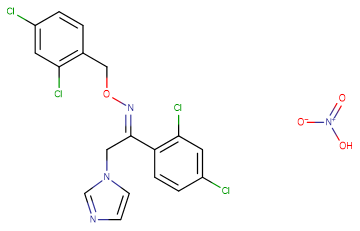
Oxiconazole nitrate
CAS No. 64211-46-7
Oxiconazole nitrate( Ro 13-8996 )
Catalog No. M15441 CAS No. 64211-46-7
Oxiconazole nitrate (U.S.: Oxistat, Canada: Oxizole) is an antifungal medication typically administered in a cream or lotion to treat skin infections such as athlete's foot, jock itch and ringworm.
Purity : >98% (HPLC)
 COA
Datasheet
HNMR
HPLC
MSDS
Handing Instructions
COA
Datasheet
HNMR
HPLC
MSDS
Handing Instructions
| Size | Price / USD | Stock | Quantity |
| 1 mL x 10 mM in DMSO | 48 | In Stock |


|
| 5MG | 33 | In Stock |
|
| 10MG | 49 | In Stock |
|
| 25MG | 98 | In Stock |
|
| 50MG | 169 | In Stock |
|
| 100MG | 334 | In Stock |
|
| 200MG | 463 | In Stock |
|
| 500MG | 755 | In Stock |
|
| 1G | Get Quote | In Stock |
|
Biological Information
-
Product NameOxiconazole nitrate
-
NoteResearch use only, not for human use.
-
Brief DescriptionOxiconazole nitrate (U.S.: Oxistat, Canada: Oxizole) is an antifungal medication typically administered in a cream or lotion to treat skin infections such as athlete's foot, jock itch and ringworm.
-
DescriptionOxiconazole nitrate (U.S.: Oxistat, Canada: Oxizole) is an antifungal medication typically administered in a cream or lotion to treat skin infections such as athlete's foot, jock itch and ringworm. (In Vitro):Oxiconazole (24 h; 0-40 μM) inhibits CRC cell growth.Oxiconazole has antifungal activity against Candida, Aspergillus and Trichophyton.(In Vivo):Oxiconazole (50 mg/kg/day; IP; for 12 days) significantly restrains CRC cell growth.
-
In VitroOxiconazole (24 h; 0-40 μM) inhibits CRC cell growth.Oxiconazole has antifungal activity against Candida, Aspergillus and Trichophyton.Antifungal Activities of Oxiconazole.Cell Proliferation Assay Cell Line:HCT116, SW480, RKO, DLD-1, SW620, LoVo and NCM460 Concentration:0-40 μM Incubation Time:24 h Result:Exhibited inhibitory activity against HCT116, SW480, RKO, DLD-1, SW620, LoVo and NCM460 with IC50s of 25.86 μM, 27.34 μM, 21.01 μM, 25.56 μM, 21.75 μM, 24.87 μM and 126.4 μM.
-
In VivoOxiconazole (50 mg/kg/day; IP; for 12 days) significantly restrains CRC cell growth. Animal Model:BALB/c nude mice (injected subcutaneously with HCT116 cells (1×10⁷/mouse)Dosage:50 mg/kg/day Administration:IP; for 12 days Result:Significantly restrained CRC cell growth and showed no obvious side effects.
-
SynonymsRo 13-8996
-
PathwayMicrobiology/Virology
-
TargetAntifection
-
Recptor14-α Demethylase| LSS
-
Research AreaInfection
-
Indication——
Chemical Information
-
CAS Number64211-46-7
-
Formula Weight492.14
-
Molecular FormulaC18H13Cl4N3O·HNO3
-
Purity>98% (HPLC)
-
SolubilityDMSO: 10 mM
-
SMILESC1=CC(=C(C=C1Cl)Cl)CO/N=C(\CN2C=CN=C2)/C3=C(C=C(C=C3)Cl)Cl.[N+](=O)(O)[O-]
-
Chemical Name——
Shipping & Storage Information
-
Storage(-20℃)
-
ShippingWith Ice Pack
-
Stability≥ 2 years
Reference
1.Carrillo-Munoz AJ, et al. Rev Esp Quimioter. 2006 Jun;19(2):130-9.
molnova catalog



related products
-
13,21-Dihydroeurycom...
13,21-Dihydroeurycomanone is a natural product isolated from the root of Eurycoma longifolia with antiparasitic activity such as Plasmodium falciparum and Toxoplasma gondii.
-
Quercimeritrin
Quercimeritrin has antibacterial activity, it shows promising activity against Staphylococcus aureus.
-
Fluconazole
Triazole antifungal agent that is used to treat oropharyngeal candidiasis and cryptococcal meningitis in AIDS.
