


 Cart
Cart
 sales@molnova.com


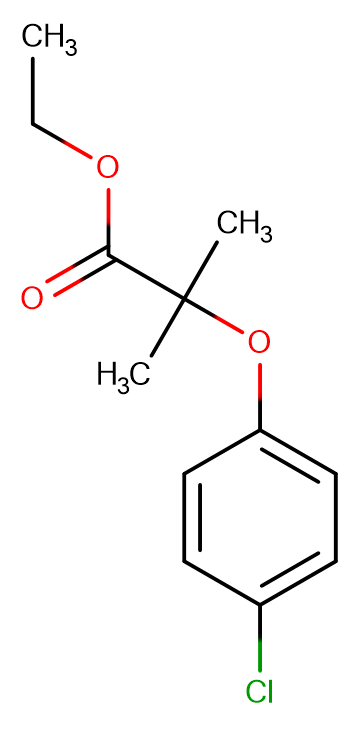
Clofibrate
CAS No. 637-07-0
Clofibrate( ICI 28257 | NSC 79389 )
Catalog No. M15417 CAS No. 637-07-0
Clofibrate (Atromid-S), a fibric acid derivative used in the treatment of hyperlipoproteinemia type III and severe hypertriglyceridemia.
Purity : >98% (HPLC)
 COA
Datasheet
HNMR
HPLC
MSDS
Handing Instructions
COA
Datasheet
HNMR
HPLC
MSDS
Handing Instructions
| Size | Price / USD | Stock | Quantity |
| 1 mL x 10 mM in DMSO | 46 | In Stock |


|
| 100MG | Get Quote | In Stock |
|
| 200MG | 28 | In Stock |
|
| 500MG | 41 | In Stock |
|
| 1G | 49 | In Stock |
|
Biological Information
-
Product NameClofibrate
-
NoteResearch use only, not for human use.
-
Brief DescriptionClofibrate (Atromid-S), a fibric acid derivative used in the treatment of hyperlipoproteinemia type III and severe hypertriglyceridemia.
-
DescriptionClofibrate (Atromid-S), a fibric acid derivative used in the treatment of hyperlipoproteinemia type III and severe hypertriglyceridemia.(In Vitro):Clofibrate is a PPAR agonist, with E50s of 50 μM, ~500 μM for murine PPARα and PPARγ, and 55 μM, ~500 μM for human PPARα and PPARγ, respectively. Clofibrate (0.5, 1, 2 mM) increases FABP1 expression in two fatty acid (FA)-treated rat hepatoma cells. Clofibrate lowers ROS levels after early treatment, much more than late treatment in FA-treated cells.(In Vivo):Clofibrate (0.5%) up-regulates serum concentrations and hepatic expression of FGF21 in fetuses, with a return to basal levels after Clofibrate administration withdrawal. Clofibrate administration-offspring have significantly higher expression of thermogenic genes (Ucp1, Cidea, Ppara Ppargc1a, Cpt1b) and UCP1 protein levels in response to HFD in inguinal fat, but not in retroperitoneal (combined with perirenal) or epididymal fat.
-
In VitroClofibrate is a PPAR agonist, with E50s of 50 μM, ~500 μM for murine PPARα and PPARγ, and 55 μM, ~500 μM for human PPARα and PPARγ, respectively. Clofibrate (0.5, 1, 2 mM) increases FABP1 expression in two fatty acid (FA)-treated rat hepatoma cells. Clofibrate lowers ROS levels after early treatment, much more than late treatment in FA-treated cells.
-
In VivoClofibrate (0.5%) up-regulates serum concentrations and hepatic expression of FGF21 in fetuses, with a return to basal levels after Clofibrate administration withdrawal. Clofibrate administration-offspring have significantly higher expression of thermogenic genes (Ucp1, Cidea, Ppara Ppargc1a, Cpt1b) and UCP1 protein levels in response to HFD in inguinal fat, but not in retroperitoneal (combined with perirenal) or epididymal fat.
-
SynonymsICI 28257 | NSC 79389
-
PathwayMetabolic Enzyme/Protease
-
TargetPPAR
-
RecptorPPARα
-
Research AreaCardiovascular Disease
-
Indication——
Chemical Information
-
CAS Number637-07-0
-
Formula Weight242.7
-
Molecular FormulaC12H15ClO3
-
Purity>98% (HPLC)
-
SolubilityDMSO: 7 mg/mL; Water: <1 mg/mL
-
SMILESCCOC(=O)C(C)(C)OC1=CC=C(Cl)C=C1
-
Chemical Name——
Shipping & Storage Information
-
Storage(-20℃)
-
ShippingWith Ice Pack
-
Stability≥ 2 years
Reference
1.Casas F, et al. FEBS Lett. 2000, 478(1-2):4-8.
molnova catalog



related products
-
XAV939
XAV-939 selectively inhibits Wnt/β-catenin-mediated transcription through tankyrase1/2 inhibition with IC50 of 11 nM/4 nM in cell-free assays.
-
Nuciferine
Nuciferine is an alkaloid found within the plants Nymphaea caerulea and Nelumbo nucifera.
-
Troglitazone
A PPARγ activator that has antidiabetic, anti-tumor and anti-inflammatory activities.
