


 Cart
Cart
 sales@molnova.com


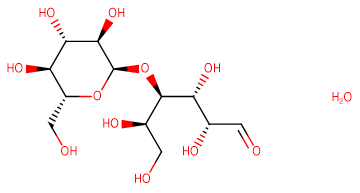
D-(+)-Maltose monohydrate
CAS No. 6363-53-7
D-(+)-Maltose monohydrate( —— )
Catalog No. M15411 CAS No. 6363-53-7
A dextrodisaccharide from malt and starch. It is used as a sweetening agent and fermentable intermediate in brewing.
Purity : >98% (HPLC)
 COA
Datasheet
HNMR
HPLC
MSDS
Handing Instructions
COA
Datasheet
HNMR
HPLC
MSDS
Handing Instructions
| Size | Price / USD | Stock | Quantity |
| 100MG | Get Quote | In Stock |


|
| 200MG | Get Quote | In Stock |
|
| 500MG | Get Quote | In Stock |
|
| 1G | Get Quote | In Stock |
|
Biological Information
-
Product NameD-(+)-Maltose monohydrate
-
NoteResearch use only, not for human use.
-
Brief DescriptionA dextrodisaccharide from malt and starch. It is used as a sweetening agent and fermentable intermediate in brewing.
-
DescriptionA dextrodisaccharide from malt and starch. It is used as a sweetening agent and fermentable intermediate in brewing.
-
In Vitro——
-
In Vivo——
-
Synonyms——
-
PathwayOthers
-
TargetOther Targets
-
RecptorOthers
-
Research Area——
-
Indication——
Chemical Information
-
CAS Number6363-53-7
-
Formula Weight360.31
-
Molecular FormulaC12H22011·H2O
-
Purity>98% (HPLC)
-
SolubilitySoluble in Water
-
SMILESC([C@@H]1[C@H]([C@@H]([C@H]([C@H](O1)O[C@H]([C@@H](CO)O)[C@@H]([C@H](C=O)O)O)O)O)O)O.O
-
Chemical Name——
Shipping & Storage Information
-
Storage(-20℃)
-
ShippingWith Ice Pack
-
Stability≥ 2 years
Reference
1.Sugawara K, et al. Anal Chim Acta. 2014 Mar 3;814:55-62.
molnova catalog



related products
-
AU-224
AU-224 is an orally available benzamide derivative that is a potent gastrointestinal prokinetic.
-
naphthalene-1,3,6,8-...
The pentaketide 1,3,6,8-tetrahydroxynaphthalene (T4HN) is a key precursor of 1,8-dihydroxynaphthalene-melanin.
-
Trans-Chrysanthemyl ...
Trans-Chrysanthemyl Alcohol is a natural product.
