


 Cart
Cart
 sales@molnova.com


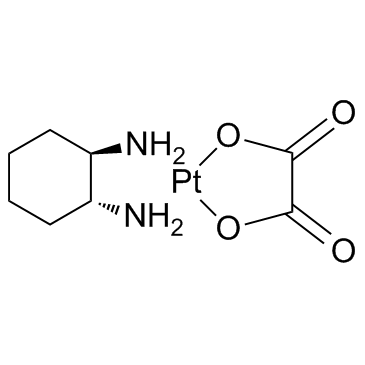
Oxaliplatin
CAS No. 61825-94-3
Oxaliplatin( Dacplat | Eloxatin? | Elplat | Lipoxal | NSC 266046 | RP 54780 )
Catalog No. M15339 CAS No. 61825-94-3
A platinum-based antineoplastic agent that works by blocking the duplication of DNA; forms both inter- and intra-strand cross links in DNA, prevents DNA replication and transcription, causing cell death.
Purity : >98% (HPLC)
 COA
Datasheet
HNMR
HPLC
MSDS
Handing Instructions
COA
Datasheet
HNMR
HPLC
MSDS
Handing Instructions
| Size | Price / USD | Stock | Quantity |
| 50MG | 45 | In Stock |


|
| 100MG | 61 | In Stock |
|
| 200MG | 105 | In Stock |
|
| 500MG | 125 | In Stock |
|
| 1G | Get Quote | In Stock |
|
Biological Information
-
Product NameOxaliplatin
-
NoteResearch use only, not for human use.
-
Brief DescriptionA platinum-based antineoplastic agent that works by blocking the duplication of DNA; forms both inter- and intra-strand cross links in DNA, prevents DNA replication and transcription, causing cell death.
-
DescriptionA platinum-based antineoplastic agent that works by blocking the duplication of DNA; forms both inter- and intra-strand cross links in DNA, prevents DNA replication and transcription, causing cell death.Chemotherapeutic Agents Approved(In Vitro):Oxaliplatin (24-72 hours; 2-128 μM; HCC, HCCLM3 and Hep3B cells) inhibits cell growth and induces apoptosis.Oxaliplatin (10 μM; 15-240 mins; CEM cells ) induces primary and secondary DNA lesions, including DNA cross-links (ISC) and DNA-protein cross-links (DPC).Oxaliplatin (0.01 to 100 μM; 24 hours) potently inhibits bladder carcinoma cell lines RT4 and TCCSUP, ovarian carcinoma cell line A2780, colon carcinoma cell line HT-29, glioblastoma cell lines U-373MG and U-87MG, and melanoma cell lines SK-MEL-2 and HT-144 with IC50 of 11 μM, 15 μM, 0.17 μM, 0.97 μM, 2.95 μM, 17.6 μM, 30.9 μM and 7.85 μM, respectively.(In Vivo):Oxaliplatin (5-10 mg/kg; i.p.; for 32 days; nude mice) inhibits tumor growth.
-
In VitroCell Viability Assay Cell Line:HCC, HCCLM3 and Hep3B cells Concentration:24, 48 and 72 hours Incubation Time:2, 4, 8, 16, 32, 64 and 128 μM Result:Decreased cell viability in a dose- and time-dependent manner.Cell Cycle AnalysisCell Line:HCCLM3 and Hep3B cells Concentration:10 μM Incubation Time:24 hours Result:Increased the percentage of apoptotic cells (17.70% for HCCLM3 cells; 21.19% for Hep3B cells).Cell Cycle Analysis Cell Line:HCCLM3 cells Concentration:10 μM Incubation Time:48 hours Result:Down-regulated the expression of Bcl-2 and Bcl-xL, and increased the expression of Bax.
-
In VivoAnimal Model:Nude mice Dosage:5 and 10 mg/kg Administration:Intraperitoneal injection; for 32 days Result:Reduced tumor volume in HCCLM3 tumor xenografts.
-
SynonymsDacplat | Eloxatin? | Elplat | Lipoxal | NSC 266046 | RP 54780
-
PathwayCell Cycle/DNA Damage
-
TargetDNA Alkylator
-
RecptorDNAsynthesis
-
Research AreaCancer
-
IndicationChemotherapeutic
Chemical Information
-
CAS Number61825-94-3
-
Formula Weight397.2917
-
Molecular FormulaC8H14N2O4Pt
-
Purity>98% (HPLC)
-
SolubilityDMSO: 32 mg/mL (Need ultrasonic)
-
SMILESO=C1[O-][Pt+2]2([O-]C1=O)[NH2]C3CCCCC3[NH2]2
-
Chemical NamePlatinum, [(1R,2R)-1,2-cyclohexanediamine-κN1,κN2][ethanedioato(2-)-κO1,κO2]-, (SP-4-2)-
Shipping & Storage Information
-
Storage(-20℃)
-
ShippingWith Ice Pack
-
Stability≥ 2 years
Reference
molnova catalog



related products
-
Thio-TEPA
An alkylating agent used to treat cancer that has been previously used in the palliation of a wide variety of neoplastic diseases.
-
OBI-3424
OBI-3424 (AST-3424, TH-3424) is a first-in-class, novel prodrug that selectively targets cancers overexpressing the enzyme AKR1C3, OBI-3424 is a highly selective prodrug that is converted by AKR1C3 to a DNA alkylating agent.
-
Methyl methanesulfon...
Methyl methanesulfonate is a DNA alkylator that modifies adenine (3-methyladenine) and guanine (7-methyladenine) respectively, resulting in base mismatch and replication disorders.
