


 Cart
Cart
 sales@molnova.com


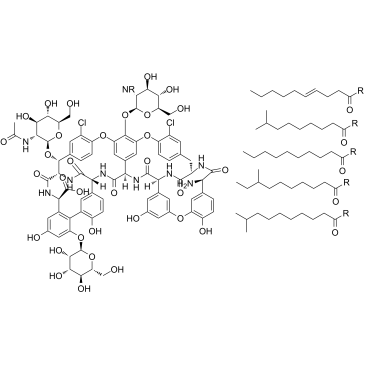
Teicoplanin
CAS No. 61036-62-2
Teicoplanin( Antibiotic 8327A | Antibiotic MDL 507 | MDL 507 )
Catalog No. M15294 CAS No. 61036-62-2
Teicoplanin is a semisynthetic glycopeptide antibiotic used in the prophylaxis and treatment of serious infections caused by Gram-positive bacteria.
Purity : >98% (HPLC)
 COA
Datasheet
HNMR
HPLC
MSDS
Handing Instructions
COA
Datasheet
HNMR
HPLC
MSDS
Handing Instructions
| Size | Price / USD | Stock | Quantity |
| 25MG | 42 | In Stock |


|
| 50MG | 55 | In Stock |
|
| 100MG | 83 | In Stock |
|
| 200MG | Get Quote | In Stock |
|
| 500MG | Get Quote | In Stock |
|
| 1G | Get Quote | In Stock |
|
Biological Information
-
Product NameTeicoplanin
-
NoteResearch use only, not for human use.
-
Brief DescriptionTeicoplanin is a semisynthetic glycopeptide antibiotic used in the prophylaxis and treatment of serious infections caused by Gram-positive bacteria.
-
DescriptionTeicoplanin is a semisynthetic glycopeptide antibiotic used in the prophylaxis and treatment of serious infections caused by Gram-positive bacteria, including Methicillin-resistant Staphylococcus aureus and Enterococcus faecalis.
-
In Vitro——
-
In VivoAnimal Model:20-30 g, Male CD1 mice (2?*?106 cfu/mL MRSA (43?300) 50 μL; murine thigh infection model)Dosage:10, 30 mg/kg Administration:I.v.; once every 12?h Result:Showed a dose-dependent decline in the total bacterial density with the total bactericidal effect was achieved with dosages of ≥10?mg/kg/day and suppression of resistance with dosages ≥30?mg/kg/day.
-
SynonymsAntibiotic 8327A | Antibiotic MDL 507 | MDL 507
-
PathwayOthers
-
TargetOther Targets
-
RecptorOthers
-
Research AreaInfection
-
Indication——
Chemical Information
-
CAS Number61036-62-2
-
Formula Weight1709.39
-
Molecular FormulaC77H77N5O31CI2R
-
Purity>98% (HPLC)
-
SolubilityWater: 100 mg/mL (58.5 mM)
-
SMILESCCCCCCCCC/C(O)=N/[C@]([C@@](OC1=C2C=C([C@](/N=C(O)\[C@](/N=C(O)/[C@@](/N=C(O)\[C@@](N)([H])C3=CC4=C(O)C=C3)([H])CC5=CC(Cl)=C(O2)C=C5)([H])C6=CC(O)=CC(O4)=C6)([H])/C(O)=N/[C@](/C(O)=N/7)([H])C8=CC(C9=C([C@@]%10([H])C(O)=O)C=C(O)C=C9OC%11([H])[C@](O)([H])[C@](O)([H])[C@@](O)([H])[C@@](O%11)([H])CO)=C(O)C=C8)C=C1OC%12=C(Cl)C=C([C@](O[C@@]%13([H])[C@@](/N=C(O)/C)([H])[C@](O)([H])[C@@](O)([H])[C@@](O%13)([H])CO)([H])[C@@]7([H])/C(O)=N/%10)C=C%12)([H])O%14)([H])[C@](O)([H])[C@@](O)([H])[C@@]%14([H])CO
-
Chemical Name34-O-[2-(acetylamino)-2-deoxy-.beta.-D-glucopyranosyl]-22,31-dichloro-7-demethyl-64-O-demethyl-19-deoxy-56-O-[2-deoxy-2-[(8-methyl-1-oxononyl)amino]-.beta.-D-glucopyranosyl]-42-O-.alpha.-D-mannopyranosyl-
Shipping & Storage Information
-
Storage(-20℃)
-
ShippingWith Ice Pack
-
Stability≥ 2 years
Reference
1.Bereczki I, et al. Bioorg Med Chem Lett. 2014 Aug 1;24(15):3251-4.
molnova catalog



related products
-
Poriol
Poriol is a natural product from Cephalotaxus sinensis.
-
Bradykinin [Des-Arg1...
Bradykinin [Des-Arg1]
-
Entero-Kassinin
Entero-Kassinin
