


 Cart
Cart
 sales@molnova.com


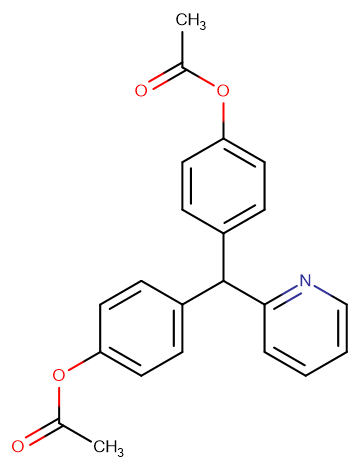
Bisacodyl
CAS No. 603-50-9
Bisacodyl( Bisacodyl, Durolax, Dulcolax, Fenilaxan, Neolax, Ulcolax )
Catalog No. M15257 CAS No. 603-50-9
Bisacodyl (INN) is a stimulant laxative drug that works directly on the colon to produce a bowel movement.
Purity : >98% (HPLC)
 COA
Datasheet
HNMR
HPLC
MSDS
Handing Instructions
COA
Datasheet
HNMR
HPLC
MSDS
Handing Instructions
| Size | Price / USD | Stock | Quantity |
| 1 mL x 10 mM in DMSO | 44 | In Stock |


|
| 100MG | Get Quote | In Stock |
|
| 200MG | Get Quote | In Stock |
|
| 500MG | 39 | In Stock |
|
| 1G | Get Quote | In Stock |
|
Biological Information
-
Product NameBisacodyl
-
NoteResearch use only, not for human use.
-
Brief DescriptionBisacodyl (INN) is a stimulant laxative drug that works directly on the colon to produce a bowel movement.
-
DescriptionBisacodyl (INN) is a stimulant laxative drug that works directly on the colon to produce a bowel movement.(In Vivo):Bisacodyl (20 mg/kg) results in a decrease in AQP3 protein expression and increased mRNA expression level of TNF-α in the colon of rats . Bisacodyl inhibits water absorption in rat jejunum, ileum, and colon, the degree of inhibition is linearly related to the logarithm of the bisacodyl concentration over the range of 0.05 mg to 2.0 mg per 100 mL . Bisacodyl (10 mg/kg, intragastrically) induces a significant decrease in jejunal NOS activity in rats. Bisacodyl (10 mg/kg, intragastrically) increases the distance traveled by the marker in all time periods . Bisacodyl (5.9 mg/kg) decreases significantly jejunal and colonic (Na + K) ATPase activity as compared to saline-treated rats. Bisacodyl (5.9 mg/kg) increases significantly jejunal and colonic PGE2 content and stimulates jejunal and colonic adenyl cyclase activity as compared to those in control rats without affecting cAMP content . Bisacodyl (4.3 mg/kg) coupled with AOM increases the number of crypt per focus, but not the number of tumors in rats. Bisacodyl (43 mg/kg) significantly increases the number of crypt per focus and tumors in rats .
-
In Vitro——
-
In VivoBisacodyl (20 mg/kg) results in a decrease in AQP3 protein expression and increased mRNA expression level of TNF-α in the colon of rats . Bisacodyl inhibits water absorption in rat jejunum, ileum, and colon, the degree of inhibition is linearly related to the logarithm of the bisacodyl concentration over the range of 0.05 mg to 2.0 mg per 100 mL . Bisacodyl (10 mg/kg, intragastrically) induces a significant decrease in jejunal NOS activity in rats. Bisacodyl (10 mg/kg, intragastrically) increases the distance traveled by the marker in all time periods . Bisacodyl (5.9 mg/kg) decreases significantly jejunal and colonic (Na + K) ATPase activity as compared to saline-treated rats. Bisacodyl (5.9 mg/kg) increases significantly jejunal and colonic PGE2 content and stimulates jejunal and colonic adenyl cyclase activity as compared to those in control rats without affecting cAMP content . Bisacodyl (4.3 mg/kg) coupled with AOM increases the number of crypt per focus, but not the number of tumors in rats. Bisacodyl (43 mg/kg) significantly increases the number of crypt per focus and tumors in rats .
-
SynonymsBisacodyl, Durolax, Dulcolax, Fenilaxan, Neolax, Ulcolax
-
PathwayOthers
-
TargetOther Targets
-
RecptorOthers
-
Research AreaMetabolic Disease
-
Indication——
Chemical Information
-
CAS Number603-50-9
-
Formula Weight361.39
-
Molecular FormulaC22H19NO4
-
Purity>98% (HPLC)
-
SolubilityDMSO: 72 mg/mL (199.23 mM)
-
SMILESCC(OC1=CC=C(C(C2=CC=C(OC(C)=O)C=C2)C3=NC=CC=C3)C=C1)=O
-
Chemical Name(pyridin-2-ylmethylene)bis(4,1-phenylene) diacetate
Shipping & Storage Information
-
Storage(-20℃)
-
ShippingWith Ice Pack
-
Stability≥ 2 years
Reference
1.Ikarashi N, et al. Am J Physiol Gastrointest Liver Physiol, 2011, 301(5), G887-895.
molnova catalog



related products
-
Lys-(Ala3)-Bradykini...
Lys-(Ala3)-Bradykinin
-
TRi-1
TRi-1 is irreversible inhibitor of?cytosolic thioredoxin reductase 1 (TXNRD1) with an?IC50?of 12 nM. TRi-1 has little mitochondrial toxicity for anticancer therapy.
-
β-Amyloid (16-26)
β-Amyloid (16-26)
