


 Cart
Cart
 sales@molnova.com


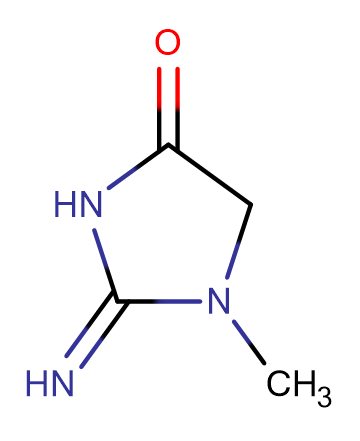
Creatinine
CAS No. 60-27-5
Creatinine( Creatinine | NSC 13123 | NSC-13123 | NSC13123 )
Catalog No. M15248 CAS No. 60-27-5
Creatinine is a break-down product of creatine phosphate in muscle, and is usually produced at a fairly constant rate by the body.
Purity : >98% (HPLC)
 COA
Datasheet
HNMR
HPLC
MSDS
Handing Instructions
COA
Datasheet
HNMR
HPLC
MSDS
Handing Instructions
| Size | Price / USD | Stock | Quantity |
| 1 mL x 10 mM in DMSO | 44 | In Stock |


|
| 100MG | Get Quote | In Stock |
|
| 200MG | Get Quote | In Stock |
|
| 500MG | 39 | In Stock |
|
| 1G | 47 | In Stock |
|
Biological Information
-
Product NameCreatinine
-
NoteResearch use only, not for human use.
-
Brief DescriptionCreatinine is a break-down product of creatine phosphate in muscle, and is usually produced at a fairly constant rate by the body.
-
DescriptionCreatinine is a break-down product of creatine phosphate in muscle, and is usually produced at a fairly constant rate by the body.
-
In Vitro——
-
In Vivo——
-
SynonymsCreatinine | NSC 13123 | NSC-13123 | NSC13123
-
PathwayOthers
-
TargetOther Targets
-
RecptorOthers
-
Research AreaMetabolic Disease
-
Indication——
Chemical Information
-
CAS Number60-27-5
-
Formula Weight113.12
-
Molecular FormulaC4H7N3O
-
Purity>98% (HPLC)
-
SolubilityWater: 23 mg/mL (203.32 mM)
-
SMILESO=C(CN1C)NC1=N
-
Chemical Name2-Imino-1-methylimidazolidin-4-one
Shipping & Storage Information
-
Storage(-20℃)
-
ShippingWith Ice Pack
-
Stability≥ 2 years
Reference
1.Allen PJ, et al. Neurosci Biobehav Rev, 2012, 36(5), 1442-1462.
molnova catalog



related products
-
IR-783
IR 783 is a heptamethine cyanine fluorescent probe for in vivo imaging of tumor cells.
-
L-Threonine derivati...
L-Threonine derivative-1 is acetylsalicylic acid-L-threonine ester with potential analgesic activity.
-
1H-Tetrazole-1-aceti...
1H-Tetrazole-1-acetic acid is a chemical compound.
