


 Cart
Cart
 sales@molnova.com


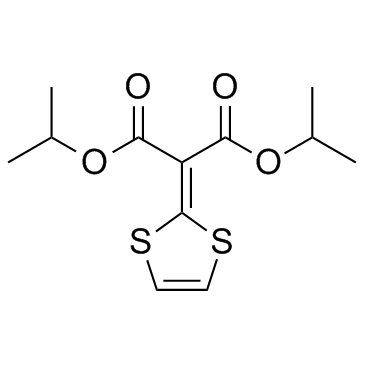
Malotilate
CAS No. 59937-28-9
Malotilate( Malotilate | CL-1500 | NKK 105 | NKK-105 )
Catalog No. M15231 CAS No. 59937-28-9
Malotilate, diisopropyl 1,3-dithiol-2-ylidenemalonate, is a drug used for the treatment of liver cirrhosis.
Purity : >98% (HPLC)
 COA
Datasheet
HNMR
HPLC
MSDS
Handing Instructions
COA
Datasheet
HNMR
HPLC
MSDS
Handing Instructions
| Size | Price / USD | Stock | Quantity |
| 1 mL x 10 mM in DMSO | 28 | In Stock |


|
| 10MG | 29 | In Stock |
|
| 25MG | 46 | In Stock |
|
| 50MG | 63 | In Stock |
|
| 100MG | 91 | In Stock |
|
| 200MG | Get Quote | In Stock |
|
| 500MG | 221 | In Stock |
|
| 1G | Get Quote | In Stock |
|
Biological Information
-
Product NameMalotilate
-
NoteResearch use only, not for human use.
-
Brief DescriptionMalotilate, diisopropyl 1,3-dithiol-2-ylidenemalonate, is a drug used for the treatment of liver cirrhosis.
-
DescriptionMalotilate, diisopropyl 1,3-dithiol-2-ylidenemalonate, is a drug used for the treatment of liver cirrhosis.(In Vitro):Malotilate reduces collagen synthesis and cell migration activity of fibroblasts in vitro.Malotilate, an anti-fibrotic substance, selectively inhibited the 5-lipoxygenase, whereas both the 12- and the 15-lipoxygenase pathways are stimulated. Malotilate has been shown to prevent acute experimental liver injury induced by several hepatotoxic compounds, including Ahyl alcohot, Bromobenzene, Carbon tetrachloride, ChIoroform, Dimethylnitrosamine and Thioacetamide.(In Vivo):Malotilate (100 mg/kg; p.o.; daily for 3 days) treatment in rats with hypocholesterolemia results in a rapid normalization of lowered serum cholesterol.
-
In VitroMalotilate reduces collagen synthesis and cell migration activity of fibroblasts in vitro.Malotilate, an anti-fibrotic substance, selectively inhibited the 5-lipoxygenase, whereas both the 12- and the 15-lipoxygenase pathways are stimulated. Malotilate has been shown to prevent acute experimental liver injury induced by several hepatotoxic compounds, including Ahyl alcohot, Bromobenzene, Carbon tetrachloride, ChIoroform, Dimethylnitrosamine and Thioacetamide.
-
In VivoMalotilate (100 mg/kg; p.o.; daily for 3 days) treatment in rats with hypocholesterolemia results in a rapid normalization of lowered serum cholesterol. Animal Model:Male rats of the SLC-SD strain (rats with carbon tetrachloride-induced liver damage)Dosage:100 mg/kg Administration:P.o.; daily for 3 days Result:The triglyceride secretion from livers in rats given CCI4 was inhibited to about 40% of the level in the control rats. This inhibition of the triglyceride secretion was completely normalized in response to malotilate administration for 3 days.
-
SynonymsMalotilate | CL-1500 | NKK 105 | NKK-105
-
PathwayOthers
-
TargetOther Targets
-
RecptorOthers
-
Research AreaCancer
-
Indication——
Chemical Information
-
CAS Number59937-28-9
-
Formula Weight288.38
-
Molecular FormulaC12H16O4S2
-
Purity>98% (HPLC)
-
SolubilityEthanol: 58 mg/mL (201.12 mM); DMSO: 58 mg/mL (201.12 mM)
-
SMILESO=C(OC(C)C)/C(C(OC(C)C)=O)=C1SC=CS/1
-
Chemical Name1,3-Dithiol-2-ylidenepropanedioic acid, bis(1-methylethyl) ester
Shipping & Storage Information
-
Storage(-20℃)
-
ShippingWith Ice Pack
-
Stability≥ 2 years
Reference
1.Ohgoda O, et al. J Dermatol Sci, 1998, 17(2), 123-13
molnova catalog



related products
-
Folcisteine
Folcisteine is a plant growth regulator.
-
[Ala4] - MBP (1 - 11...
[Ala4] - MBP (1 - 11)
-
Dihydroconfertin
The herbs of Inula hupehensis.
