


 Cart
Cart
 sales@molnova.com


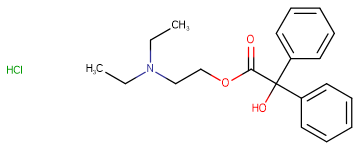
Benactyzine hydrochloride
CAS No. 57-37-4
Benactyzine hydrochloride( —— )
Catalog No. M15094 CAS No. 57-37-4
Benactyzine hydrochloride is a centrally acting muscarinic antagonist.
Purity : >98% (HPLC)
 COA
Datasheet
HNMR
HPLC
MSDS
Handing Instructions
COA
Datasheet
HNMR
HPLC
MSDS
Handing Instructions
| Size | Price / USD | Stock | Quantity |
| 1 mL x 10 mM in DMSO | 43 | In Stock |


|
| 100MG | 38 | In Stock |
|
| 200MG | 55 | In Stock |
|
| 500MG | Get Quote | In Stock |
|
| 1G | Get Quote | In Stock |
|
Biological Information
-
Product NameBenactyzine hydrochloride
-
NoteResearch use only, not for human use.
-
Brief DescriptionBenactyzine hydrochloride is a centrally acting muscarinic antagonist.
-
DescriptionBenactyzine hydrochloride is a centrally acting muscarinic antagonist. Benactyzine has been used in the treatment of depression and is used in research to investigate the role of cholinergic systems on behavior.(In Vitro):Benactyzine hydrochloride and drofenine are widely used anticholinergic drugs which are also competitive inhibitors of BChE with Ki values of 0.010±0.001 and 0.003±0.000 mM, respectively. Results indicate that the inhibition of BChE by Benactyzine hydrochloride is pure or partial competitive. Pure competitive inhibition can be distinguished from partial competitive inhibition by plotting v vs [Benactyzine] at a fixed [BTCh].(In Vivo):Benactyzine hydrochloride (1 mg/kg) does not influence the attention response. Benactyzine hydrochloride increases the duration of the exploratory-motor reaction, but slightly diminishes the salivation elicited by acetylcholine. There is no blocking effect of Benactyzine hydrochloride and promazine on the EEG-seizure activity elicited by acetylcholine, and almost no inhibitory effect on emotional reactions. Emotional reactions are blocked by high doses of imipramine and promazine, but not by Benactyzine hydrochloride. The data indicates that imipramine, promazine and Benactyzine hydrochloride influence the autonomic effects of serotonin in different ways. Promazine, and especially Benactyzine hydrochloride, inhibit and shorten the period of salivation elicited by the intra-amygdaloid injection of serotonin.
-
In VitroBenactyzine hydrochloride and drofenine are widely used anticholinergic drugs which are also competitive inhibitors of BChE with Ki values of 0.010±0.001 and 0.003±0.000 mM, respectively. Results indicate that the inhibition of BChE by Benactyzine hydrochloride is pure or partial competitive. Pure competitive inhibition can be distinguished from partial competitive inhibition by plotting v vs [Benactyzine] at a fixed [BTCh].
-
In VivoBenactyzine hydrochloride (1 mg/kg) does not influence the attention response. Benactyzine hydrochloride increases the duration of the exploratory-motor reaction, but slightly diminishes the salivation elicited by acetylcholine. There is no blocking effect of Benactyzine hydrochloride and promazine on the EEG-seizure activity elicited by acetylcholine, and almost no inhibitory effect on emotional reactions. Emotional reactions are blocked by high doses of imipramine and promazine, but not by Benactyzine hydrochloride. The data indicates that imipramine, promazine and Benactyzine hydrochloride influence the autonomic effects of serotonin in different ways. Promazine, and especially Benactyzine hydrochloride, inhibit and shorten the period of salivation elicited by the intra-amygdaloid injection of serotonin.
-
Synonyms——
-
PathwayEndocrinology/Hormones
-
TargetAChR
-
RecptormAChR
-
Research Area——
-
Indication——
Chemical Information
-
CAS Number57-37-4
-
Formula Weight363.88
-
Molecular FormulaC20H26ClNO3
-
Purity>98% (HPLC)
-
SolubilityDMSO: 10 mM
-
SMILESCl.CCN(CC)CCOC(=O)C(O)(C1=CC=CC=C1)C1=CC=CC=C1
-
Chemical Name——
Shipping & Storage Information
-
Storage(-20℃)
-
ShippingWith Ice Pack
-
Stability≥ 2 years
Reference
1.Amitai G, et al. Mol Pharmacol. 1987 Nov;32(5):678-85.
molnova catalog



related products
-
CGS 15943
CGS 15943 is an orally bioavailable non-xanthine antagonist of Adenosine Receptor.
-
Ribavirin
Ribavirin is a nucleoside antimetabolite antiviral agent that blocks nucleic acid synthesis and is used against both RNA and DNA viruses.
-
AVex-73
AVex-73 is a muscarinic M1 agonist potentially for the treatment of Alzheimer's disease.
