


 Cart
Cart
 sales@molnova.com


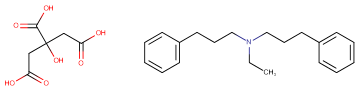
Alverine citrate
CAS No. 5560-59-8
Alverine citrate( NSC 35459 )
Catalog No. M15021 CAS No. 5560-59-8
Alverine Citrate(NSC35459) is a drug used for functional gastrointestinal disorders.
Purity : >98% (HPLC)
 COA
Datasheet
HNMR
HPLC
MSDS
Handing Instructions
COA
Datasheet
HNMR
HPLC
MSDS
Handing Instructions
| Size | Price / USD | Stock | Quantity |
| 1 mL x 10 mM in DMSO | 42 | In Stock |


|
| 100MG | Get Quote | In Stock |
|
| 200MG | Get Quote | In Stock |
|
| 500MG | 37 | In Stock |
|
| 1G | 52 | In Stock |
|
Biological Information
-
Product NameAlverine citrate
-
NoteResearch use only, not for human use.
-
Brief DescriptionAlverine Citrate(NSC35459) is a drug used for functional gastrointestinal disorders.
-
DescriptionAlverine Citrate(NSC35459) is a drug used for functional gastrointestinal disorders.(In Vitro):Alverine is a drug used for functional gastrointestinal disorders. Alverine acts directly on the muscle in the gut, causing it to relax. Alverine Citrate (20 mg/kg) suppresses the effect of 5-HTP, but not that of 8-OH-DPAT. However, when injected intracerebroventricularly (75 μg/rat) alverine citrate reduces 8-OH-DPAT-induced enhancement of rectal distension-induced abdominal contractions. In-vitro binding studies reveal that Alverine citrate has a high affinity for 5-HT1A receptors and a weak affinity for 5-HT3 and 5-HT4 subtypes. Alverine may increase Ca influx during action potentials due to inhibition of the inactivation of L-type Ca channels, but may also suppress evoked activity by inhibiting the sensitivity of contractile proteins to Ca2+.
-
In VitroAlverine is a drug used for functional gastrointestinal disorders. Alverine acts directly on the muscle in the gut, causing it to relax. Alverine Citrate (20 mg/kg) suppresses the effect of 5-HTP, but not that of 8-OH-DPAT. However, when injected intracerebroventricularly (75 μg/rat) alverine citrate reduces 8-OH-DPAT-induced enhancement of rectal distension-induced abdominal contractions. In-vitro binding studies reveal that Alverine citrate has a high affinity for 5-HT1A receptors and a weak affinity for 5-HT3 and 5-HT4 subtypes. Alverine may increase Ca influx during action potentials due to inhibition of the inactivation of L-type Ca channels, but may also suppress evoked activity by inhibiting the sensitivity of contractile proteins to Ca2+.
-
In Vivo——
-
SynonymsNSC 35459
-
PathwayEndocrinology/Hormones
-
Target5-HT Receptor
-
Recptor5-HT
-
Research AreaMetabolic Disease
-
Indication——
Chemical Information
-
CAS Number5560-59-8
-
Formula Weight473.57
-
Molecular FormulaC26H35NO7
-
Purity>98% (HPLC)
-
SolubilityDMSO: 95 mg/mL (200.6 mM)
-
SMILESOC(=O)CC(O)(CC(O)=O)C(O)=O.CCN(CCCC1=CC=CC=C1)CCCC1=CC=CC=C1
-
Chemical Name——
Shipping & Storage Information
-
Storage(-20℃)
-
ShippingWith Ice Pack
-
Stability≥ 2 years
Reference
1.Coelho AM, et al. J Pharm Pharmacol. 2001 Oct; 53(10):1419-26.
molnova catalog



related products
-
Nefazodone hydrochlo...
Nefazodone hydrochloride is an antidepressant drug.
-
AVN492
AVN-492 is a potent and selective 5-HT6R Antagonist (Ki:?91 pM).
-
Chlorpromazine hydro...
Chlorpromazine hydrochloride is a dopamine and potassium channel inhibitor used as the prototypical phenothiazine antipsychotic drug.
