


 Cart
Cart
 sales@molnova.com


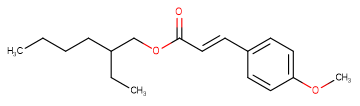
Octyl 4-methoxycinnamate
CAS No. 5466-77-3
Octyl 4-methoxycinnamate( —— )
Catalog No. M14965 CAS No. 5466-77-3
Octinoxate is an organic compound that is an ingredient in some sunscreens and lip balms, primarily used is in sunscreens and other cosmetics to absorb UV-B rays from the sun.
Purity : >98% (HPLC)
 COA
Datasheet
HNMR
HPLC
MSDS
Handing Instructions
COA
Datasheet
HNMR
HPLC
MSDS
Handing Instructions
| Size | Price / USD | Stock | Quantity |
| 100MG | Get Quote | In Stock |


|
| 200MG | Get Quote | In Stock |
|
| 500MG | 38 | In Stock |
|
| 1G | 45 | In Stock |
|
Biological Information
-
Product NameOctyl 4-methoxycinnamate
-
NoteResearch use only, not for human use.
-
Brief DescriptionOctinoxate is an organic compound that is an ingredient in some sunscreens and lip balms, primarily used is in sunscreens and other cosmetics to absorb UV-B rays from the sun.
-
DescriptionOctinoxate is an organic compound that is an ingredient in some sunscreens and lip balms, primarily used is in sunscreens and other cosmetics to absorb UV-B rays from the sun, protecting the skin from damage. It is also used to reduce the appearance of scars.
-
In Vitro——
-
In Vivo——
-
Synonyms——
-
PathwayOthers
-
TargetOther Targets
-
RecptorOthers
-
Research Area——
-
Indication——
Chemical Information
-
CAS Number5466-77-3
-
Formula Weight290.4
-
Molecular FormulaC18H26O3
-
Purity>98% (HPLC)
-
SolubilityDMSO: > 10 mM
-
SMILESCCCCC(CC)COC(=O)/C=C/C1=CC=C(C=C1)OC
-
Chemical Name——
Shipping & Storage Information
-
Storage(-20℃)
-
ShippingWith Ice Pack
-
Stability≥ 2 years
Reference
1.Hayden CG, et al. Skin Pharmacol Physiol. 2005 Jul-Aug;18(4):170-4.
molnova catalog



related products
-
GSK962
GSK962 is a GSK963 inactive enantiomer. It can be used to confirm the on-target effects.
-
Leucokinin I
Leucokinin I
-
HCV Core Protein (19...
PQDVKFP is a synthetic peptide, recognizing antigenic domains within the hepatitis C virus (HCV) core protein.
