


 Cart
Cart
 sales@molnova.com


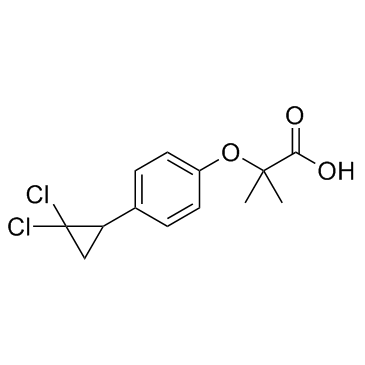
Ciprofibrate
CAS No. 52214-84-3
Ciprofibrate( (±)-Ciprofibrate | WIN 35,833 )
Catalog No. M14841 CAS No. 52214-84-3
Ciprofibrate is a peroxisome proliferator-activated receptor agonist.
Purity : >98% (HPLC)
 COA
Datasheet
HNMR
HPLC
MSDS
Handing Instructions
COA
Datasheet
HNMR
HPLC
MSDS
Handing Instructions
| Size | Price / USD | Stock | Quantity |
| 1 mL x 10 mM in DMSO | 44 | In Stock |


|
| 100MG | 39 | In Stock |
|
| 200MG | Get Quote | In Stock |
|
| 500MG | 91 | In Stock |
|
| 1G | Get Quote | In Stock |
|
Biological Information
-
Product NameCiprofibrate
-
NoteResearch use only, not for human use.
-
Brief DescriptionCiprofibrate is a peroxisome proliferator-activated receptor agonist.
-
DescriptionCiprofibrate is a peroxisome proliferator-activated receptor agonist. It was reported that ciprofibrate decreased the levels of plasma triglycerides and total cholesterol as well as low-density lipoprotein cholesterol. Meanwhile, ciprofibrate elevated plasma levels of high-density lipoprotein cholesterol. (In Vitro):Ciprofibrate (500 μM; 4 hours) increases the PPARa phosphorylation level in rat Fao cells.In a LucLite assay, Ciprofibrate (10-100μM; 24 hours) induces PPARR activation by existing increased LUC activities in the rat liver H4IIEC3 cells transfected with PPRE-AB LUC reporter gene plasmid.Ciprofibrate (10-100 μM; 24 hours) is not cytotoxic for HepG2 cells, and the cell viability is 99.7%.Ciprofibrate (100 μM; 24 hours) also abolishes FFAs mixture-induced lipid deposition and decreases FFAs mixture-increased TG contents in HepG2 cells.Ciprofibrate (100 μM; 24 hours) almost entirely eliminates the FFAs mixture-induced inflammatory cytokines overproduction, including MCP-1, TNF-α, and IL-6 in HepG2 cells.(In Vivo):Ciprofibrate (oral administration; 10 mg/kg/day; 3 days) does not result in any significant effects on body weight or absolute liver weight for MCD diet-fed mice. Ciprofibrate improves hepatic steatosis and reduced hepatic necro-inflammation in MCD diet-fed mice. It also reduced hepatic cytokine protein and mRNA levels (MCP-1, TNFα and IL-6) as compared to those of choline-deficient (MCD) diet-fed mice.
-
In VitroCiprofibrate (500 μM; 4 hours) increases the PPARa phosphorylation level in rat Fao cells.In a LucLite assay, Ciprofibrate (10-100μM; 24 hours) induces PPARR activation by existing increased LUC activities in the rat liver H4IIEC3 cells transfected with PPRE-AB LUC reporter gene plasmid.Ciprofibrate (10-100 μM; 24 hours) is not cytotoxic for HepG2 cells, and the cell viability is 99.7%.Ciprofibrate (100 μM; 24 hours) also abolishes FFAs mixture-induced lipid deposition and decreases FFAs mixture-increased TG contents?in HepG2 cells.Ciprofibrate (100 μM; 24 hours) almost entirely eliminates the FFAs mixture-induced inflammatory cytokines overproduction, including MCP-1, TNF-α, and IL-6 in HepG2 cells.
-
In VivoCiprofibrate (oral administration; 10 mg/kg/day; 3 days) does not result in any significant effects on body weight or absolute liver weight for MCD diet-fed mice. Ciprofibrate improves hepatic steatosis and reduced hepatic necro-inflammation in MCD diet-fed mice. It also reduced hepatic cytokine protein and mRNA levels (MCP-1, TNFα and IL-6) as compared to those of ?choline-deficient (MCD) diet-fed mice. Animal Model:C57BL/6 mice (six-week-old males)Dosage:10 mg/kg Administration:Oral administration; 10 mg/kg/day; 3 days Result:Decreased MCD diet-resulted hepatic steatosis and hepatic necro-inflammation in mice.
-
Synonyms(±)-Ciprofibrate | WIN 35,833
-
PathwayMetabolic Enzyme/Protease
-
TargetPPAR
-
RecptorPPAR
-
Research AreaCancer
-
Indication——
Chemical Information
-
CAS Number52214-84-3
-
Formula Weight289.16
-
Molecular FormulaC13H14Cl2O3
-
Purity>98% (HPLC)
-
SolubilitySoluble in DMSO
-
SMILESCC(C)(OC1=CC=C(C2C(Cl)(Cl)C2)C=C1)C(O)=O
-
Chemical Name2-(4-(2,2-dichlorocyclopropyl)phenoxy)-2-methylpropanoic acid
Shipping & Storage Information
-
Storage(-20℃)
-
ShippingWith Ice Pack
-
Stability≥ 2 years
Reference
1.Domingos H, et al. Arq Bras Cardiol. 2012 Nov;99(5):997-1007.
molnova catalog



related products
-
Hydroxyhexamide
Hydroxyhexamide is a pharmacologically active metabolite of Acetohexamide, used as a hypoglycemic agent.
-
Daltroban
Daltroban (SKF 96148) is a specific thromboxane A2 (TXA2) receptor antagonist. Daltroban shows protective effect in reperfusion injury. Daltroban increase intracellular calcium in vascular smooth muscle cells.
-
Tesaglitazar
Tesaglitazar is a potent and selective peroxide PPARα / γ receptor dual agonist with a more potent affinity for PPARγ than PPARα, The EC50 values for rat PPARα and human PPARα were 13.4 μM and 3.6 μM, respectively, and 0.2 μM for rat PPARγ and human PPARγ.
