


 Cart
Cart
 sales@molnova.com


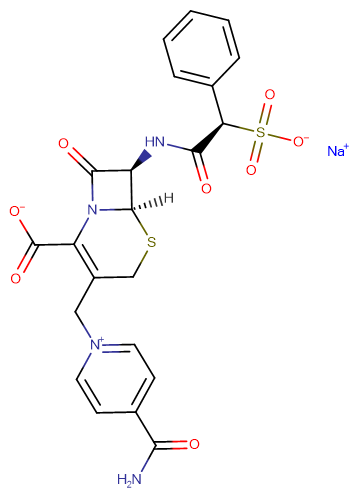
Cefsulodine sodium
CAS No. 52152-93-9
Cefsulodine sodium( —— )
Catalog No. M14833 CAS No. 52152-93-9
Cefsulodin sodium salt hydrate is a third generation β lactam antibiotic and member of the cephems subgroub of antibiotics.
Purity : >98% (HPLC)
 COA
Datasheet
HNMR
HPLC
MSDS
Handing Instructions
COA
Datasheet
HNMR
HPLC
MSDS
Handing Instructions
| Size | Price / USD | Stock | Quantity |
| 1 mL x 10 mM in DMSO | 63 | In Stock |


|
| 25MG | 29 | In Stock |
|
| 50MG | 38 | In Stock |
|
| 100MG | 55 | In Stock |
|
| 200MG | 77 | In Stock |
|
| 500MG | Get Quote | In Stock |
|
| 1G | Get Quote | In Stock |
|
Biological Information
-
Product NameCefsulodine sodium
-
NoteResearch use only, not for human use.
-
Brief DescriptionCefsulodin sodium salt hydrate is a third generation β lactam antibiotic and member of the cephems subgroub of antibiotics.
-
DescriptionCefsulodin sodium salt hydrate is a third generation β lactam antibiotic and member of the cephems subgroub of antibiotics.(In Vitro):Cefsulodin sodium (0.5-64 mg/mL; 18 h) is active in minimum inhibitory concentrations (MICs) of 0.5-64 mg/mL, is about 16- to 32-fold more active than Carbenicillin (HY-B0525) against Psuedomonas aeruginosa.Cefsulodin sodium (8-16 μg/mL; 4.5 h) is not hydrolyzed by the beta-lactamase induced in P. aeruginosa by growth in the presence of benzylpenicillin.(In Vivo):Cefsulodin sodium (1 g/kg/tag; i.p.; 5 d, 9 single doses with intervals of 12 h) shows a increasing excretion of tubule cells in the rat, as a measure of nephrotoxicity, and displays tubule toxic threshold doses of 250 mg/kg (s.c.; 12 d) with nine single doses.
-
In VitroCefsulodin sodium (0.5-64 mg/mL; 18 h) is active in minimum inhibitory concentrations (MICs) of 0.5-64 mg/mL, is about 16- to 32-fold more active than Carbenicillin (HY-B0525) against Psuedomonas aeruginosa.Cefsulodin sodium (8-16 μg/mL; 4.5 h) is not hydrolyzed by the beta-lactamase induced in P. aeruginosa by growth in the presence of benzylpenicillin.
-
In VivoCefsulodin sodium (1 g/kg/tag; i.p.; 5 d, 9 single doses with intervals of 12 h) shows a increasing excretion of tubule cells in the rat, as a measure of nephrotoxicity, and displays tubule toxic threshold doses of 250 mg/kg (s.c.; 12 d) with nine single doses. Animal Model:Female Wistar rats (200 g)Dosage:1000 mg/kg/tag Administration:Intraperitoneal injection; 5 days; nine single doses, with intervals of 12 h (injection volume: 10 mL)Result:Increased in excretion of tubule cells in the 12-hour night urine during five-day treatment.
-
Synonyms——
-
PathwayOthers
-
TargetOther Targets
-
RecptorOthers
-
Research AreaInfection
-
Indication——
Chemical Information
-
CAS Number52152-93-9
-
Formula Weight554.52
-
Molecular FormulaC22H19N4NaO8S2
-
Purity>98% (HPLC)
-
SolubilityDMSO: 10 mM
-
SMILESO=C(C(N12)=C(C[N+]3=CC=C(C(N)=O)C=C3)CS[C@]2([H])[C@H](NC([C@@H](C4=CC=CC=C4)S(=O)([O-])=O)=O)C1=O)[O-].[Na+]
-
Chemical Namesodium (6R,7R)-3-((4-carbamoylpyridin-1-ium-1-yl)methyl)-8-oxo-7-((R)-2-phenyl-2-sulfonatoacetamido)-5-thia-1-azabicyclo[4.2.0]oct-2-ene-2-carboxylate
Shipping & Storage Information
-
Storage(-20℃)
-
ShippingWith Ice Pack
-
Stability≥ 2 years
Reference
1.Sarkar SK, et al. PLoS One. 2012;7(11):e48598.
molnova catalog



related products
-
Collagen Binding Fra...
Collagen binding peptide is a conserved fibronectin peptide.
-
16-O-acetyl-cucurbit...
16-O-acetyl-cucurbitacin F
-
Ac-GRP (20-26) (huma...
Ac-GRP (20-26) (human, porcine, canine)
