


 Cart
Cart
 sales@molnova.com


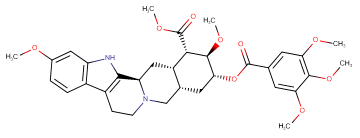
Reserpine
CAS No. 50-55-5
Reserpine( NSC 59272 | NSC 237659 | Rausedil )
Catalog No. M14726 CAS No. 50-55-5
Reserpine (Serpalan) is an indole alkaloid antipsychotic and antihypertensive drug that irreversibly blocks the vesicular monoamine transporter (VMAT).
Purity : >98% (HPLC)
 COA
Datasheet
HNMR
HPLC
MSDS
Handing Instructions
COA
Datasheet
HNMR
HPLC
MSDS
Handing Instructions
| Size | Price / USD | Stock | Quantity |
| 50MG | 32 | In Stock |


|
| 100MG | 47 | In Stock |
|
| 200MG | Get Quote | In Stock |
|
| 500MG | Get Quote | In Stock |
|
| 1G | Get Quote | In Stock |
|
Biological Information
-
Product NameReserpine
-
NoteResearch use only, not for human use.
-
Brief DescriptionReserpine (Serpalan) is an indole alkaloid antipsychotic and antihypertensive drug that irreversibly blocks the vesicular monoamine transporter (VMAT).
-
DescriptionReserpine (Serpalan) is an indole alkaloid antipsychotic and antihypertensive drug that irreversibly blocks the vesicular monoamine transporter (VMAT).(In Vitro):Reserpine is an inhibitor of the vesicular monoamine transporter 2 (VMAT2). Reserpine displays a significant effect on the density of dopamine D1 receptors (F2,12=8.81, p<0.01) in the rat striatum. The affinity (Kd) for the dopamine D1 and D2 receptors during withdrawal from acute and chronic administration of reserpine is not change. IC50 values of 43.9 and 54.9 μM are obtained after 1 day of treatment with Reserpine in JB6 P+ and HepG2-C8 cells, respectively. Reserpine induces luciferase activity in a dose-dependent manner at concentrations ranging from 5 to 50 μM, and no significant induction is observed at concentrations lower than 5 μM. Results demonstrate that Reserpine (2.5 to 10 μM) also increases the protein expression of Nrf2, HO-1, and NQO1. Reserpine at concentrations of 2.5 to 10 μM decreases the mRNA expression of DNMT1, DNMT3a, and DNMT3b in a concentration-dependent manner in JB6 P+ cells after 7 days of treatment. Reserpine at 10 μM generates a significant difference for DNMT3a expression (p<0.05).
-
In VitroReserpine is an inhibitor of the vesicular monoamine transporter 2 (VMAT2). Reserpine displays a significant effect on the density of dopamine D1 receptors (F2,12=8.81, p<0.01) in the rat striatum. The affinity (Kd) for the dopamine D1 and D2 receptors during withdrawal from acute and chronic administration of reserpine is not change. IC50 values of 43.9 and 54.9 μM are obtained after 1 day of treatment with Reserpine in JB6 P+ and HepG2-C8 cells, respectively. Reserpine induces luciferase activity in a dose-dependent manner at concentrations ranging from 5 to 50 μM, and no significant induction is observed at concentrations lower than 5 μM. Results demonstrate that Reserpine (2.5 to 10 μM) also increases the protein expression of Nrf2, HO-1, and NQO1. Reserpine at concentrations of 2.5 to 10 μM decreases the mRNA expression of DNMT1, DNMT3a, and DNMT3b in a concentration-dependent manner in JB6 P+ cells after 7 days of treatment. Reserpine at 10 μM generates a significant difference for DNMT3a expression (p<0.05).
-
In Vivo——
-
SynonymsNSC 59272 | NSC 237659 | Rausedil
-
PathwayEndocrinology/Hormones
-
TargetMRP
-
RecptorMRP1| SVAT| Bile salt export pump
-
Research AreaNeurological Disease
-
Indication——
Chemical Information
-
CAS Number50-55-5
-
Formula Weight608.68
-
Molecular FormulaC33H40N2O9
-
Purity>98% (HPLC)
-
SolubilityDMSO: 13 mg/mL (21.35 mM)
-
SMILESCO[C@H]1[C@@H](C[C@@H]2CN3CCC4=C([C@H]3C[C@@H]2[C@@H]1C(=O)OC)NC5=C4C=CC(=C5)OC)OC(=O)C6=CC(=C(C(=C6)OC)OC)OC
-
Chemical Name——
Shipping & Storage Information
-
Storage(-20℃)
-
ShippingWith Ice Pack
-
Stability≥ 2 years
Reference
1.Sievert MK, et al. Anal Biochem. 2007 Aug 1;367(1):68-78.
molnova catalog



related products
-
Propafenone
An antiarrhythmia agent that is particularly effective in ventricular arrhythmias. It also has weak beta-blocking activity.
-
Benzocaine
Benzocaine is a surface anesthetic that acts by preventing transmission of impulses along nerve fibers and at nerve endings.
-
Cholesterol
Cholesterol is the major sterol in mammals, and its importance in fundamental cellular processes is becoming more appreciated.
