


 Cart
Cart
 sales@molnova.com


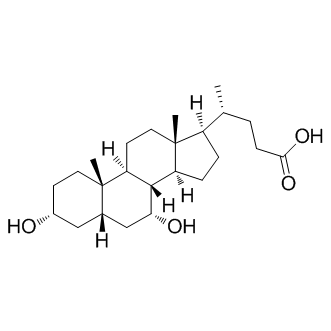
Chenodeoxycholic Acid
CAS No. 474-25-9
Chenodeoxycholic Acid( CDCA )
Catalog No. M14575 CAS No. 474-25-9
A potent natural bile acid at stimulating the nuclear bile acid receptor, farnesoid X receptor (FXR).
Purity : >98% (HPLC)
 COA
Datasheet
HNMR
HPLC
MSDS
Handing Instructions
COA
Datasheet
HNMR
HPLC
MSDS
Handing Instructions
| Size | Price / USD | Stock | Quantity |
| 1 mL x 10 mM in DMSO | 33 | In Stock |


|
| 100MG | 29 | In Stock |
|
| 200MG | Get Quote | In Stock |
|
| 500MG | 45 | In Stock |
|
| 1G | 60 | In Stock |
|
Biological Information
-
Product NameChenodeoxycholic Acid
-
NoteResearch use only, not for human use.
-
Brief DescriptionA potent natural bile acid at stimulating the nuclear bile acid receptor, farnesoid X receptor (FXR).
-
DescriptionA potent natural bile acid at stimulating the nuclear bile acid receptor, farnesoid X receptor (FXR); increases plasma concentrations of GLP-1, C-peptide, glucagon, peptide YY, neurotensin, total bile acids, and FGF19 significantly compared with placebo; also activates NLRP3 inflammasome and contributes to cholestatic liver fibrosis.Other Indication Approved(In Vitro):Chenodeoxycholic acid (CDCA) and Deoxycholic acid (DCA) both inhibit 11 beta HSD2 with IC50 values of 22 mM and 38 mM, respectively and causes cortisol-dependent nuclear translocation and increases transcriptionalactivity of mineralocorticoid receptor (MR). Chenodeoxycholic acid is able to stimulate Ishikawa cell growth by inducing a significant increase in Cyclin D1 protein and mRNA expression through the activation of the membrane G protein-coupled receptor (TGR5)-dependent pathway. Chenodeoxycholic acid (CDCA) induces LDL receptor mRNA levels approximately 4 fold and mRNA levels for HMG-CoA reductase and HMG-CoA synthase two fold in a cultured human hepatoblastoma cell line, Hep G2. Chenodeoxycholic acid-induced Isc is inhibited (≥67%) by Bumetanide, BaCl2, and the cystic fibrosis transmembrane conductance regulator (CFTR) inhibitor CFTRinh-172. Chenodeoxycholic acid-stimulated Isc is decreased 43% by the adenylate cyclase inhibitor MDL12330A and Chenodeoxycholic acid increases intracellular cAMP concentration. Chenodeoxycholic acid treatment activates C/EBPβ, as shown by increases in its phosphorylation, nuclear accumulation, and expression in HepG2 cells. Chenodeoxycholic acid enhances luciferase gene transcription from the construct containing -1.65-kb GSTA2 promoter, which contains C/EBP response element (pGL-1651). Chenodeoxycholic acid treatment activates AMP-activated protein kinase (AMPK), which leads to extracellular signal-regulated kinase 1/2 (ERK1/2) activation, as evidenced by the results of experiments using a dominant-negative mutant of AMPKα and chemical inhibitor.
-
In Vitro——
-
In Vivo——
-
SynonymsCDCA
-
PathwayMetabolic Enzyme/Protease
-
TargetFXR
-
RecptorBileacidreceptor
-
Research AreaOther Indications
-
IndicationOther Disease
Chemical Information
-
CAS Number474-25-9
-
Formula Weight392.572
-
Molecular FormulaC24H40O4
-
Purity>98% (HPLC)
-
SolubilityDMSO: ≥ 3.6 mg/mL
-
SMILESC[C@@H]([C@H]1CC[C@@]2([H])[C@]3([H])[C@H](O)C[C@]4([H])C[C@H](O)CC[C@]4(C)[C@@]3([H])CC[C@]12C)CCC(O)=O
-
Chemical NameCholan-24-oic acid, 3,7-dihydroxy-, (3α,5β,7α)-
Shipping & Storage Information
-
Storage(-20℃)
-
ShippingWith Ice Pack
-
Stability≥ 2 years
Reference
1. Parks DJ, et al. Science. 1999 May 21;284(5418):1365-8.
2. Nielsen S, et al. Physiol Rep. 2017 Feb;5(3). pii: e13140.
3. Gong Z, et al. Oncotarget. 2016 Dec 20;7(51):83951-83963.
molnova catalog



related products
-
FXR-sHE modulator 57
A potent, orally active dual modulator of FXR and soluble epoxide hydrolase (sEH) that exertss partial FXR agonism (pEC50=7.7) and sEH inhibitory activity (pIC50=8.4).
-
INT-747
INT-747(Obeticholic acid, 6-ECDCA, 6-Ethylchenodeoxycholic acid)?is a potent and selective FXR agonist (EC50=99 nM).
-
Lithocholic acid
Lithocholic acid is a toxic secondary bile acid, causes intrahepatic cholestasis, has tumor-promoting activity.
