


 Cart
Cart
 sales@molnova.com


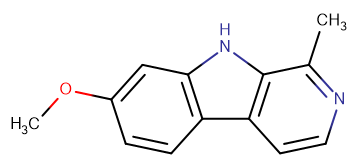
Harmine
CAS No. 442-51-3
Harmine( Harmine | telepathine | Yageine | Yajeine | Banisterine | Leucoharmine )
Catalog No. M14504 CAS No. 442-51-3
Banisterine monohydrate(Harmine), a tricyclic b-carboline alkaloid that was originally isolated from seeds of Peganum harmala, has been reported to possess anxiolytic, behavioral effects.
Purity : >98% (HPLC)
 COA
Datasheet
HNMR
HPLC
MSDS
Handing Instructions
COA
Datasheet
HNMR
HPLC
MSDS
Handing Instructions
| Size | Price / USD | Stock | Quantity |
| 1 mL x 10 mM in DMSO | 48 | In Stock |


|
| 100MG | Get Quote | In Stock |
|
| 200MG | 29 | In Stock |
|
| 500MG | 45 | In Stock |
|
| 1G | Get Quote | In Stock |
|
Biological Information
-
Product NameHarmine
-
NoteResearch use only, not for human use.
-
Brief DescriptionBanisterine monohydrate(Harmine), a tricyclic b-carboline alkaloid that was originally isolated from seeds of Peganum harmala, has been reported to possess anxiolytic, behavioral effects.
-
DescriptionBanisterine monohydrate(Harmine),a tricyclic b-carboline alkaloid that was originally isolated from seeds of Peganum harmala, has been reported to possess anxiolytic, behavioral effects.(In Vitro):Harmine inhibits tau phosphorylation by DYRK1A by selected DANDYs, with an IC50 of 190 nM.Harmine negatively regulates homologous recombination (HR) by interfering Rad51 recruitment, resulting in severe cytotoxicity in hepatoma cells. Furthermore, NHEJ inhibitor Nu7441 markedly sensitizes Hep3B cells to the anti-proliferative effects of Harmine. (In Vivo):It is shown that brain water content is significantly increased in the TBI group. Treatment with Harmine significantly reduces the tissue water content at 1, 3 and 5 days, compared with the TBI group. Harmine treatment significantly reduces the escape latency at 3 and 5 days, compared with the TBI group. Post-TBI administration of Harmine significantly improves the motor function recovery of the rats at 1, 3 and 5 days following TBI, compared with the TBI group without Harmine treatment. The neuronal survival rate in the Harmine-treated group is significantly increased, compared with the TBI group. Administration of Harmine results in marked elevation in the expression of GLT-1, compared with the TBI group. The administration of Harmine significantly reduces the expression of caspase 3, compared with the TBI group.
-
In VitroHarmine inhibits tau phosphorylation by DYRK1A by selected DANDYs, with an IC50 of 190 nM.Harmine negatively regulates homologous recombination (HR) by interfering Rad51 recruitment, resulting in severe cytotoxicity in hepatoma cells. Furthermore, NHEJ inhibitor Nu7441 markedly sensitizes Hep3B cells to the anti-proliferative effects of Harmine.
-
In VivoIt is shown that brain water content is significantly increased in the TBI group. Treatment with Harmine significantly reduces the tissue water content at 1, 3 and 5 days, compared with the TBI group. Harmine treatment significantly reduces the escape latency at 3 and 5 days, compared with the TBI group. Post-TBI administration of Harmine significantly improves the motor function recovery of the rats at 1, 3 and 5 days following TBI, compared with the TBI group without Harmine treatment. The neuronal survival rate in the Harmine-treated group is significantly increased, compared with the TBI group. Administration of Harmine results in marked elevation in the expression of GLT-1, compared with the TBI group. The administration of Harmine significantly reduces the expression of caspase 3, compared with the TBI group.
-
SynonymsHarmine | telepathine | Yageine | Yajeine | Banisterine | Leucoharmine
-
PathwayMetabolic Enzyme/Protease
-
TargetMAO
-
RecptorMAO
-
Research AreaOther Indications
-
Indication——
Chemical Information
-
CAS Number442-51-3
-
Formula Weight212.25
-
Molecular FormulaC13H12N2O
-
Purity>98% (HPLC)
-
SolubilityDMSO: 10 mg/mL
-
SMILESCC1=NC=CC2=C1NC3=C2C=CC(OC)=C3
-
Chemical Name7-methoxy-1-methyl-9H-pyrido[3,4-b]-indole
Shipping & Storage Information
-
Storage(-20℃)
-
ShippingWith Ice Pack
-
Stability≥ 2 years
Reference
1.Zhang H, et al. Phytomedicine. 2014 Feb 15;21(3):348-55.
molnova catalog



related products
-
LAZABEMIDE
LAZABEMIDE(Ro 19-6327) is selective reversible monoamine oxidase B (MAO-B) inhibitor (IC50 values are 0.03 and > 100 μM for MAO-B and MAO-A respectively).
-
CHBO4
CHBO4 is an hMAO-B inhibitor that is potent, reversible, competitive and selective.The IC50 value of CHBO4 against hMAO-B in the CHBO assay was 0.031 μM, and the Ki value was 0.010 ± 0.005 μM.CHBO4 reduces cellular damage by scavenging intracellular reactive oxygen species (ROS), and can be used to study Parkinson's disease (PD).
-
BW-1370U87
BW-1370U87 is a reversible competitive monoamine oxidase-A inhibitor for the study of depression and other CNS disorders.
