


 Cart
Cart
 sales@molnova.com


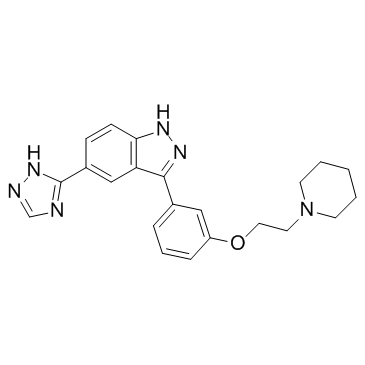
CC-401
CAS No. 395104-30-0
CC-401( CC401 | JNK-401 )
Catalog No. M14359 CAS No. 395104-30-0
CC-401 (JNK-401) is a potent, selective, ATP-competitive pan-JNK inhibitor with Ki of 25-50 nM.
Purity : >98% (HPLC)
 COA
Datasheet
HNMR
HPLC
MSDS
Handing Instructions
COA
Datasheet
HNMR
HPLC
MSDS
Handing Instructions
| Size | Price / USD | Stock | Quantity |
| 5MG | 873 | Get Quote |


|
| 100MG | Get Quote | Get Quote |
|
| 200MG | Get Quote | Get Quote |
|
| 500MG | Get Quote | Get Quote |
|
| 1G | Get Quote | Get Quote |
|
Biological Information
-
Product NameCC-401
-
NoteResearch use only, not for human use.
-
Brief DescriptionCC-401 (JNK-401) is a potent, selective, ATP-competitive pan-JNK inhibitor with Ki of 25-50 nM.
-
DescriptionCC-401 (JNK-401) is a potent, selective, ATP-competitive pan-JNK inhibitor with Ki of 25-50 nM, displays >40-fold selectivity over other related kinases; blocks JNK signaling and renal fibrosis in a rat obstructed kidney model, decrease hepatic necrosis and apoptosis after orthotopic liver transplantation and prevent acute renal failure following ischemia/reperfusion associated with renal transplantation in rats.Blood Cancer Phase 1 Discontinued.
-
In VitroCC-401 has at least 40-fold selectivity for JNK compared with other related kinases, including p38, extracellular signal-regulated kinase (ERK), inhibitor of κB kinase (IKK2), protein kinase C, Lck, zeta-associated protein of 70 kDa (ZAP70). In cell-based assays, 1 to 5 μM CC-401 provides specific JNK inhibition. CC-401, a small molecule that is a specific inhibitor of all three JNK isoforms. CC-401 competitively binds the ATP binding site in JNK, resulting in inhibition of the phosphorylation of the N-terminal activation domain of the transcription factor c-Jun. The specificity of this inhibitor is tested in vitro using osmotic stress of the HK-2 human tubular epithelial cell line. CC-401 inhibits sorbitol-induced phosphorylation of c-Jun in a dosage-dependent manner. However, CC-401 does not prevent sorbitol-induced phosphorylation of JNK, p38, or ERK.
-
In VivoThe staining of p-JNK is moderately induced in bevazicumab and Oxaliplatin treatments as compared to control, and in the CC-401-treated samples p-cJun content is significantly lower, consistent with effective JNK inhibition. DNA damage is modestly elevated in combined treatments with CC-401. CC-401 treatment from days 7 to 24 slows the progression of proteinuria, which is significantly reduced compared to the no-treatment and vehicle groups at days 14 and 21. However, there is still an increase in the degree of proteinuria at day 21 in CC-401-treated rats compared to proteinuria at day 5. The vehicle and no-treatment groups developed renal impairment at day 24 as shown by an increase in serum creatinine. This is prevented by CC-401 treatment.
-
SynonymsCC401 | JNK-401
-
PathwayMAPK/ERK Signaling
-
TargetJNK
-
RecptorJNK
-
Research AreaCancer
-
IndicationBlood cancer
Chemical Information
-
CAS Number395104-30-0
-
Formula Weight388.5
-
Molecular FormulaC22H24N6O
-
Purity>98% (HPLC)
-
Solubility——
-
SMILESC1CCN(CC1)CCOC2=CC=CC(=C2)C3=NNC4=C3C=C(C=C4)C5=NC=NN5
-
Chemical Name3-[3-[2-(1-piperidinyl)ethoxy]phenyl]-5-(1H-1,2,4-triazol-5-yl)-1H-indazole
Shipping & Storage Information
-
Storage(-20℃)
-
ShippingWith Ice Pack
-
Stability≥ 2 years
Reference
1. Uehara T, et al. Transplantation. 2004 Aug 15;78(3):324-32.
2. Ma FY, et al. J Am Soc Nephrol. 2007 Feb;18(2):472-84.
3. Kanellis J, et al. Nephrol Dial Transplant. 2010 Sep;25(9):2898-908.
molnova catalog



related products
-
JNK-IN-11
JNK-IN-11 (compound 1) is a potent inhibitor of JNK, with IC50 values of 2.2 μM, 21.4 μM, and 1.8 μM for JNK1, JNK2, and JNK3, respectively, showing potential for Alzheimer's and Parkinson's disease research.
-
Caffeic Acid
Caffeic Acid is an orally bioavailable, hydroxycinnamic acid derivative and polyphenol, with potential anti-oxidant, anti-inflammatory, and antineoplastic activities.
-
JNK-IN-13
JNK-IN-13 is a selective and potent JNK inhibitor that inhibits JNK3 and JNK2 and can be used in the study of diabetes, inflammation, and neurological disorders.
