


 Cart
Cart
 sales@molnova.com


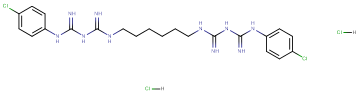
Chlorhexidine hydrochloride
CAS No. 3697-42-5
Chlorhexidine hydrochloride( CHX )
Catalog No. M14272 CAS No. 3697-42-5
Chlorhexidine dihydrochloride is an antibacterial, used as an antiseptic and for other applications.
Purity : >98% (HPLC)
 COA
Datasheet
HNMR
HPLC
MSDS
Handing Instructions
COA
Datasheet
HNMR
HPLC
MSDS
Handing Instructions
| Size | Price / USD | Stock | Quantity |
| 1 mL x 10 mM in DMSO | 28 | In Stock |


|
| 100MG | 35 | In Stock |
|
| 200MG | Get Quote | In Stock |
|
| 500MG | Get Quote | In Stock |
|
| 1G | Get Quote | In Stock |
|
Biological Information
-
Product NameChlorhexidine hydrochloride
-
NoteResearch use only, not for human use.
-
Brief DescriptionChlorhexidine dihydrochloride is an antibacterial, used as an antiseptic and for other applications.
-
DescriptionChlorhexidine dihydrochloride is an antibacterial, used as an antiseptic and for other applications.
-
In VitroCell Viability Assay Cell Line:S. aureus Concentration:100 μM, 200 μM Incubation Time:15min, 30 min, 15 min, 60 min, 120 min, 240 min Result:Showed a slow decrease during the first two hours and a sharp drop between 2 and 4 h of incubation at 200 μM.
-
In VivoAnimal Model:Wistar rats Dosage:0.5 ml of 0.12% chlorhexidine digluconate Administration:Oral Result:Observed significant increase of DNA damage in leukocytes and oral mucosal cells.
-
SynonymsCHX
-
PathwayMicrobiology/Virology
-
TargetAntifection
-
RecptorHNMT| CAT| cell wall
-
Research AreaInfection
-
Indication——
Chemical Information
-
CAS Number3697-42-5
-
Formula Weight578.38
-
Molecular FormulaC22H32Cl4N10
-
Purity>98% (HPLC)
-
SolubilityDMSO: 100 mg/mL warmed (172.89 mM)
-
SMILESN=C(NC1=CC=C(Cl)C=C1)NC(NCCCCCCNC(NC(NC2=CC=C(Cl)C=C2)=N)=N)=N.[H]Cl.[H]Cl
-
Chemical Name2,4,11,13-Tetraazatetradecanediimidamide, N,N''-bis(4-chlorophenyl)-3,12-diimino-, dihydrochloride
Shipping & Storage Information
-
Storage(-20℃)
-
ShippingWith Ice Pack
-
Stability≥ 2 years
Reference
1.Jenkins S, et al. J Clin Periodontol, 1988, 15(7), 415-424.
molnova catalog



related products
-
Isocolumbin
Isocolumbin is a diterpenoid isolated from Jateorhiza palmate Miers (Colombo root).
-
Pyromeconic acid
Pyromeconic acid and derivatives thereof are potent inhibitors of endonuclease.
-
rosmanol-9-ethylethe...
7-Ethoxyrosmanol is a phenolic diterpene that is isolated from Salvia chamelaeagnea. 7-Ethoxyrosmanol has antioxidant activity in vitro and antitumor effects on neuroblastoma cells. 7-Ethoxyrosmanol alleviates hyperglycemia-induced endothelial cell dysfunction via regulating FBXL7.
