


 Cart
Cart
 sales@molnova.com


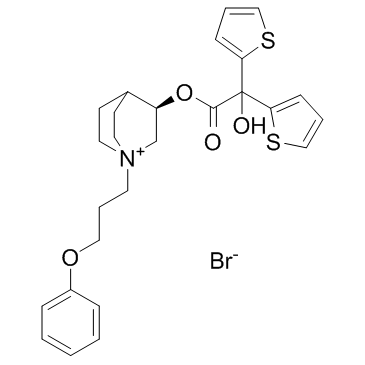
Aclidinium bromide
CAS No. 320345-99-1
Aclidinium bromide( LAS 34273 | LAS-W 330 )
Catalog No. M14042 CAS No. 320345-99-1
Aclidinium Bromide inhibits human muscarinic AChR M1, M2, M3, M4 and M5 with Ki of 0.1 nM, 0.14 nM, 0.14 nM, 0.21 nM and 0.16 nM, respectively.
Purity : >98% (HPLC)
 COA
Datasheet
HNMR
HPLC
MSDS
Handing Instructions
COA
Datasheet
HNMR
HPLC
MSDS
Handing Instructions
| Size | Price / USD | Stock | Quantity |
| 1 mL x 10 mM in DMSO | 63 | In Stock |


|
| 2MG | 31 | In Stock |
|
| 5MG | 49 | In Stock |
|
| 10MG | 77 | In Stock |
|
| 25MG | 141 | In Stock |
|
| 50MG | 229 | In Stock |
|
| 100MG | 343 | In Stock |
|
| 200MG | Get Quote | In Stock |
|
| 500MG | 807 | In Stock |
|
| 1G | Get Quote | In Stock |
|
Biological Information
-
Product NameAclidinium bromide
-
NoteResearch use only, not for human use.
-
Brief DescriptionAclidinium Bromide inhibits human muscarinic AChR M1, M2, M3, M4 and M5 with Ki of 0.1 nM, 0.14 nM, 0.14 nM, 0.21 nM and 0.16 nM, respectively.
-
DescriptionAclidinium Bromide inhibits human muscarinic AChR M1, M2, M3, M4 and M5 with Ki of 0.1 nM, 0.14 nM, 0.14 nM, 0.21 nM and 0.16 nM, respectively.(In Vitro):Preclinically, aclidinium showed potent antagonism of human muscarinic receptors, with a long residence time at M3 receptors and a shorter residence time at M2 receptors, indicating the potential to provide sustained bronchodilation. Aclidinium is rapidly hydrolysed in human plasma, unlike other currently available antimuscarinics including tiotropium. Early clinical studies in healthy subjects have confirmed the low systemic bioavailability and favourable safety profile of single and multiple doses of aclidinium. In a subsequent Phase IIb study, which included 464 patients with moderate to severe COPD, aclidinium displayed long-lasting bronchodilatory activity and was well tolerated.
-
In VitroPreclinically, aclidinium showed potent antagonism of human muscarinic receptors, with a long residence time at M3 receptors and a shorter residence time at M2 receptors, indicating the potential to provide sustained bronchodilation. Aclidinium is rapidly hydrolysed in human plasma, unlike other currently available antimuscarinics including tiotropium. Early clinical studies in healthy subjects have confirmed the low systemic bioavailability and favourable safety profile of single and multiple doses of aclidinium. In a subsequent Phase IIb study, which included 464 patients with moderate to severe COPD, aclidinium displayed long-lasting bronchodilatory activity and was well tolerated.
-
In Vivo——
-
SynonymsLAS 34273 | LAS-W 330
-
PathwayEndocrinology/Hormones
-
TargetAChR
-
RecptorM1 mAChR| M2 mAChR| M3 mAChR| M4 mAChR| M5 mAChR
-
Research AreaInflammation/Immunology
-
Indication——
Chemical Information
-
CAS Number320345-99-1
-
Formula Weight564.55
-
Molecular FormulaC26H30NO4S2·Br
-
Purity>98% (HPLC)
-
SolubilityDMSO: 113 mg/mL (200.15 mM)
-
SMILESO=C(O[C@H]1C[N+]2(CCCOC3=CC=CC=C3)CCC1CC2)C(C4=CC=CS4)(O)C5=CC=CS5.[Br-]
-
Chemical Name[(8R)-1-(3-phenoxypropyl)-1-azoniabicyclo[2.2.2]octan-8-yl] 2-hydroxy-2,2-dithiophen-2-ylacetate bromide
Shipping & Storage Information
-
Storage(-20℃)
-
ShippingWith Ice Pack
-
Stability≥ 2 years
Reference



-
Pilocarpine nitrate
Pilocarpine nitrate is a non-selective muscarinic receptor agonist.
-
Catestatin
Non-competitive nicotinic cholinergic antagonist; selectively inhibits nicotinic-stimulated catecholamine secretion from chromaffin cells and noradrenergic neurons (IC50 ~ 200 nM). Blocks nicotinic-induced cationic signaling (IC50 ~ 200 - 250 nM) and inhibits nicotinic-agonist induced desensitization of catecholamine release. Also stimulates mast cell release of histamine via a separate mechanism.
-
Hodostin
Neostigmine methyl sulfate is a cholinesterase inhibitor used in the treatment of myasthenia gravis and to reverse the effects of muscle relaxants such as gallamine and tubocurarine. Neostigmine, unlike PHYSOSTIGMINE, does not cross the blood-brain barrier.
