


 Cart
Cart
 sales@molnova.com


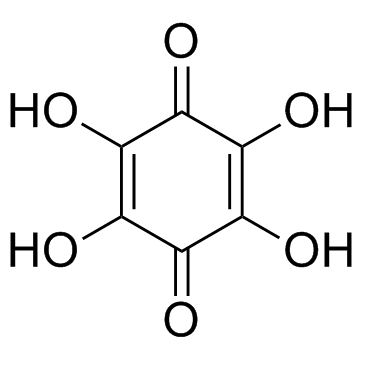
Tetroquinone
CAS No. 319-89-1
Tetroquinone( Tetroquinone | Tetroquinona | Tetroquinonum )
Catalog No. M14040 CAS No. 319-89-1
Tetrahydroxy-1,4-benzoquinone, also called tetrahydroxy-p-benzoquinone, tetrahydroxybenzoquinone, or tetrahydroxyquinone (THBQ, THQ), is an organic compound with formula C6O2(OH)4.
Purity : >98% (HPLC)
 COA
Datasheet
HNMR
HPLC
MSDS
Handing Instructions
COA
Datasheet
HNMR
HPLC
MSDS
Handing Instructions
| Size | Price / USD | Stock | Quantity |
| 100MG | 27 | In Stock |


|
| 200MG | Get Quote | In Stock |
|
| 500MG | Get Quote | In Stock |
|
| 1G | Get Quote | In Stock |
|
Biological Information
-
Product NameTetroquinone
-
NoteResearch use only, not for human use.
-
Brief DescriptionTetrahydroxy-1,4-benzoquinone, also called tetrahydroxy-p-benzoquinone, tetrahydroxybenzoquinone, or tetrahydroxyquinone (THBQ, THQ), is an organic compound with formula C6O2(OH)4.
-
DescriptionTetrahydroxy-1,4-benzoquinone, also called tetrahydroxy-p-benzoquinone, tetrahydroxybenzoquinone, or tetrahydroxyquinone (THBQ, THQ), is an organic compound with formula C6O2(OH)4. Its molecular structure consists of a cyclohexadiene ring with four hydroxyl groups and two ketone groups in opposite (para) positions.
-
In VitroTetrahydroxyquinone (100-500 μM; 24 hours; HL60 cells) treatment shows cytotoxic for HL60 leukaemia cells by total protein content (IC50 of 20 μM), phosphatase activity (IC50 of 40 μM), or by MTT assay (IC50 of 45 μM). Tetrahydroxyquinone is an efficient inducer of ROS production in HL60 leukaemia cells. Tetrahydroxyquinone efficiently activates caspase 3 in concentration in excess of 25 μM, stimulates DNA fragmentation at the same concentration and provoke phosphatidylserine exposure. Tetrahydroxyquinone induces the release of cytochrome c from the mitochondria at concentration as low as 25 μM. Tetrahydroxyquinone treatment also causes increase of phosphorylation of Ser473 in protein kinase B (the Bad kinase for Ser112). Cell Viability Assay Cell Line:HL60 leukaemia cells Concentration:100 μM, 200 μM, 300 μM, 400 μM, 500 μM Incubation Time:24 hours Result:Showed cytotoxic for HL60 leukaemia cells.
-
In Vivo——
-
SynonymsTetroquinone | Tetroquinona | Tetroquinonum
-
PathwayOthers
-
TargetOther Targets
-
RecptorOthers
-
Research AreaCancer
-
Indication——
Chemical Information
-
CAS Number319-89-1
-
Formula Weight172.09
-
Molecular FormulaC6H4O6
-
Purity>98% (HPLC)
-
SolubilityDMSO: 10 mM
-
SMILESO=C1C(O)=C(O)C(C(O)=C1O)=O
-
Chemical Name2,5-Cyclohexadiene-1,4-dione, 2,3,5,6-tetrahydroxy-
Shipping & Storage Information
-
Storage(-20℃)
-
ShippingWith Ice Pack
-
Stability≥ 2 years
Reference
1.Lou K, et al. J Am Chem Soc. 2010 Dec 15; 132(49):17635-4
molnova catalog



related products
-
Adenine hydrochlorid...
Adenine HCl is a hydrochloride salt form of adenine which is a nucleobase with a variety of roles in biochemistry.
-
UDP-GlcNAc Disodium ...
UDP-GlcNAc Disodium Salt is a nucleotide sugar.?It is synthesized from glucose via the hexosamine biosynthetic pathway (HBP).OGT is a nucleocytoplasmic glycosyltransferase assigned to the GT41 family in the CAZY database.
-
SCH900776 S-isomer
SCH900776 (S-isomer) is an effective, specific and orally bioavailable inhibitor of checkpoint kinase Chk1 (IC50: 3 nM).
