


 Cart
Cart
 sales@molnova.com


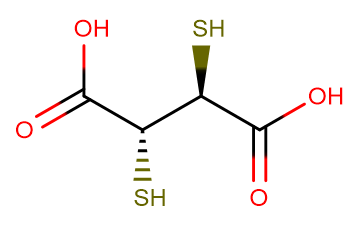
Succimer
CAS No. 304-55-2
Succimer( Succimer | DMSA )
Catalog No. M13963 CAS No. 304-55-2
Succimer is a Lead Chelator. The mechanism of action of succimer is as a Lead Chelating Activity.
Purity : >98% (HPLC)
 COA
Datasheet
HNMR
HPLC
MSDS
Handing Instructions
COA
Datasheet
HNMR
HPLC
MSDS
Handing Instructions
| Size | Price / USD | Stock | Quantity |
| 100MG | Get Quote | In Stock |


|
| 200MG | Get Quote | In Stock |
|
| 500MG | 37 | In Stock |
|
| 1G | 52 | In Stock |
|
Biological Information
-
Product NameSuccimer
-
NoteResearch use only, not for human use.
-
Brief DescriptionSuccimer is a Lead Chelator. The mechanism of action of succimer is as a Lead Chelating Activity.
-
DescriptionSuccimer is a Lead Chelator. The mechanism of action of succimer is as a Lead Chelating Activity.(In Vivo):Succimer is a widely used chelating agent for the treatment of Pb poisoning. Red blood cells (RBCs) from lead exposed animals treated with NAC or Succimer are shown to have significantly higher glutathione (GSH) levels and diminished malondialdehyde (MDA) levels when compare to the lead group. Succimer administration also results in decreased glucose 6-phosphate dehydrogenase (G6PD) activity in RBCs from lead exposed animals. Succimer treatment produces a significant reduction in blood lead levels for both lead exposure conditions: the High Pb-succ group has blood lead levels that are 27% of the blood lead levels of the High Pb group at the end of treatment. Succimer is effective in substantially reducing brain lead, as brain lead levels in the High Pb-succ group are 37% of levels in the High Pb group.
-
In Vitro——
-
In VivoSuccimer is a widely used chelating agent for the treatment of Pb poisoning. Red blood cells (RBCs) from lead exposed animals treated with NAC or Succimer are shown to have significantly higher glutathione (GSH) levels and diminished malondialdehyde (MDA) levels when compare to the lead group. Succimer administration also results in decreased glucose 6-phosphate dehydrogenase (G6PD) activity in RBCs from lead exposed animals. Succimer treatment produces a significant reduction in blood lead levels for both lead exposure conditions: the High Pb-succ group has blood lead levels that are 27% of the blood lead levels of the High Pb group at the end of treatment. Succimer is effective in substantially reducing brain lead, as brain lead levels in the High Pb-succ group are 37% of levels in the High Pb group.
-
SynonymsSuccimer | DMSA
-
PathwayOthers
-
TargetOther Targets
-
RecptorCadmium| Lead| Mercury| Others
-
Research Area——
-
Indication——
Chemical Information
-
CAS Number304-55-2
-
Formula Weight182.22
-
Molecular FormulaC4H6O4S2
-
Purity>98% (HPLC)
-
SolubilityDMSO: 10 mM
-
SMILESO=C(O)[C@@H](S)[C@@H](S)C(O)=O
-
Chemical Namemeso-2,3-Dimercaptosuccinic acid;
Shipping & Storage Information
-
Storage(-20℃)
-
ShippingWith Ice Pack
-
Stability≥ 2 years
Reference
1.Blanusa M, et al. Curr Med Chem. 2005;12(23):2771-94.
molnova catalog



related products
-
L-Propargylglycine
L-Propargylglycine is an inhibitor of the enzyme.l-propargylglycine (LPG) irreversibly inhibited the enzyme from Crotalus adamanteus and Crotalus atrox in a dose- and time-dependent manner.?Inactivation was irreversible which was significantly protected by the substrate l-phenylalanine.?
-
BCAT-IN-2
BCAT-IN-2 is an orally active and selective inhibitor of mitochondrial branched-chain aminotransferase (BCATm), inhibits BCATm and BCATc, and is used in obesity and dyslipidemia.
-
Sodium fluoride
Sodium Fluoride is an inorganic salt of fluoride used as an insecticide. It is also used as a wood preservative in cleaning compounds manufacture of glass and for many other uses.
