


 Cart
Cart
 sales@molnova.com


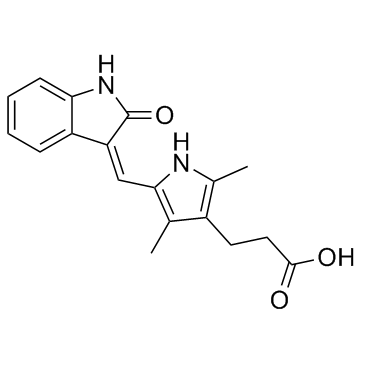
TSU-68
CAS No. 252916-29-3
TSU-68( SU-6668 | TSU68 | TSU 68 | SU6668 | Orantinib )
Catalog No. M13746 CAS No. 252916-29-3
TSU-68 (Orantinib, SU6668) is a small-molecule, ATP-competitiv inhibitor of angiogenic related RTKs KDR, PDGFRβ, FGFR1.
Purity : >98% (HPLC)
 COA
Datasheet
HNMR
HPLC
MSDS
Handing Instructions
COA
Datasheet
HNMR
HPLC
MSDS
Handing Instructions
| Size | Price / USD | Stock | Quantity |
| 1 mL x 10 mM in DMSO | 48 | In Stock |


|
| 5MG | 45 | In Stock |
|
| 10MG | 68 | In Stock |
|
| 25MG | 145 | In Stock |
|
| 50MG | 272 | In Stock |
|
| 100MG | 479 | In Stock |
|
| 200MG | Get Quote | In Stock |
|
| 500MG | Get Quote | In Stock |
|
| 1G | Get Quote | In Stock |
|
Biological Information
-
Product NameTSU-68
-
NoteResearch use only, not for human use.
-
Brief DescriptionTSU-68 (Orantinib, SU6668) is a small-molecule, ATP-competitiv inhibitor of angiogenic related RTKs KDR, PDGFRβ, FGFR1.
-
DescriptionTSU-68 (Orantinib, SU6668) is a small-molecule, ATP-competitiv inhibitor of angiogenic related RTKs KDR, PDGFRβ, FGFR1; inhibits receptor tyrosine phosphorylation and mitogenesis after stimulation of cells by appropriate ligands; significant growth inhibition of a diverse panel of human tumor xenografts after oral or i.p. administration.Gastric Cancer Phase 3 Discontinued(In Vitro):Orantinib (SU6668; 0.03-10 μM) shows inhibitory activity against tyrosine phosphorylation of KDR in VEGF stimulated HUVECs, and also blocks PDGF-stimulated PDGFRβ tyrosine phosphorylation in NIH-3T3 cells overexpressing PDGFRβ. Orantinib (≥10 μM) inhibits acidic FGF-induced phosphorylation of the FGFR1 substrate 2. However, Orantinib (up to 100 μM) has no effect on EGF-stimulated EGFR tyrosine phosphorylation in NIH-3T3 cells overexpressing EGFR. Furthermore, Orantinib inhibits VEGF-driven and FGF-driven mitogenesis of HUVECs with mean IC50 of 0.34 μM and 9.6 μM, respectively. In human myeloid leukemia MO7E cells, Orantinib (SU6668) inhibits the tyrosine autophosphorylation of stem cell factor (SCF) receptor, c-kit, with IC50 of 0.1-1 μM, as well as ERK1/2 phosphorylation. In addition, Orantinib suppresses SCF-induced proliferation of MO7E cells with an IC50 of 0.29 μM, and induces apoptosis. (In Vivo):Orantinib (SU6668; 75-200 mg/kg) causes tumor growth inhibition on several tumor types in xenograft models in athymic mice, such as A375, Colo205, H460, Calu-6, C6, SF763T, and SKOV3TP5 cells. Orantinib (75 mg/kg) also inhibits tumor angiogenesis of C6 glioma xenografts. In a tumor model of HT29 human colon carcinoma, Orantinib (200 mg/kg) decreases the average vessel permeability and average fractional plasma volume in the tumor rim and core. Orantinib enhances abnormal stromal development at the periphery of carcinomas. Moreover, Orantinib (TSU-68; 200 mg/kg) augments the effect of chemotherapeutic infusion in a rabbit VX2 liver tumor model.
-
In VitroOrantinib (SU6668; 0.03-10 μM) shows inhibitory activity against tyrosine phosphorylation of KDR in VEGF stimulated HUVECs, and also blocks PDGF-stimulated PDGFRβ tyrosine phosphorylation in NIH-3T3 cells overexpressing PDGFRβ. Orantinib (≥10 μM) inhibits acidic FGF-induced phosphorylation of the FGFR1 substrate 2. However, Orantinib (up to 100 μM) has no effect on EGF-stimulated EGFR tyrosine phosphorylation in NIH-3T3 cells overexpressing EGFR. Furthermore, Orantinib inhibits VEGF-driven and FGF-driven mitogenesis of HUVECs with mean IC50 of 0.34 μM and 9.6 μM, respectively. In human myeloid leukemia MO7E cells, Orantinib (SU6668) inhibits the tyrosine autophosphorylation of stem cell factor (SCF) receptor, c-kit, with IC50 of 0.1-1 μM, as well as ERK1/2 phosphorylation. In addition, Orantinib suppresses SCF-induced proliferation of MO7E cells with an IC50 of 0.29 μM, and induces apoptosis.
-
In VivoOrantinib (SU6668; 75-200 mg/kg) causes tumor growth inhibition on several tumor types in xenograft models in athymic mice, such as A375, Colo205, H460, Calu-6, C6, SF763T, and SKOV3TP5 cells. Orantinib (75 mg/kg) also inhibits tumor angiogenesis of C6 glioma xenografts. In a tumor model of HT29 human colon carcinoma, Orantinib (200 mg/kg) decreases the average vessel permeability and average fractional plasma volume in the tumor rim and core. Orantinib enhances abnormal stromal development at the periphery of carcinomas. Moreover, Orantinib (TSU-68; 200 mg/kg) augments the effect of chemotherapeutic infusion in a rabbit VX2 liver tumor model.
-
SynonymsSU-6668 | TSU68 | TSU 68 | SU6668 | Orantinib
-
PathwayAngiogenesis
-
TargetPDGFR
-
RecptorFGFR1|Flk1|PDGFRβ
-
Research AreaCancer
-
IndicationGastric Cancer
Chemical Information
-
CAS Number252916-29-3
-
Formula Weight310.3471
-
Molecular FormulaC18H18N2O3
-
Purity>98% (HPLC)
-
SolubilityDMSO: ≥ 28 mg/mL
-
SMILESO=C(O)CCC1=C(C)NC(/C=C2C(NC3=C\2C=CC=C3)=O)=C1C
-
Chemical Name1H-Pyrrole-3-propanoic acid, 5-[(1,2-dihydro-2-oxo-3H-indol-3-ylidene)methyl]-2,4-dimethyl-
Shipping & Storage Information
-
Storage(-20℃)
-
ShippingWith Ice Pack
-
Stability≥ 2 years
Reference
1. Laird AD, et al. Cancer Res. 2000 Aug 1;60(15):4152-60.
2. Shaheen RM, et al. Cancer Res. 2001 Feb 15;61(4):1464-8.
3. Marzola P, et al. Clin Cancer Res. 2004 Jan 15;10(2):739-50.
molnova catalog



related products
-
PDGFRα kinase inhibi...
PDGFRα kinase inhibitor 1 is a highly selective inhibitor of type II PDGFRα kinase (PDGFRα and PDGFRβ) with IC50 values of 132 nM and 6115 nM, respectively.
-
PDGFR Tyrosine Kinas...
PDGFR Tyrosine Kinase Inhibitor III (PDGF Receptor Tyrosine Kinase Inhibitor III) is a multikinase inhibitor that inhibits PDGFR, EGFR, FGFR, PKA, and PKC and can be used for research on amyotrophic lateral sclerosis .
-
AG-1295
A quinoxaline-type tyrphostin that acts as a potent and selective inhibitor of PDGFR kinase in vitro and in Swiss 3T3 cells with IC50 of 0.3-1 uM.
