


 Cart
Cart
 sales@molnova.com


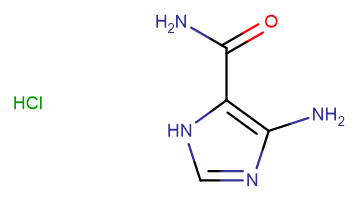
5-Amino-4-imidazolecarboxamide
CAS No. 21299-72-9
5-Amino-4-imidazolecarboxamide( —— )
Catalog No. M13390 CAS No. 21299-72-9
An imidazole derivative which is a metabolite of the antineoplastic agents BIC and DIC.
Purity : >98% (HPLC)
 COA
Datasheet
HNMR
HPLC
MSDS
Handing Instructions
COA
Datasheet
HNMR
HPLC
MSDS
Handing Instructions
| Size | Price / USD | Stock | Quantity |
| 1 mL x 10 mM in DMSO | 28 | In Stock |


|
| 50MG | 43 | In Stock |
|
| 100MG | 56 | In Stock |
|
| 200MG | 79 | In Stock |
|
| 500MG | Get Quote | In Stock |
|
| 1G | Get Quote | In Stock |
|
Biological Information
-
Product Name5-Amino-4-imidazolecarboxamide
-
NoteResearch use only, not for human use.
-
Brief DescriptionAn imidazole derivative which is a metabolite of the antineoplastic agents BIC and DIC.
-
DescriptionAn imidazole derivative which is a metabolite of the antineoplastic agents BIC and DIC. By itself, or as the ribonucleotide, it is used as a condensation agent in the preparation of nucleosides and nucleotides. Compounded with orotic acid, it is used to treat liver diseases.
-
In Vitro——
-
In Vivo——
-
Synonyms——
-
PathwayOthers
-
TargetOther Targets
-
RecptorOthers
-
Research Area——
-
Indication——
Chemical Information
-
CAS Number21299-72-9
-
Formula Weight126.12
-
Molecular FormulaC4H6N4O
-
Purity>98% (HPLC)
-
SolubilityLimited solubility
-
SMILESCl.NC(=O)C1=C(N)N=CN1
-
Chemical Name——
Shipping & Storage Information
-
Storage(-20℃)
-
ShippingWith Ice Pack
-
Stability≥ 2 years
Reference
1.Velavan A, et al. Org Biomol Chem. 2012 Aug 21;10(31):6420-3
molnova catalog



related products
-
Neurokinin A
Neurokinin A (NKA), formerly known as Substance K, is a neurologically active peptide translated from the pre-protachykinin gene.
-
CCT018159
The heat shock protein 90 (Hsp90) is a molecular chaperone that activates and maintains the biological functioning of several client proteins, many of which are associated with oncogenic signaling pathways.
-
H-Leu-Ser-Ser-Phe-Va...
H-Leu-Ser-Ser-Phe-Val-Arg-Ile-NH2
