


 Cart
Cart
 sales@molnova.com


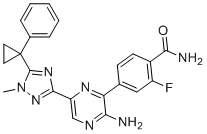
PI3Kδ-IN-7n
CAS No. 2088525-31-7
PI3Kδ-IN-7n( —— )
Catalog No. M13260 CAS No. 2088525-31-7
PI3Kδ-IN-7n is a highly potent and selective PI3Kδ inhibitor with IC50 of 0.9 nM.
Purity : >98% (HPLC)
 COA
Datasheet
HNMR
HPLC
MSDS
Handing Instructions
COA
Datasheet
HNMR
HPLC
MSDS
Handing Instructions
| Size | Price / USD | Stock | Quantity |
| 5MG | 150 | In Stock |


|
| 10MG | 226 | In Stock |
|
| 25MG | 372 | In Stock |
|
| 50MG | 498 | In Stock |
|
| 100MG | 681 | In Stock |
|
| 200MG | 917 | In Stock |
|
| 500MG | Get Quote | In Stock |
|
| 1G | Get Quote | In Stock |
|
Biological Information
-
Product NamePI3Kδ-IN-7n
-
NoteResearch use only, not for human use.
-
Brief DescriptionPI3Kδ-IN-7n is a highly potent and selective PI3Kδ inhibitor with IC50 of 0.9 nM.
-
DescriptionPI3Kδ-IN-7n is a highly potent and selective PI3Kδ inhibitor with IC50 of 0.9 nM, displays high selectivity (>1,500-fold) over PI3Kα, PI3Kβ, PI3Kγ (IC50>1.5 uM); shows reasonable pharmacokinetics with good bioavailability and moderate in vivo half-life; one of the most selective PI3Kδ inhibitors published to date.
-
In Vitro——
-
In Vivo——
-
Synonyms——
-
PathwayPI3K/Akt/mTOR signaling
-
TargetPI3K
-
RecptorPI3K
-
Research Area——
-
Indication——
Chemical Information
-
CAS Number2088525-31-7
-
Formula Weight429.459
-
Molecular FormulaC23H20FN7O
-
Purity>98% (HPLC)
-
Solubility——
-
SMILES——
-
Chemical Name4-(3-amino-6-(1-methyl-5-(1-phenylcyclopropyl)-1H-1,2,4-triazol-3-yl)pyrazin-2-yl)-2-fluorobenzamide
Shipping & Storage Information
-
Storage(-20℃)
-
ShippingWith Ice Pack
-
Stability≥ 2 years
Reference
1. Terstiege I, et al. Bioorg Med Chem Lett. 2017 Feb 1;27(3):679-687.
molnova catalog



related products
-
I-OMe-Tyrphostin AG ...
I-OMe-Tyrphostin AG 538 is a specific IGF-1R inhibitor and ATP-competitive inhibitor of PI5P4Kα (IC50: 1 μM).
-
PQR-530
PQR-530 (PQR530) is a potent, BBB penetrant, dual pan-PI3K/mTOR inhibitor.
-
RV-1729
RV-1729 is a potent, selective PI3Kδ inhibitor with IC50 of 12 nM.
