


 Cart
Cart
 sales@molnova.com


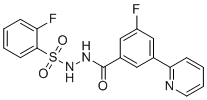
WM-1119
CAS No. 2055397-28-7
WM-1119( WM1119 | WM 1119 )
Catalog No. M13193 CAS No. 2055397-28-7
WM-1119 (WM1119) is a highly potent, selective inhibitor of lysine acetyltransferase KAT6A with Kd of 2 nM.
Purity : >98% (HPLC)
 COA
Datasheet
HNMR
HPLC
MSDS
Handing Instructions
COA
Datasheet
HNMR
HPLC
MSDS
Handing Instructions
| Size | Price / USD | Stock | Quantity |
| 1 mL x 10 mM in DMSO | 49 | In Stock |


|
| 5MG | 45 | In Stock |
|
| 10MG | 61 | In Stock |
|
| 25MG | 101 | In Stock |
|
| 50MG | 145 | In Stock |
|
| 100MG | 215 | In Stock |
|
| 200MG | Get Quote | In Stock |
|
| 500MG | Get Quote | In Stock |
|
| 1G | Get Quote | In Stock |
|
Biological Information
-
Product NameWM-1119
-
NoteResearch use only, not for human use.
-
Brief DescriptionWM-1119 (WM1119) is a highly potent, selective inhibitor of lysine acetyltransferase KAT6A with Kd of 2 nM.
-
DescriptionWM-1119 (WM1119) is a highly potent, selective inhibitor of lysine acetyltransferase KAT6A with Kd of 2 nM, shows greate bioavailability and specificity for KAT6A than WM-8014; displays 1,100-fold and 250-fold selectivity over KAT5 and KAT7, respectively; causes cell cycle arrest in G1 and senescence phenotype similar to WM-8014; demonstrates growth inhibition assays in lymphoma cell line EMRK1184 (IC50=0.25 uM, 10-fold potency than WM-8014), increases levels of Cdkn2a and Cdkn2b mRNA and p16INK4a and p19ARF protein, as well as a delayed increase in Cdkn1a mRNA; arrests lymphoma growth in vivo without effect on haematocrit, erythrocytes or platelet numbers.
-
In VitroWM-1119 induces cell cycle exit and cellular senescence without causing DNA damage. WM-1119 is 1,100-fold and 250-fold more active against KAT6A than against KAT5 or KAT7, respectively, and so shows greater specificity for KAT6A than does WM-8014. Treatment of MEFs with WM-1119 results in cell cycle arrest in G1 and a senescence phenotype similar to that seen upon treatment with WM-8014. Notably, the activity of WM-1119 in this cell-based assay is an order of magnitude greater than WM-8014 and WM-1119 is able to induce cell cycle arrest at 1 μM. Treatment with WM-1119 inhibits the proliferation of the EMRK1184 lymphoma cells in vitro, WM-1119 (IC50=0.25 μM) is ninefold more active than WM-8014 (IC50=2.3 μM), as expected on the basis of reduced protein binding.
-
In VivoBy day 14, the cohorts that are treated four times per day with WM-1119 have arrested tumour growth, with the exception of one mouse that does not respond. Spleen weights in the WM-1119-treatment group (treated four times per day) are substantially lower than spleen weights in the vehicle-treated group. Treatment with WM-1119 three times per day leads to a significant reduction in tumour burden and spleen weight, but is not as effective as treatment four times per day. WM-1119 is well-tolerated; mice show no generalized ill effects and weight loss is not observed. The proportion and overall number of tumour cells is substantially reduced by WM-1119 treatment (four times per day).
-
SynonymsWM1119 | WM 1119
-
PathwayChromatin/Epigenetic
-
TargetHAT
-
RecptorKAT6A|KAT5|KAT7
-
Research AreaCancer
-
Indication——
Chemical Information
-
CAS Number2055397-28-7
-
Formula Weight389.377
-
Molecular FormulaC18H13F2N3O3S
-
Purity>98% (HPLC)
-
SolubilityDMSO: ≥150 mg/mL (385.23 mM) ( < 1 mg/ml refers to the product slightly soluble or insoluble )
-
SMILESO=C(NNS(=O)(C1=CC=CC=C1F)=O)C2=CC(C3=NC=CC=C3)=CC(F)=C2
-
Chemical NameBenzoic acid, 3-fluoro-5-(2-pyridinyl)-, 2-[(2-fluorophenyl)sulfonyl]hydrazide
Shipping & Storage Information
-
Storage(-20℃)
-
ShippingWith Ice Pack
-
Stability≥ 2 years
Reference
1. Baell JB, et al. Nature. 2018 Aug;560(7717):253-257.
molnova catalog



related products
-
CTPB
CTPB is an anacardic acid derivative, was reported as a selective activator of p300 (KAT3B) HAT activity but not PCAF (KAT2B).
-
A-485
A potent, selective and, cell and in vivo active p300/CBP catalytic inhibitor with IC50 of 9.8/2.6 nM.
-
TTK21
TTK21 (CBP-p300 activator TTK21) is a small molecule activator of CBP/p300 histone acetyltransferase activity with a maximal effect at a concentration of 275 uM.
