


 Cart
Cart
 sales@molnova.com


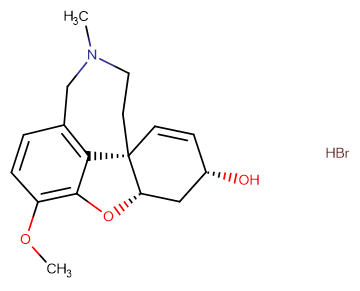
Galanthamine HBr
CAS No. 1953-04-4
Galanthamine HBr( —— )
Catalog No. M13058 CAS No. 1953-04-4
Galanthamine hydrobromide is a long-acting, centrally active acetylcholinesterase(AChE) inhibitor (IC50 = 410 nM) and allosteric potentiator at neuronal nicotinic ACh receptors.
Purity : >98% (HPLC)
 COA
Datasheet
HNMR
HPLC
MSDS
Handing Instructions
COA
Datasheet
HNMR
HPLC
MSDS
Handing Instructions
| Size | Price / USD | Stock | Quantity |
| 1 mL x 10 mM in DMSO | 54 | In Stock |


|
| 25MG | 32 | In Stock |
|
| 50MG | 47 | In Stock |
|
| 100MG | 56 | In Stock |
|
| 200MG | Get Quote | In Stock |
|
| 500MG | 187 | In Stock |
|
| 1G | Get Quote | In Stock |
|
Biological Information
-
Product NameGalanthamine HBr
-
NoteResearch use only, not for human use.
-
Brief DescriptionGalanthamine hydrobromide is a long-acting, centrally active acetylcholinesterase(AChE) inhibitor (IC50 = 410 nM) and allosteric potentiator at neuronal nicotinic ACh receptors.
-
DescriptionGalanthamine hydrobromide is a long-acting, centrally active acetylcholinesterase(AChE) inhibitor (IC50 = 410 nM) and allosteric potentiator at neuronal nicotinic ACh receptors.(In Vitro):Galanthamine hydrobromide is 53-fold selectivity for AChE over butyrylcholinesterase.Galanthamine hydrobromide (25-1000 μM) inhibits both Aβ 1-40 (50 μM) and Aβ 1-42 (50 μM) aggregation.Galanthamine hydrobromide (25-1000 μM) protects against Aβ(1-40) and Aβ(1-42) toxicity in SH-SY5Y cells.Galanthamine hydrobromide also dramatically reduces Aβ(1-40)-induced cellular apoptosis.(In Vivo):Galanthamine hydrobromide (1.25-2.5 mg/kg; i.p. ) reduces cognitive deficits in APP23 mice.Galanthamine hydrobromide (10 mg/kg; i.g.) displays short elimination half-life of approximately 2 h in wild-type mice.
-
In VitroGalanthamine hydrobromide is 53-fold selectivity for AChE over butyrylcholinesterase.Galanthamine hydrobromide (25-1000 μM) inhibits both Aβ 1-40 (50 μM) and Aβ 1-42 (50 μM) aggregation.Galanthamine hydrobromide (25-1000 μM) protects against Aβ(1-40) and Aβ(1-42) toxicity in SH-SY5Y cells.Galanthamine hydrobromide also dramatically reduces Aβ(1-40)-induced cellular apoptosis.
-
In VivoGalanthamine hydrobromide (1.25-2.5 mg/kg; i.p. ) reduces cognitive deficits in APP23 mice.Galanthamine hydrobromide (10 mg/kg; i.g.) displays short elimination half-life of approximately 2 h in wild-type mice. Animal Model:APP23 mice Dosage:1.25 mg/kg, 2.5 mg/kg Administration:Intraperitoneal injection, daily, 1 week Result:Effectively remedied the spatial learning deficit.Animal Model:Female 57B1/6J wild type Dosage:10 mg/kg Administration:Oral gavage (Pharmacokinetic Analysis)Result:Cmax (0.31 μg/mL), t1/2β (1.6 h), AUC0-24h (0.67 μg ? h/mL).
-
Synonyms——
-
PathwayEndocrinology/Hormones
-
TargetAChR
-
RecptorAChE
-
Research AreaNeurological Disease
-
Indication——
Chemical Information
-
CAS Number1953-04-4
-
Formula Weight368.27
-
Molecular FormulaC17H21NO3·HBr
-
Purity>98% (HPLC)
-
SolubilityWater: 36 mg/mL (97.75 mM)
-
SMILESCN1CC[C@@]23C=C[C@@H](C[C@@H]2OC4=C(C=CC(=C34)C1)OC)O.Br
-
Chemical Name——
Shipping & Storage Information
-
Storage(-20℃)
-
ShippingWith Ice Pack
-
Stability≥ 2 years
Reference
1.Thomsen T, et al. Eur J Clin Chem Clin Biochem, 1991, 29(8), 487-492.
molnova catalog



related products
-
(+)-Pilocarpine hydr...
Pilocarpine hydrochloride is a nonselective muscarinic acetylcholine receptor agonist used to produce an experimental model of epilepsy.
-
Erdosteine
Erdosteine is a mucolytic. Erdosteine is a thiol derivative developed for the treatment of chronic obstructive bronchitis, including acute infective exacerbation of chronic bronchitis.
-
Cytisine
Cytisine is an alkaloid that is found naturally in several plant genera such as Laburnum and Cytisus of the family Fabaceae.
