


 Cart
Cart
 sales@molnova.com


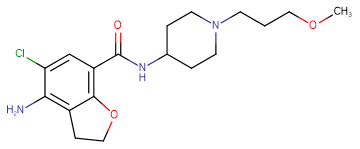
Prucalopride
CAS No. 179474-81-8
Prucalopride( Prucalopride | Prucalopride free base )
Catalog No. M12708 CAS No. 179474-81-8
Prucalopride is a selective, high affinity 5-HT receptor agonist for 5-HT4A and 5-HT4B receptor with Ki of 2.5 nM and 8 nM, respectively.
Purity : >98% (HPLC)
 COA
Datasheet
HNMR
HPLC
MSDS
Handing Instructions
COA
Datasheet
HNMR
HPLC
MSDS
Handing Instructions
| Size | Price / USD | Stock | Quantity |
| 1 mL x 10 mM in DMSO | 29 | Get Quote |


|
| 10MG | 36 | Get Quote |
|
| 25MG | 50 | Get Quote |
|
| 50MG | 63 | Get Quote |
|
| 100MG | 105 | Get Quote |
|
| 200MG | 156 | Get Quote |
|
| 500MG | Get Quote | Get Quote |
|
| 1G | Get Quote | Get Quote |
|
Biological Information
-
Product NamePrucalopride
-
NoteResearch use only, not for human use.
-
Brief DescriptionPrucalopride is a selective, high affinity 5-HT receptor agonist for 5-HT4A and 5-HT4B receptor with Ki of 2.5 nM and 8 nM, respectively.
-
DescriptionPrucalopride is a selective, high affinity 5-HT receptor agonist for 5-HT4A and 5-HT4B receptor with Ki of 2.5 nM and 8 nM, respectively, exhibits >290-fold selectivity against other 5-HT receptor subtypes.(In Vitro):Prucalopride (10 μM; 24, 48, 72 h) shows anti proliferative activity in A549 cells.Prucalopride induces autophagy and apoptosis, decreases the expression of the phosphorylated protein kinase B (AKT) and mammalian target of rapamycin (mTor) in A549/A427 cells.(In Vivo):Prucalopride (5, 10 μg/kg; p.o.; single daily for 2 weeks) shortens the colonic transit time in DM model, promotes the regeneration of colonic neural stem cells and neurons.Prucalopride (5, 10 μg/kg; p.o.; single daily for 2 weeks) promotes the differentiation of colonic neural stem cells, activates the expression of glial proteins and promotes the recovery of neuronal injury to a certain extent.
-
In VitroPrucalopride (10 μM; 24, 48, 72 h) shows anti proliferative activity in A549 cells.Prucalopride induces autophagy and apoptosis, decreases the expression of the phosphorylated protein kinase B (AKT) and mammalian target of rapamycin (mTor) in A549/A427 cells. Cell Proliferation Assay Cell Line:A549 cells Concentration:10 μM Incubation Time:24, 48, 72 h Result:Repressed lung cancer cells proliferation.
-
In VivoPrucalopride (5, 10 μg/kg; p.o.; single daily for 2 weeks) shortens the colonic transit time in DM model, promotes the regeneration of colonic neural stem cells and neurons.Prucalopride (5, 10 μg/kg; p.o.; single daily for 2 weeks) promotes the differentiation of colonic neural stem cells, activates the expression of glial proteins and promotes the recovery of neuronal injury to a certain extent. Animal Model:Sprague dawley rats (diabetes mellitus (DM) model).Dosage:5 or 10 μg/kg Administration:Oral gavage; single daily for 2 weeks.Result:Accelerated colonic movement and shortened the colonic transit time, and markedly increased the expression levels of Ki67.Increased expression of SOX10 in the columnar epithelial nuclei and enteraden (when at 5 μg/kg), and in the columnar epithelial cells, the nuclei of lamina propria cells and enteraden (when at 10 μg/kg). Significantly increased Nestin expression, which concentrated in columnar epithelial cells and the mesenchyme. (Nestin:a marker of enteric neural stem cells in the ENS).
-
SynonymsPrucalopride | Prucalopride free base
-
PathwayEndocrinology/Hormones
-
Target5-HT Receptor
-
Recptor5-HT1A| 5-HT1B| 5-HT3| 5-HT4A| 5-HT4B
-
Research AreaNeurological Disease
-
Indication——
Chemical Information
-
CAS Number179474-81-8
-
Formula Weight367.87
-
Molecular FormulaC18H26ClN3O3
-
Purity>98% (HPLC)
-
SolubilityEthanol: 38 mg/mL (103.29 mM); DMSO: 60 mg/mL (163.1 mM)
-
SMILESClC1=CC(C(NC2CCN(CCCOC)CC2)=O)=C3C(CCO3)=C1N
-
Chemical Name4-amino-5-chloro-N-(1-(3-methoxypropyl)piperidin-4-yl)-2,3-dihydrobenzofuran-7-carboxamide
Shipping & Storage Information
-
Storage(-20℃)
-
ShippingWith Ice Pack
-
Stability≥ 2 years
Reference
1.Briejer MR, et al. Eur J Pharmacol, 2001, 423(1), 71-83.
molnova catalog



related products
-
Amisulpride
Amisulpride(DAN 2163) is an antipsychotic drug, which is a selective dopamine antagonist.
-
GSK-812
GSK-812 is a potent neuroprotectant that can induce GDNF in normal and diseased retina.
-
Hesperetin
Hesperetin is a bioflavonoid and, to be more specific, a flavanone.
