


 Cart
Cart
 sales@molnova.com


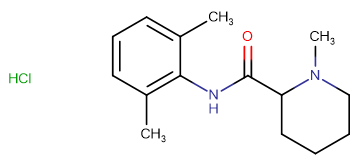
Mepivacaine hydrochloride
CAS No. 1722-62-9
Mepivacaine hydrochloride( —— )
Catalog No. M12620 CAS No. 1722-62-9
Mepivacaine is a tertiary amine used as a local anesthetic.
Purity : >98% (HPLC)
 COA
Datasheet
HNMR
HPLC
MSDS
Handing Instructions
COA
Datasheet
HNMR
HPLC
MSDS
Handing Instructions
| Size | Price / USD | Stock | Quantity |
| 1 mL x 10 mM in DMSO | 37 | In Stock |


|
| 100MG | Get Quote | In Stock |
|
| 200MG | 28 | In Stock |
|
| 500MG | 41 | In Stock |
|
| 1G | 57 | In Stock |
|
Biological Information
-
Product NameMepivacaine hydrochloride
-
NoteResearch use only, not for human use.
-
Brief DescriptionMepivacaine is a tertiary amine used as a local anesthetic.
-
DescriptionMepivacaine is a tertiary amine used as a local anesthetic.(In Vitro):Mepivacaine hydrochloride binds to specific voltage-gated sodium ion channels in neuronal cell membranes, which inhibits both sodium influx and membrane depolarization. This leads to a blockage of nerve impulse initiation and conduction and results in a reversible loss of sensation. Compared to other local anesthetics, this agent has a more rapid onset and moderate duration of action.Mepivacaine hydrochloride has a reasonably rapid onset (more rapid than that of procaine) and medium duration of action (shorter than that of procaine).Mepivacaine hydrochloride displays a preferential use-dependent block of Na(v)1.8, S(-)-bupivacaine displays a preference for TTXs Na(+) channels.
-
In VitroMepivacaine hydrochloride binds to specific voltage-gated sodium ion channels in neuronal cell membranes, which inhibits both sodium influx and membrane depolarization. This leads to a blockage of nerve impulse initiation and conduction and results in a reversible loss of sensation. Compared to other local anesthetics, this agent has a more rapid onset and moderate duration of action.Mepivacaine hydrochloride has a reasonably rapid onset (more rapid than that of procaine) and medium duration of action (shorter than that of procaine).Mepivacaine hydrochloride displays a preferential use-dependent block of Na(v)1.8, S(-)-bupivacaine displays a preference for TTXs Na(+) channels.
-
In Vivo——
-
Synonyms——
-
PathwayMembrane Transporter/Ion Channel
-
TargetSodium Channel
-
RecptorSodium Channel
-
Research AreaNeurological Disease
-
Indication——
Chemical Information
-
CAS Number1722-62-9
-
Formula Weight282.81
-
Molecular FormulaC15H22N2O·HCl
-
Purity>98% (HPLC)
-
SolubilityEthanol: 8 mg/mL (28.28 mM); Water: 57 mg/mL (201.54 mM); DMSO: 3 mg/mL (10.6 mM)
-
SMILESCl.CN1CCCCC1C(=O)NC1=C(C)C=CC=C1C
-
Chemical Name——
Shipping & Storage Information
-
Storage(-20℃)
-
ShippingWith Ice Pack
-
Stability≥ 2 years
Reference
1. Gough MR, et al. Equine Vet J, 2002, 34(1), 80-84.
molnova catalog



related products
-
APETx2
Acid-sensing ion channel 3 (ASIC3) channel blocker (IC50 values are 63 and 175 nM for homomeric rat and human ASIC3 channels). Also inhibits NaV1.8 and NaV1.2 channels (IC50 values are 55 and 114 nM respectively). Demonstrates analgesic properties against acid-induced and inflammatory pain.
-
AZ194
CRMP2-Ubc9-NaV1.7 inhibitor 194, is a CRMP2-Ubc9-NaV1.7 inhibitor.
-
Amiloride hydrochlor...
A pyrazine compound inhibiting SODIUM reabsorption through SODIUM CHANNELS in renal EPITHELIAL CELLS.
