


 Cart
Cart
 sales@molnova.com


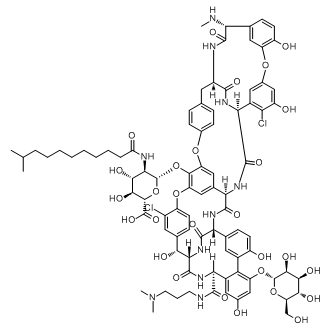
Dalbavancin
CAS No. 171500-79-1
Dalbavancin( MDL-63397 | BI-397 )
Catalog No. M12613 CAS No. 171500-79-1
Dalbavancin(MDL-63397, BI-397) is a novel second-generation lipoglycopeptide antibiotic that exerts its bactericidal effect by disrupting cell wall biosynthesis.
Purity : >98% (HPLC)
 COA
Datasheet
HNMR
HPLC
MSDS
Handing Instructions
COA
Datasheet
HNMR
HPLC
MSDS
Handing Instructions
| Size | Price / USD | Stock | Quantity |
| 1 mL x 10 mM in DMSO | 195 | In Stock |


|
| 5MG | 123 | In Stock |
|
| 10MG | 185 | In Stock |
|
| 25MG | 373 | In Stock |
|
| 50MG | 550 | In Stock |
|
| 100MG | 784 | In Stock |
|
| 200MG | Get Quote | In Stock |
|
| 500MG | Get Quote | In Stock |
|
| 1G | Get Quote | In Stock |
|
Biological Information
-
Product NameDalbavancin
-
NoteResearch use only, not for human use.
-
Brief DescriptionDalbavancin(MDL-63397, BI-397) is a novel second-generation lipoglycopeptide antibiotic that exerts its bactericidal effect by disrupting cell wall biosynthesis.
-
DescriptionDalbavancin(MDL-63397, BI-397) is a novel second-generation lipoglycopeptide antibiotic that exerts its bactericidal effect by disrupting cell wall biosynthesis.
-
In VitroDalbavancin is a parenterally administered semisynthetic lipoglycopeptide developed to combat infections caused by resistant gram-positive pathogens. Dalbavancin exhibits potent in vitro bactericidal activity against gram-positive pathogens including S. aureus (MRSA), VISA, and non-VanA strains of VRE. Dalbavancin is developed for the treatment of complicated skin and skin structure infections (cSSSIs), predominantly those caused by MRSA and β-hemolytic streptococci, organisms against which it has shown greater potency than existing glycopeptide therapeutic agents.
-
In VivoDalbavancin (15-240 mg/kg; intraperitoneal injection; every 36 h or 72 h; for 14 days; female BALB/c mice) treatment has a survival rate of 80% to 100% of mice with all dose regimens. Animal Model:Female BALB/c mice (6-8 weeks) challenged with Ames strain of B. anthracis Dosage:15 mg/kg, 30 mg/kg, 60 mg/kg, 120 mg/kg, 240 mg/kg Administration:Intraperitoneal injection; every 36 h or 72 h; for 14 days Result:The efficacy was 80 to 100%, as determined by the rate of survival at 42 days, when treatment was initiated 24 h postchallenge with regimens of 15 to 120 mg/kg every 36 h or 30 to 240 mg/kg every 72 h.
-
SynonymsMDL-63397 | BI-397
-
PathwayGPCR/G Protein
-
TargetAntibacterial
-
RecptorAntibacterial
-
Research AreaInfection
-
Indication——
Chemical Information
-
CAS Number171500-79-1
-
Formula Weight1816.692
-
Molecular FormulaC88H100Cl2N10O28
-
Purity>98% (HPLC)
-
SolubilityDMSO: ≥ 24 mg/mL
-
SMILESCC(C)CCCCCCCCC(=O)NC1C(C(C(OC1OC2=C3C=C4C=C2OC5=C(C=C(C=C5)C(C6C(=O)NC(C7=C(C(=CC(=C7)O)OC8C(C(C(C(O8)CO)O)O)O)C9=C(C=CC(=C9)C(C(=O)N6)NC(=O)C4NC(=O)C1C2=C(C(=CC(=C2)OC2=C(C=CC(=C2)C(C(=O)NC(CC2=CC=C(O3)C=C2)C(=O)N1)NC)O)O)Cl)O)C(=O)NCCCN(C)C)O)Cl)C(=O)O)O)O
-
Chemical NameRistomycin A aglycone, 5,31-dichloro-38-de(methoxycarbonyl)-7-demethyl-19-deoxy-56-O-[2-deoxy-2-[(10-methyl-1-oxoundecyl)amino]-β-D-glucopyranuronosyl]-38-[[[3-(dimethylamino)propyl]amino]carbonyl]-42-O-α-D-mannopyranosyl-N15-methyl-
Shipping & Storage Information
-
Storage(-20℃)
-
ShippingWith Ice Pack
-
Stability≥ 2 years
Reference
1. Chen AY, et al. Int J Clin Pract. 2007 May;61(5):853-63.
2. Boucher HW, et al. N Engl J Med. 2014 Jun 5;370(23):2169-79.
molnova catalog



related products
-
MUT-056399
A novel, highly potent inhibitor of the FabI enzyme of both Staphylococcus aureus and Escherichia coli.
-
CPFX4158
CPFX4158 is a mannose deriviative and an antibacterial agent that is potentially useful in transgenic humanized- CEACAM6 mouse.
-
Bactenecin
Bactenecin (Bactenecin, bovine) is a potent 12-aa looped antimicrobial peptide isolated from bovine neutrophils. Bactenecin inhibits the growth of bacteria and yeast, and kills the fungus Trichophyton rubrum. Bactenecin increass membrane permeability, inhibits the growth and biofilm formation of B. pseudomallei.
