


 Cart
Cart
 sales@molnova.com


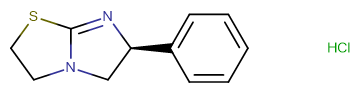
Levamisole hydrochloride
CAS No. 16595-80-5
Levamisole hydrochloride( NSC 177023 | R 12654 | L-Tetramisole )
Catalog No. M12532 CAS No. 16595-80-5
Levamisole Hcl is an anthelmintic and immunomodulator belonging to a class of synthetic imidazothiazole derivatives.
Purity : >98% (HPLC)
 COA
Datasheet
HNMR
HPLC
MSDS
Handing Instructions
COA
Datasheet
HNMR
HPLC
MSDS
Handing Instructions
| Size | Price / USD | Stock | Quantity |
| 10MG | 37 | In Stock |


|
| 25MG | 50 | In Stock |
|
| 50MG | 72 | In Stock |
|
| 100MG | Get Quote | In Stock |
|
| 200MG | Get Quote | In Stock |
|
| 500MG | Get Quote | In Stock |
|
| 1G | Get Quote | In Stock |
|
Biological Information
-
Product NameLevamisole hydrochloride
-
NoteResearch use only, not for human use.
-
Brief DescriptionLevamisole Hcl is an anthelmintic and immunomodulator belonging to a class of synthetic imidazothiazole derivatives.
-
DescriptionLevamisole Hcl is an anthelmintic and immunomodulator belonging to a class of synthetic imidazothiazole derivatives.
-
In Vitro——
-
In Vivo——
-
SynonymsNSC 177023 | R 12654 | L-Tetramisole
-
PathwayEndocrinology/Hormones
-
TargetAChR
-
RecptornAChR| PLAP
-
Research AreaNeurological Disease
-
Indication——
Chemical Information
-
CAS Number16595-80-5
-
Formula Weight240.75
-
Molecular FormulaC11H12N2S·HCl
-
Purity>98% (HPLC)
-
SolubilityWater: 48 mg/mL (199.37 mM)
-
SMILESC1CSC2=N[C@H](CN21)C3=CC=CC=C3.Cl
-
Chemical Name——
Shipping & Storage Information
-
Storage(-20℃)
-
ShippingWith Ice Pack
-
Stability≥ 2 years
Reference
1.Chang YL, et al. J Biomed Mater Res. 2000 Nov;52(2):270-8.
molnova catalog



related products
-
SKF38393 HCl
SKF38393 HCl is a selective dopamine D1/D5 receptor agonist.
-
Pirenzepine dihydroc...
An antimuscarinic agent that inhibits gastric secretion at lower doses than are required to affect gastrointestinal motility, salivary, central nervous system, cardiovascular, ocular, and urinary function.
-
α-Conotoxin MII
α-Conotoxin MII is a highly potent and selective competitive antagonist for α3β2 subunit-containing nicotinic receptors.
