


 Cart
Cart
 sales@molnova.com


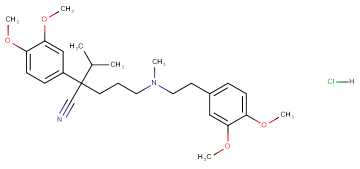
Verapamil hydrochloride
CAS No. 152-11-4
Verapamil hydrochloride( NSC 272366 | NSC 657799 )
Catalog No. M12122 CAS No. 152-11-4
Verapamil Hcl is an L-type calcium channel blocker of the phenylalkylamine class.
Purity : >98% (HPLC)
 COA
Datasheet
HNMR
HPLC
MSDS
Handing Instructions
COA
Datasheet
HNMR
HPLC
MSDS
Handing Instructions
| Size | Price / USD | Stock | Quantity |
| 1 mL x 10 mM in DMSO | 43 | In Stock |


|
| 100MG | Get Quote | In Stock |
|
| 200MG | Get Quote | In Stock |
|
| 500MG | 38 | In Stock |
|
| 1G | 45 | In Stock |
|
Biological Information
-
Product NameVerapamil hydrochloride
-
NoteResearch use only, not for human use.
-
Brief DescriptionVerapamil Hcl is an L-type calcium channel blocker of the phenylalkylamine class.
-
DescriptionVerapamil Hcl is an L-type calcium channel blocker of the phenylalkylamine class.(In Vitro):The EverFluor FL Verapamil (EFV) uptake by TR-iBRB2 cells is inhibited by cationic drugs, and inhibits by verapamil in a concentration-dependent manner with an IC50 of 98.0 μM.(In Vivo):Given orally Verapamil is useful for the prophylaxis of atrioventricular reentry tachycardia, and also in modulating the atrioventricular nodal response in atrial fibrillation.Verapamil is injected i.v. into a femoral vein prior to ischemia. Verapamil (1 mg/kg) significantly decreases the incidence of ventricular arrhythmias including premature ventricular contractions (PVC), ventricular tachycardia (VT) and ventricular fibrillation (VF) for 45-min coronary artery occlusion. Total arrhythmia scores are significantly increased when the heart is subjected to ischemia. Verapamil (1 mg/kg) significantly prevents the enhancement of total arrhythmia scores induced by ischemia.
-
In VitroThe EverFluor FL Verapamil (EFV) uptake by TR-iBRB2 cells is inhibited by cationic drugs, and inhibits by verapamil in a concentration-dependent manner with an IC50 of 98.0 μM.
-
In VivoGiven orally Verapamil is useful for the prophylaxis of atrioventricular reentry tachycardia, and also in modulating the atrioventricular nodal response in atrial fibrillation.Verapamil is injected i.v. into a femoral vein prior to ischemia. Verapamil (1 mg/kg) significantly decreases the incidence of ventricular arrhythmias including premature ventricular contractions (PVC), ventricular tachycardia (VT) and ventricular fibrillation (VF) for 45-min coronary artery occlusion. Total arrhythmia scores are significantly increased when the heart is subjected to ischemia. Verapamil (1 mg/kg) significantly prevents the enhancement of total arrhythmia scores induced by ischemia.
-
SynonymsNSC 272366 | NSC 657799
-
PathwayGPCR/G Protein
-
TargetCalcium Channel
-
RecptorCalcium Channel
-
Research AreaCardiovascular Disease
-
Indication——
Chemical Information
-
CAS Number152-11-4
-
Formula Weight491.06
-
Molecular FormulaC27H39ClN2O4
-
Purity>98% (HPLC)
-
SolubilityEthanol: 12 mg/mL (24.43 mM); Water: 50 mg/mL (101.82 mM); DMSO: 98 mg/mL (199.56 mM)
-
SMILESN#CC(C(C)C)(C1=CC=C(OC)C(OC)=C1)CCCN(CCC2=CC=C(OC)C(OC)=C2)C.[H]Cl
-
Chemical Name2-(3,4-dimethoxyphenyl)-5-[2-(3,4-dimethoxyphenyl)ethyl-methylamino]-2-propan-2-ylpentanenitrile hydrochloride
Shipping & Storage Information
-
Storage(-20℃)
-
ShippingWith Ice Pack
-
Stability≥ 2 years
Reference
1.Dilmac N, et al. Mol Pharmacol. 2004 Nov;66(5):1236-47.
molnova catalog



related products
-
Etripamil
Etripamil displays atrioventricular nodal conduction and prolongs atrioventricular nodal refractory periods by inhibiting calcium ion influx through the calcium slow channels in the atrioventricular node cells. Etripamil is an antagonist of short-acting L-type calcium-channel.
-
Ethyl cinnamate
Ethyl cinnamate has antifungal, and vasorelaxant effects. Ethyl cinnamate can lead to the damage of cell membrane system and metabolic disorder through inducing lipid peroxidation via initiating ROS overproduction.
-
2-Nitrobenzoic acid
2-Nitrobenzoic acid (o-Nitrobenzoic acid) is a antiproliferation agent. 2-Nitrobenzoic acid shows IC50 of 8.3 μM to jurkat cell line expressing T type calcium channel alpha 1H or its splice variant delta 25.
