


 Cart
Cart
 sales@molnova.com


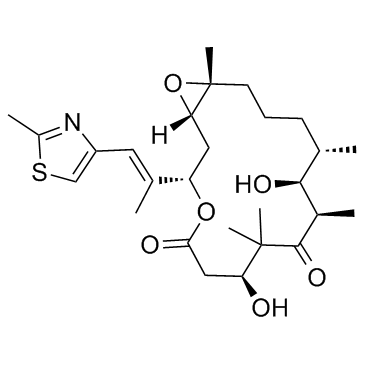
Epothilone B
CAS No. 152044-54-7
Epothilone B( EPO-906 | Patupilone )
Catalog No. M12121 CAS No. 152044-54-7
A blood-brain barrier-permeable microtubule-stabilizing agent that promotes tubulin polymerization and induces G2-M cell cycle arrest with EC50 of 32 nM in HeLa cells.
Purity : >98% (HPLC)
 COA
Datasheet
HNMR
HPLC
MSDS
Handing Instructions
COA
Datasheet
HNMR
HPLC
MSDS
Handing Instructions
| Size | Price / USD | Stock | Quantity |
| 2MG | 39 | In Stock |


|
| 5MG | 55 | In Stock |
|
| 10MG | 91 | In Stock |
|
| 25MG | 203 | In Stock |
|
| 50MG | 368 | In Stock |
|
| 100MG | 536 | In Stock |
|
| 200MG | Get Quote | In Stock |
|
| 500MG | Get Quote | In Stock |
|
| 1G | Get Quote | In Stock |
|
Biological Information
-
Product NameEpothilone B
-
NoteResearch use only, not for human use.
-
Brief DescriptionA blood-brain barrier-permeable microtubule-stabilizing agent that promotes tubulin polymerization and induces G2-M cell cycle arrest with EC50 of 32 nM in HeLa cells.
-
DescriptionA blood-brain barrier-permeable microtubule-stabilizing agent that promotes tubulin polymerization and induces G2-M cell cycle arrest with EC50 of 32 nM in HeLa cells; exhibits potent cytotoxicity in MCF-7 and A549 cells (EC50=0.3 and 2.7 nM respectively), and inhibits growth of HCT-15 tumors in mice in vivo; decreases scarring after rodent spinal cord injury by abrogating polarization and directed migration of scar-forming fibroblasts.(In Vitro):Epothilone B inhibits HCT116 cells with IC50 of 0.8 nM in HCT-116 cell line cytotoxicity assay. Epothilone B (Patupilone) is a microtubule (MT) targeting agent. As shown by MTT cell proliferation assay, after 72 h of treatment Epothilone B efficiently inhibits cell growth with an IC50 of 6 nM, while concentrations ≤1 nM are not cytotoxic. Epothilone B significantly inhibits transwell cell migration at the non-cytotoxic concentration of 1 nM, and the effect is more evident at 10 nM. Epothilone B (Patupilone) is a novel, non-taxane-related and nonneurotoxic microtubule-stabilizing agent in human medulloblastoma cell lines. Epothilone B reduces the proliferative activity in the D341 cell line, with an IC50 of 0.53 nM; in the D425Med cell line, with an IC50 of 0.37 nM; and in the DAOY cell line, with an IC50 of 0.19 nM. In the D341Med cell line, the effect of Epothilone B on clonogenic survival is at dose range of Epothilone B similar to the level of proliferative activity and viability (IC50, 0.50-0.75 nM). However, the clonogenicity of D425Med and DAOY cells is already strongly reduced at a 10-fold lower concentration of Epothilone B (IC50, 30 pM). These results overall demonstrate that Epothilone B is highly potent against different medulloblastoma cell lines.(In Vivo):Treatment with Epothilone B (Patupilone) or ionizing radiation alone results in a partial tumor growth suppression over 10 days, whereas combined treatment exerts a strong supra-additive tumor growth control, with complete tumor regression in the follow-up period (P<0.005, for ionizing radiation or Epothilone B alone vs combined treatment).
-
In VitroEpothilone B inhibits HCT116 cells with IC50 of 0.8 nM in HCT-116 cell line cytotoxicity assay. Epothilone B (Patupilone) is a microtubule (MT) targeting agent. As shown by MTT cell proliferation assay, after 72 h of treatment Epothilone B efficiently inhibits cell growth with an IC50 of 6 nM, while concentrations ≤1 nM are not cytotoxic. Epothilone B significantly inhibits transwell cell migration at the non-cytotoxic concentration of 1 nM, and the effect is more evident at 10 nM. Epothilone B (Patupilone) is a novel, non-taxane-related and nonneurotoxic microtubule-stabilizing agent in human medulloblastoma cell lines. Epothilone B reduces the proliferative activity in the D341 cell line, with an IC50 of 0.53 nM; in the D425Med cell line, with an IC50 of 0.37 nM; and in the DAOY cell line, with an IC50 of 0.19 nM. In the D341Med cell line, the effect of Epothilone B on clonogenic survival is at dose range of Epothilone B similar to the level of proliferative activity and viability (IC50, 0.50-0.75 nM). However, the clonogenicity of D425Med and DAOY cells is already strongly reduced at a 10-fold lower concentration of Epothilone B (IC50, 30 pM). These results overall demonstrate that Epothilone B is highly potent against different medulloblastoma cell lines.
-
In VivoTreatment with Epothilone B (Patupilone) or ionizing radiation alone results in a partial tumor growth suppression over 10 days, whereas combined treatment exerts a strong supra-additive tumor growth control, with complete tumor regression in the follow-up period (P<0.005, for ionizing radiation or Epothilone B alone vs combined treatment).
-
SynonymsEPO-906 | Patupilone
-
PathwayCytoskeleton/Cell Adhesion Molecules
-
TargetMicrotubule/Tubulin
-
RecptorTubulin
-
Research AreaCancer
-
Indication——
Chemical Information
-
CAS Number152044-54-7
-
Formula Weight507.6825
-
Molecular FormulaC27H41NO6S
-
Purity>98% (HPLC)
-
Solubility10 mM in DMSO
-
SMILESC/C([C@@H](OC(C[C@H](O)C1(C)C)=O)C[C@H](O2)[C@@]2(C)CCC[C@H](C)[C@H](O)[C@@H](C)C1=O)=C\C3=CSC(C)=N3
-
Chemical Name4,17-Dioxabicyclo[14.1.0]heptadecane-5,9-dione, 7,11-dihydroxy-8,8,10,12,16-pentamethyl-3-[(1E)-1-methyl-2-(2-methyl-4-thiazolyl)ethenyl]-, (1S,3S,7S,10R,11S,12S,16R)-
Shipping & Storage Information
-
Storage(-20℃)
-
ShippingWith Ice Pack
-
Stability≥ 2 years
Reference
1. Narvi E, et al. Br J Cancer. 2013 Jan 15;108(1):82-90.
2. Ruschel J, et al. Science. 2015 Apr 17;348(6232):347-52.
3. O'Reilly T, et al. Cancer Chemother Pharmacol. 2008 Nov;62(6):1045-54.
molnova catalog



related products
-
Parbendazole
Parbendazole is a potent inhibitor of microtubule assembly(EC50 : 8.79?nM).Parbendazole is a carbamate ester-amine. It finds applications in control or treatment of nematode infestations.
-
Curvulin
Curvulin is the active metabolite isolated from Paraphoma sp. VIZR 1.46. Curvularin inhibits iNOS expression and microtubule assembly.
-
MPT0B098
A potent microtubule inhibitor that not only inhibits the expression levels of HIF-1α protein but also destabilizes HIF-1α mRNA.
