


 Cart
Cart
 sales@molnova.com


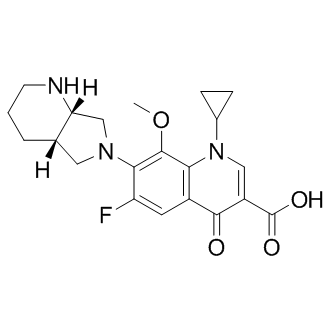
Moxifloxacin
CAS No. 151096-09-2
Moxifloxacin( —— )
Catalog No. M12112 CAS No. 151096-09-2
A fourth-generation synthetic fluoroquinolone, broad-spectrum antibacterial agent that is active against both Gram-positive and Gram-negative bacteria.
Purity : >98% (HPLC)
 COA
Datasheet
HNMR
HPLC
MSDS
Handing Instructions
COA
Datasheet
HNMR
HPLC
MSDS
Handing Instructions
| Size | Price / USD | Stock | Quantity |
| 1 mL x 10 mM in DMSO | 48 | In Stock |


|
| 100MG | 38 | In Stock |
|
| 200MG | 54 | In Stock |
|
| 500MG | 82 | In Stock |
|
| 1G | Get Quote | In Stock |
|
Biological Information
-
Product NameMoxifloxacin
-
NoteResearch use only, not for human use.
-
Brief DescriptionA fourth-generation synthetic fluoroquinolone, broad-spectrum antibacterial agent that is active against both Gram-positive and Gram-negative bacteria.
-
DescriptionA fourth-generation synthetic fluoroquinolone, broad-spectrum antibacterial agent that is active against both Gram-positive and Gram-negative bacteria; inhibits DNA gyrase and topoisomerase IV.Bacterial Infection Approved(In Vitro):The in vitro activities of Moxifloxacin and Amoxicillin are compared by time-kill curve and inhibition of intracellular growth experiments by using a model of bone marrow-derived mouse macrophages infected by L. monocytogenes EGDe. Moxifloxacin acts much more rapidly, beginning to exert its effects in the first 3 h and achieving complete broth sterilization within 24 h of incubation. Moxifloxacin appears to have a protective effect against macrophage lysis, as many cells are still viable after 24 h of incubation.(In Vivo):Moxifloxacin (12 mg/kg; intravenous injection; once-three times per day; for 7 days; white male Wistar rats) treatment every 8 hours is accompanied by longer survival. Tissue cultures 30 hours after bacterial challenge shows considerably less bacterial overgrowth in the spleens and lungs of moxifloxacin-treated than in salinetreated animals and without being toxic.
-
In VitroThe in vitro activities of Moxifloxacin and Amoxicillin are compared by time-kill curve and inhibition of intracellular growth experiments by using a model of bone marrow-derived mouse macrophages infected by L. monocytogenes EGDe. Moxifloxacin acts much more rapidly, beginning to exert its effects in the first 3 h and achieving complete broth sterilization within 24 h of incubation. Moxifloxacin appears to have a protective effect against macrophage lysis, as many cells are still viable after 24 h of incubation.
-
In VivoMoxifloxacin (12 mg/kg; intravenous injection; once-three times per day; for 7 days; white male Wistar rats) treatment every 8 hours is accompanied by longer survival. Tissue cultures 30 hours after bacterial challenge shows considerably less bacterial overgrowth in the spleens and lungs of moxifloxacin-treated than in salinetreated animals and without being toxic. Animal Model:144 white male Wistar rats (18-22 weeks; 300-400 g) infected Stenotrophomonas maltophilia Dosage:12 mg/kg Administration:Intravenous injection; once per day, twice per day, three times per day; for 7 days Result:Showed considerably less bacterial overgrowth in the spleens and lungs and without being toxic.
-
Synonyms——
-
PathwayGPCR/G Protein
-
TargetAntibacterial
-
RecptorAntibacterial
-
Research AreaInfection
-
IndicationBacterial Infection
Chemical Information
-
CAS Number151096-09-2
-
Formula Weight401.4314
-
Molecular FormulaC21H24FN3O4
-
Purity>98% (HPLC)
-
Solubility10 mM in DMSO
-
SMILESCOC1=C2C(=CC(=C1N3CC4CCCNC4C3)F)C(=O)C(=CN2C5CC5)C(=O)O
-
Chemical Name3-Quinolinecarboxylic acid, 1-cyclopropyl-6-fluoro-1,4-dihydro-8-methoxy-7-[(4aS,7aS)-octahydro-6H-pyrrolo[3,4-b]pyridin-6-yl]-4-oxo-
Shipping & Storage Information
-
Storage(-20℃)
-
ShippingWith Ice Pack
-
Stability≥ 2 years
Reference



-
Laccase
Laccase (Denilite IIS) is a polycopper oxidase (MCOs) widely found in microorganisms, plants, and fungi with antimicrobial activity and cytotoxicity that can be used in the study of cancer.Laccase promotes oxidative coupling of mono-lignin in lignin formation.
-
Salinomycin sodium
A polyether ionophore antibacterial agent that shows effects on mitochondrial ion translocation and respiration.
-
Calcimycin
Calcimycin is an ionophorous, polyether carboxylic antibiotic from Streptomyces chartreusensis.?It binds and transports calcium and other divalent cations across membranes and uncouples oxidative phosphorylation while inhibiting ATPase of rat liver mitochondria.?The substance is used mostly as a biochemical tool to study the role of divalent cations in various biological systems.?
