


 Cart
Cart
 sales@molnova.com


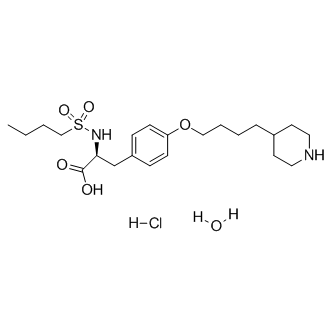
Tirofiban hydrochloride monohydrate
CAS No. 150915-40-5
Tirofiban hydrochloride monohydrate( L-700462 | MK-383 | MK-0383 )
Catalog No. M12110 CAS No. 150915-40-5
A potent, selective inhibitor of the platelet fibrinogen receptor GPIIb/IIIa with IC50 of 9 nM.
Purity : >98% (HPLC)
 COA
Datasheet
HNMR
HPLC
MSDS
Handing Instructions
COA
Datasheet
HNMR
HPLC
MSDS
Handing Instructions
| Size | Price / USD | Stock | Quantity |
| 5MG | 38 | In Stock |


|
| 10MG | 61 | In Stock |
|
| 25MG | 114 | In Stock |
|
| 50MG | 182 | In Stock |
|
| 100MG | 303 | In Stock |
|
| 200MG | Get Quote | In Stock |
|
| 500MG | 724 | In Stock |
|
| 1G | Get Quote | In Stock |
|
Biological Information
-
Product NameTirofiban hydrochloride monohydrate
-
NoteResearch use only, not for human use.
-
Brief DescriptionA potent, selective inhibitor of the platelet fibrinogen receptor GPIIb/IIIa with IC50 of 9 nM.
-
DescriptionA potent, selective inhibitor of the platelet fibrinogen receptor GPIIb/IIIa with IC50 of 9 nM, inhibition of platelet aggregation; displays > 24,000-fold over human umbilical vein endothelial cell fibrinogen receptors; inhibits ex vivo platelet aggregation induced by ADP in anesthetized dogs.Thrombosis Approved(In Vitro):Tirofiban hydrochloride monohydrate (0.25, 1, 3 μg/mL; 72 hours) increases proliferation of HAEC cells.Tirofiban hydrochloride monohydrate (24 hours) closes the scratch of HUVECs migration within 18 hours.Tirofiban hydrochloride monohydrate (0.25, 1 μg/mL; 1 hour) induces production of VEGF after 30 minutes which can stimulates proliferation of endothelial cells.(In Vivo):Tirofiban hydrochloride monohydrate (60 μg/kg; i.v.; once) shows activity of increasing contraction force, ventricular compliance, and improving heart function by increasing HR, LVESP, dp/dtmax, and reducing LVEDP.Tirofiban hydrochloride monohydrate (60 μg/kg; i.v.; once) enhances eNOS activity, decreases iNOS activity and reduces area of no-reflow after reperfusion following AMI. Tirofiban hydrochloride monohydrate (50 μg/per; irrigate; once) shows anticoagulant effect with patency rates of 59% at 24 hours after microvascular anastomosis in the crush model.
-
In VitroTirofiban hydrochloride monohydrate (0.25, 1, 3 μg/mL; 72 hours) increases proliferation of HAEC cells.Tirofiban hydrochloride monohydrate (24 hours) closes the scratch of HUVECs migration within 18 hours.Tirofiban hydrochloride monohydrate (0.25, 1 μg/mL; 1 hour) induces production of VEGF after 30 minutes which can stimulates proliferation of endothelial cells. Cell Proliferation Assay Cell Line:HAEC cells Concentration:0.25, 1, 3 μg/mL Incubation Time:72 hours Result:Increased proliferation of HAEC cells.Cell Migration Assay Cell Line:HUVEC cells Concentration:Incubation Time:24 hours Result:Stimulated the migratory capacity of endothelial cells.Western Blot Analysis Cell Line:HAEC cells Concentration:0.05, 0.12, 0.25, 1 μg/mL Incubation Time:1 hour Result:Induced production of VEGF which stimulated proliferation of endothelial cells.
-
In VivoTirofiban hydrochloride monohydrate (60 μg/kg; i.v.; once) shows activity of increasing contraction force, ventricular compliance, and improving heart function by increasing HR, LVESP, dp/dtmax, and reducing LVEDP.Tirofiban hydrochloride monohydrate (60 μg/kg; i.v.; once) enhances eNOS activity, decreases iNOS activity and reduces area of no-reflow after reperfusion following AMI.Tirofiban hydrochloride monohydrate (50 μg/per; irrigate; once) shows anticoagulant effect with patency rates of 59% at 24 hours after microvascular anastomosis in the crush model. Animal Model:Male Sprague-Dawley rats (10 to 15-week-age; 270-330 g).Dosage:60 μg/kg Administration:Intravenous injection; once.Result:Increased contraction force, ventricular compliance, and improved heart function.Reduced the size of no-reflow and infarct.Animal Model:Sprague-Dawley rats (350-400 g; crush injury model)Dosage:50 μg/per (50 μg/mL, 1 mL for each) Administration:Irrigate 1 mL within the vessel lumen (before placement of the last suture); once.Result:Showed anticoagulant effect with patency rates of 59%.
-
SynonymsL-700462 | MK-383 | MK-0383
-
PathwayCell Cycle/DNA Damage
-
TargetIntegrin
-
RecptorGPIIb/IIIa
-
Research AreaCardiovascular Disease
-
IndicationThrombosis
Chemical Information
-
CAS Number150915-40-5
-
Formula Weight495.0728
-
Molecular FormulaC22H39ClN2O6S
-
Purity>98% (HPLC)
-
SolubilityDMSO: 12 mg/mL
-
SMILESCCCCS(=O)(=O)N[C@@H](CC1=CC=C(C=C1)OCCCCC2CCNCC2)C(=O)O.O.Cl
-
Chemical NameL-Tyrosine, N-(butylsulfonyl)-O-[4-(4-piperidinyl)butyl]-, hydrochloride, hydrate (1:1:1)
Shipping & Storage Information
-
Storage(-20℃)
-
ShippingWith Ice Pack
-
Stability≥ 2 years
Reference
1. Hartman GD, et al. J Med Chem. 1992 Nov 27;35(24):4640-2.
2. Lynch JJ Jr, et al. J Pharmacol Exp Ther. 1995 Jan;272(1):20-32.
3. Cook NS, et al. Thromb Haemost. 1993 Nov 15;70(5):838-47.
molnova catalog



related products
-
MK-0429
MK-0429 is a potent, selective, orally-active nonpeptide αvβ3 integrin inhibitor with IC50 of 0.08 nM in SPAV3 assay.
-
Cilengitide
Cilengitide is a potent integrin inhibitor for αvβ3 receptor and αvβ5 receptor with IC50 of 4.1 nM and 79 nM in cell-free assays, respectively; ~10-fold selectivity against gpIIbIIIa. Phase 2.
-
Valategrast
Valategrast is a potent, α4β1 (VLA-4) and α4β7 dual antagonist.
